Inspiration
Japandi bathroom: wood, stone and warm colours in natural style
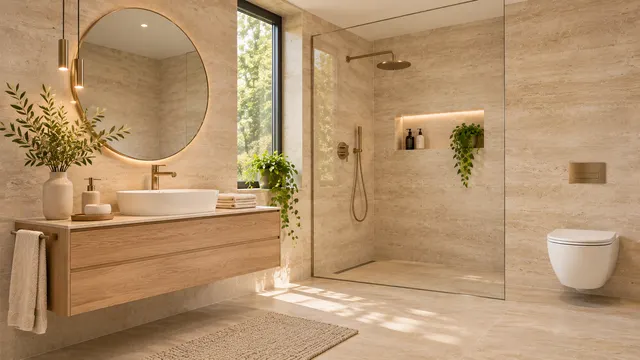
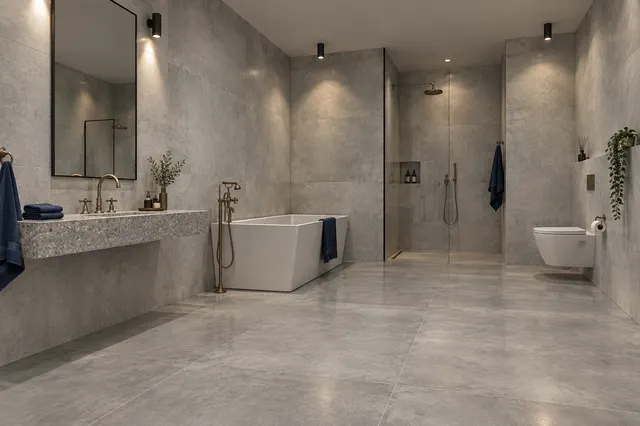
Japandi combines Japanese minimalism with Scandinavian coziness. In the bathroom, this means natural materials, warm muted colours and minimal clutter. The foundation consists of wall tiles in light wood or stone imitation, matte surfaces, low furniture in oak decor and a simple ceramic sink. Taps are often matte black or graphite, and the light is warm around 2,700 to 3,000 K. The style also suits small bathrooms – just use light tones and large format tiles.
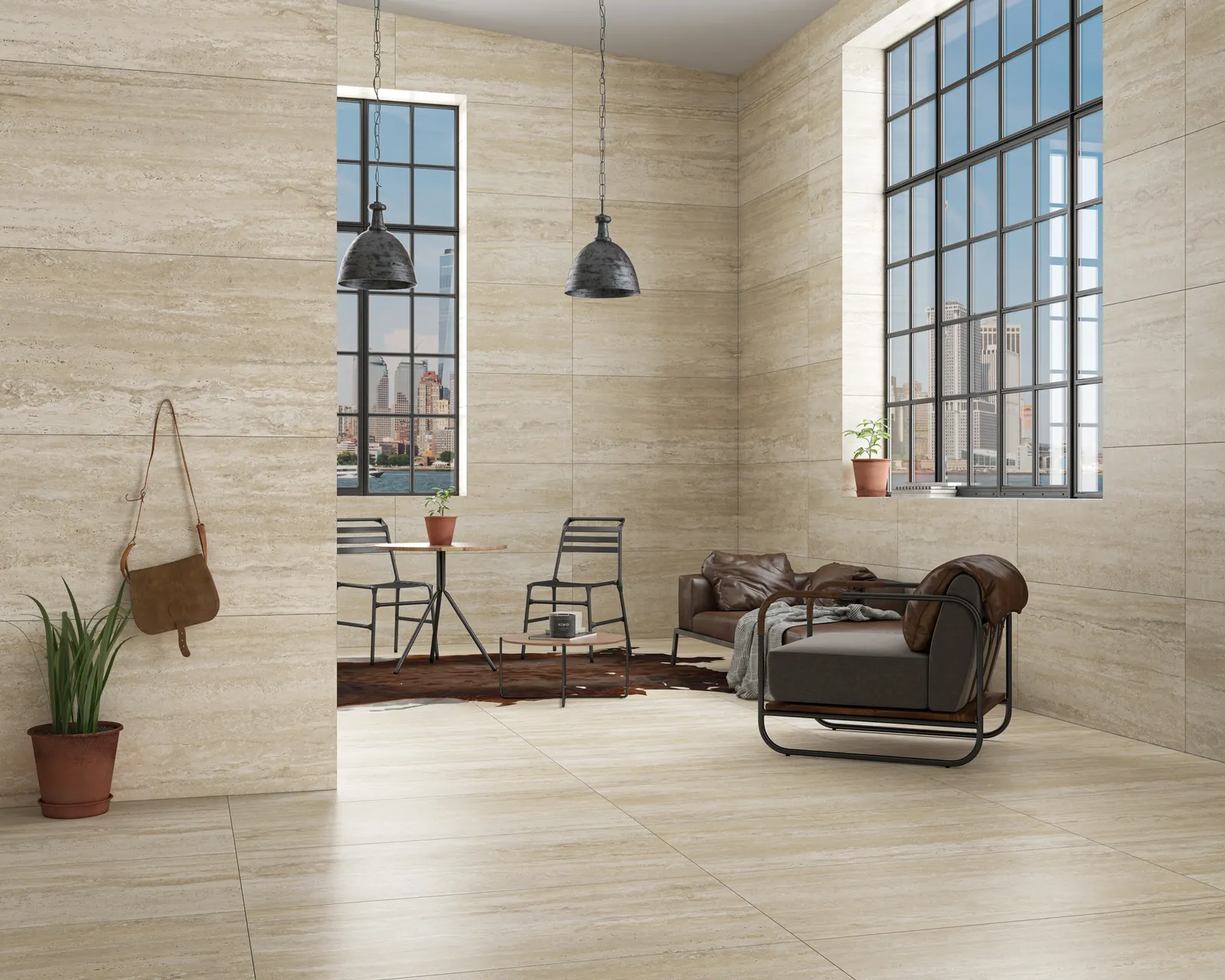
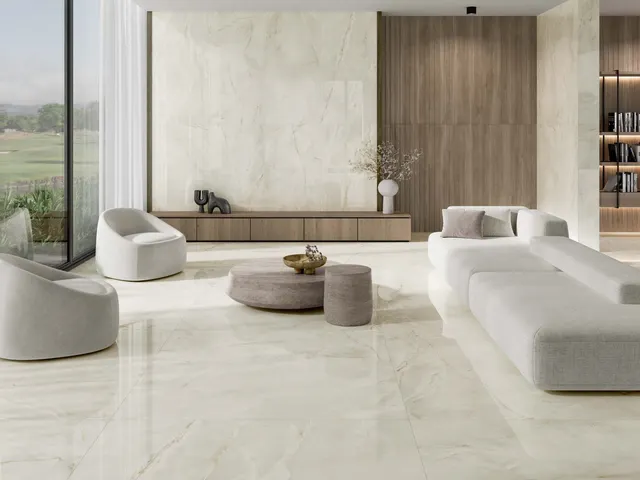
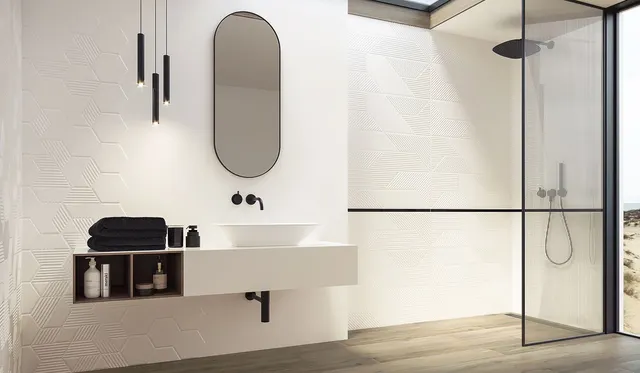
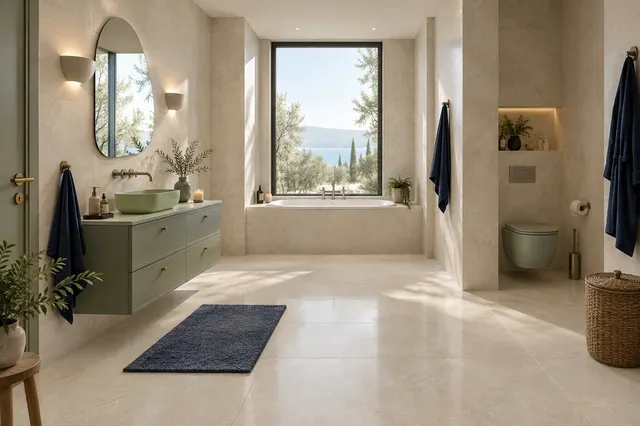
In the photo: Ecoceramic Valentino
Japandi is a blend of the words Japan and Scandi. The style takes calmness, natural materials and respect for craftsmanship from Japanese minimalism, and light wood, soft textiles and coziness from Scandinavian living. It fits perfectly in the bathroom: it’s a place where we want to start the day calmly in the morning and unwind in the evening. We will explain what colours and wall tiles to choose, what furniture, sinks and taps match them, how to light the bathroom and what to avoid.
How Japandi differs from other styles
| Style | Colours and materials | Feel |
|---|---|---|
| Scandinavian | white, light wood, light grey | bright, simple, cosy |
| Japanese minimalism | darker wood, stone, paper, bamboo | quiet, strict, very few items |
| Japandi | warm neutral tones, light and darker wood, stone, ceramics, linen | calm, natural yet cosy |
| wabi-sabi | imperfect surfaces, clay, handmade ceramics | raw, aging with charm |
Japandi is not about expensive materials, but about harmony. Every item should have a purpose, surfaces are matte and pleasant to the touch, and colours do not clash with each other.
Colours: warm, muted and natural
- Base: warm white, sand, grey-beige (greige), oat or light stone colour.
- Wood: light oak, ash, or possibly darker walnut as a contrast.
- Accents: anthracite, matte black, olive green or muted terracotta – in small amounts, for example, a mixer, mirror frame or towel.
Pure cold white and glossy surfaces tend to create a more modern minimalist bathroom. Shades of beige and brown and their combinations are described in the article Brown and Beige Bathroom, on how to make a white bathroom warmer, in the article White Bathroom.
Wall and floor tiles
| Material | Where it fits | What to consider |
|---|---|---|
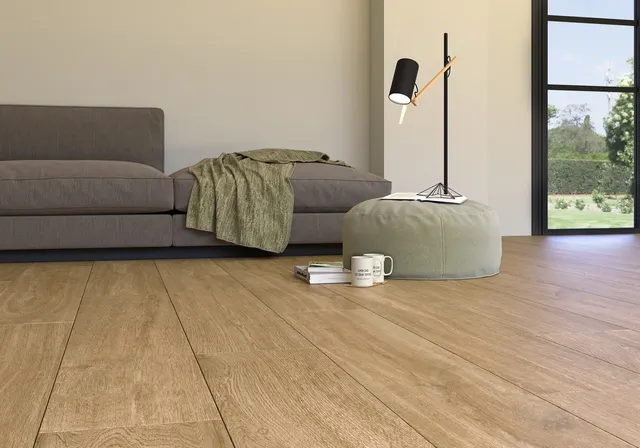
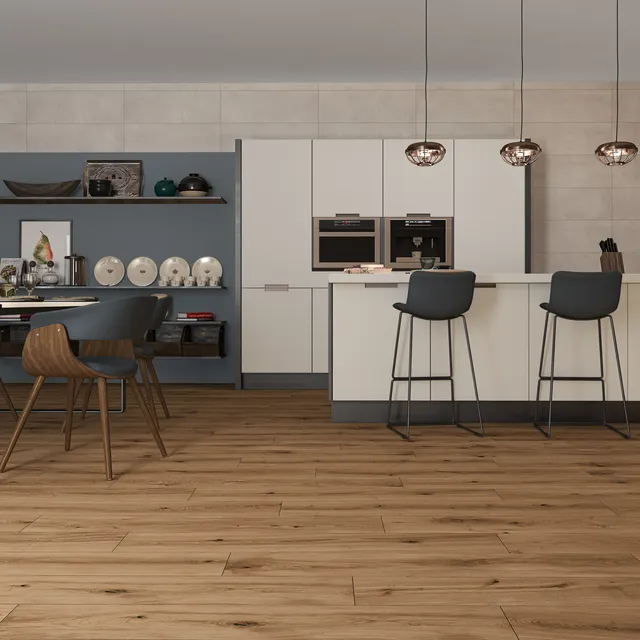
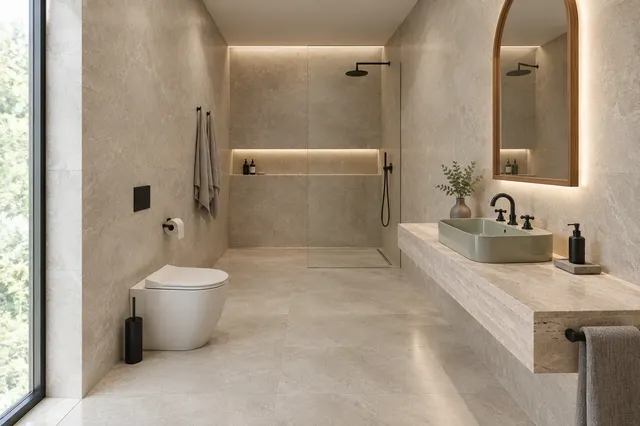
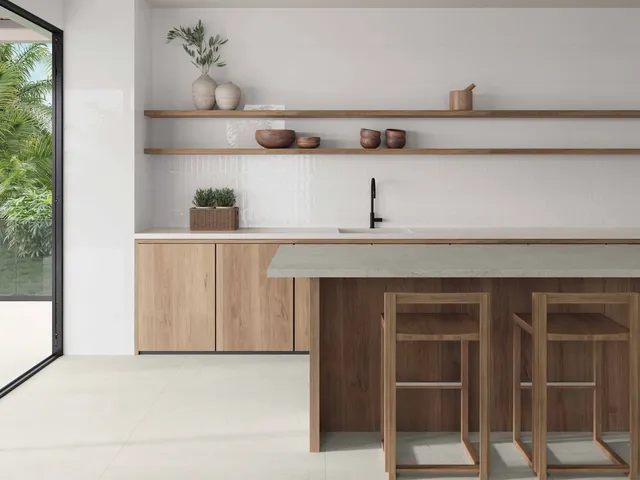
| porcelain stoneware in light wood imitation | floor, wall behind the sink or bathtub | long slabs, for example 20 × 120 cm, with a narrow joint |
| travertine or stone | shower, wall, large tiles | matte surface, calm pattern |
| warm concrete | large areas, small bathroom | grey-beige tone, not cold grey |
| handcrafted look wall tiles | accent wall, niche | slightly uneven surface and subtle shades |
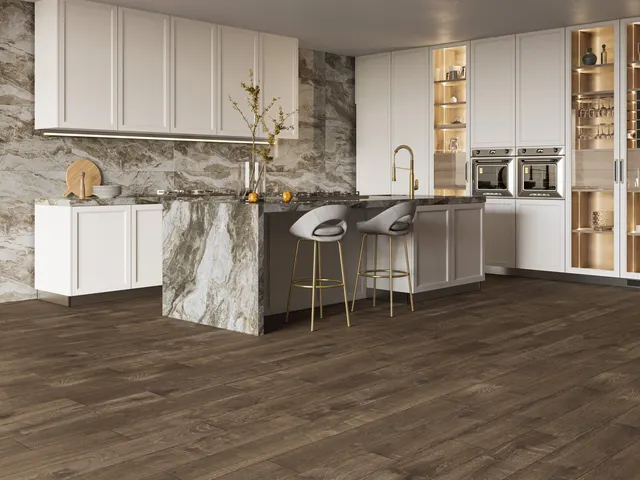
A combination of two materials works well – for example, wood on the floor and stone in the shower, or one tile throughout the bathroom and wooden tiles only on one wall. More materials can break up the bathroom. We describe the laying of wooden tiles in the article Wood Imitation Tiles, travertine in the article Travertine in the Bathroom. Matte tiles are also safer in the bathroom – a comparison can be found in the article Matte or Glossy Tiles.
Furniture and sink
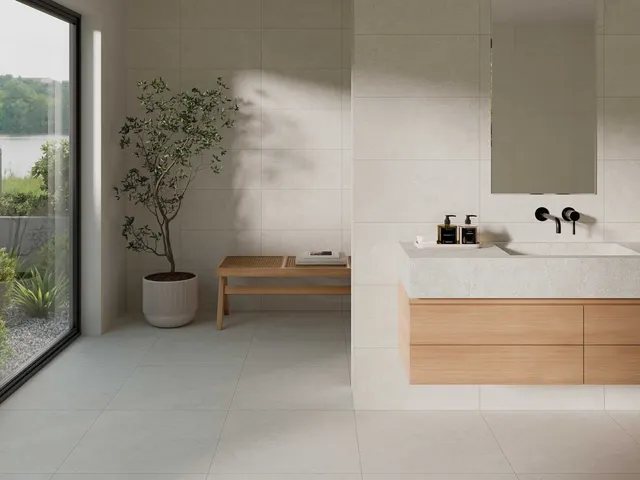
Japandi style furniture is low, with flat surfaces and no unnecessary decorations. A wall-mounted cabinet or a board with an open shelf under the sink looks light and the floor beneath it is easy to clean.
| Element | Example from vkupelni.sk | Price |
|---|---|---|
| sink board in oak decor | Mereo Aira, oak Kronberg, 101 cm | 41,00 € |
| cabinet with sink, white and oak | Mereo Bino, 121 cm, ceramic sink, 2 drawers | 470,00 € |
| ceramic sink for countertop | Mereo Celie, round, 400 × 400 × 145 mm | 57,00 € |
| cast stone sink | Aquatek FOCUS | 261,97 € |
Prices including VAT as of November 2026. More can be found in the categories Sink Boards and Countertop Sinks on vkupelni.sk. We can also make bathroom furniture to measure. How to choose a countertop sink and the height of the mixer is described in the article Countertop Sink.
Mixers, shower and fittings
Matte surfaces – black, graphite, brushed stainless steel or muted bronze – best match natural materials. Glossy chrome feels cooler, but also works in a light bathroom with wood. It is important to keep one colour of fittings for mixers, showers, handles and accessories. How to match fitting colours is described in the article Gold and Bronze Mixers, concealed mixer with a simplified wall in the article Concealed Sink Mixer.
Lighting
- Warm light around 2,700 to 3,000 K for general and mood lighting, with neutral 4,000 K at the mirror for good colour rendering.
- Indirect light – LED strip in a niche, under the wall cabinet or behind the mirror, with dimming.
- Shades made of paper, linen or frosted glass resemble Japanese lanterns, but should only be placed outside the zones near the bath and shower. Coverage and zones should be assessed by an electrician.
Details about light temperature and IP rating can be found in the article Bathroom lighting.
Bathtub and shower
The Japanese bathroom is known for the deep ofuro bath, where one sits submerged up to the shoulders. At home, the closest option is a smaller freestanding oval bath or a bath clad in the same tiles as the wall. The shower in Japandi style is open – walk-in with clear glass and floor tiles that continue from the bathroom. We describe how to create a level-access shower in the articles Walk-in shower and Wet bathroom.
Accessories: less is more
- Plants – green foliage is almost a must in Japandi style. You can find which ones withstand humidity in the article Plants for the bathroom.
- Textiles – linen and cotton towels in natural colours, a rug in sandy or grey tones. We describe how to choose a rug in the article Rug for the bathroom.
- Ceramics and wood – soap dispenser, cup and bowl made of matte ceramics, wooden stool or tray.
- Hidden storage spaces – cosmetics belong in drawers and niches, not on the countertop. Only a few items should remain visible.
You can find accessories in a uniform colour of fittings in the article Bathroom accessories.
Japandi in a small bathroom
This style also suits a small bathroom in a prefab block of flats. Choose light wood or light stone, large format tiles with narrow joints, and the same tiles on the floor and in the shower – the bathroom will appear larger. Wall-mounted furniture, a large mirror, and indirect lighting will complete the impression. More ideas can be found on the page Small bathrooms.
Common mistakes
- many different shades of wood next to each other – floor, furniture, and tiles of different wood,
- cold light and glossy white surfaces that appear sterile,
- cluttered shelves and cosmetics on the countertop,
- real wood in the shower without proper protection – in wet areas, a wood imitation made of gres is more practical,
- too many decorations – Japandi is about calmness.
You can try how a Japandi bathroom would look with your floor plan in the 3D bathroom planner for free. You can see wall tiles in wood and stone imitation, furniture and sinks live at the store in Senec. Arrange a visit. Inspirations can also be found in the styles wood, travertine, stone, and concrete.
Related: Brown and beige bathroom · Wood imitation tiles · Travertine in the bathroom · Plants for the bathroom · Bathroom lighting
Sources: e-shop vkupelni.sk – categories Sink tops, Bathroom furniture and Countertop sinks (Mereo Aira, Mereo Bino, Mereo Celie, Aquatek FOCUS; dimensions and prices, November 2026), light temperature and zones according to the article Bathroom lighting (STN 33 2000-7-701).
Terms in the dictionary: Gres (porcelain stoneware tiles) · Travertine · Concealed mixer · Light colour temperature · Freestanding bath · Walk-in shower
Frequently Asked Questions
What is the Japandi style?
A combination of Japanese minimalism and Scandinavian style. In the bathroom, this means natural materials like wood and stone, warm muted colours, matte surfaces, simple furniture and minimal clutter.
What wall tiles for a Japandi bathroom?
Porcelain stoneware in light wood imitation, travertine, stone or warm concrete with a matte surface. The best combination is two materials – for example, wood on the floor and stone in the shower.
What colours belong in a Japandi bathroom?
Warm white, sandy, grey-beige and wood colours. As an accent in small amounts, anthracite, matte black, olive or muted terracotta.
What taps suit the Japandi style?
Matte – black, graphite, brushed stainless steel or muted bronze. It is important to have one colour for the taps, shower, handles and accessories.
Can Japandi be done in a small bathroom?
Yes. Light wood or stone, large format with narrow joints, the same floor tiles in the shower and on the floor, wall-hung furniture and a large mirror will visually enlarge a small bathroom.
What lighting for a Japandi bathroom?
Warm light around 2,700 to 3,000 K and indirect light in a niche or under the cabinet. For the mirror, neutral 4,000 K to see true colours.
AI Advisor
Have a question on the topic? Ask the advisor – they will respond based on TGB Kúpeľne articles.
AI advisor – answers are generated by artificial intelligence from TGB Kúpeľne articles and may contain errors.
Bathroom design
These are tips. We will draw your bathroom for you.
In the 3D bathroom planner, you can design your bathroom yourself – for free and without registration. If you want assurance, we will prepare a photorealistic custom visualisation based on actual dimensions and specific tiles in the studio. It's free with a purchase.
Online design for free Custom visualisation
TGB Kúpeľne Studio · Bratislavská 71, Senec · Mon–Fri 8:00–12:00 and 12:30–17:00, Sat 9:00–12:00 · Map