Heating and ventilation
Heating and ventilation in the bathroom: radiator, underfloor heating and fan
In the bathroom, you want a temperature around 24 °C and dry air. The towel radiator (water, electric, or combined) usually takes care of the heat while drying towels, and underfloor heating provides warm tiles. Humidity after showering must be removed by a fan or window; otherwise, mould will appear in the corners and joints. Therefore, plan heating and ventilation together, before tiling.
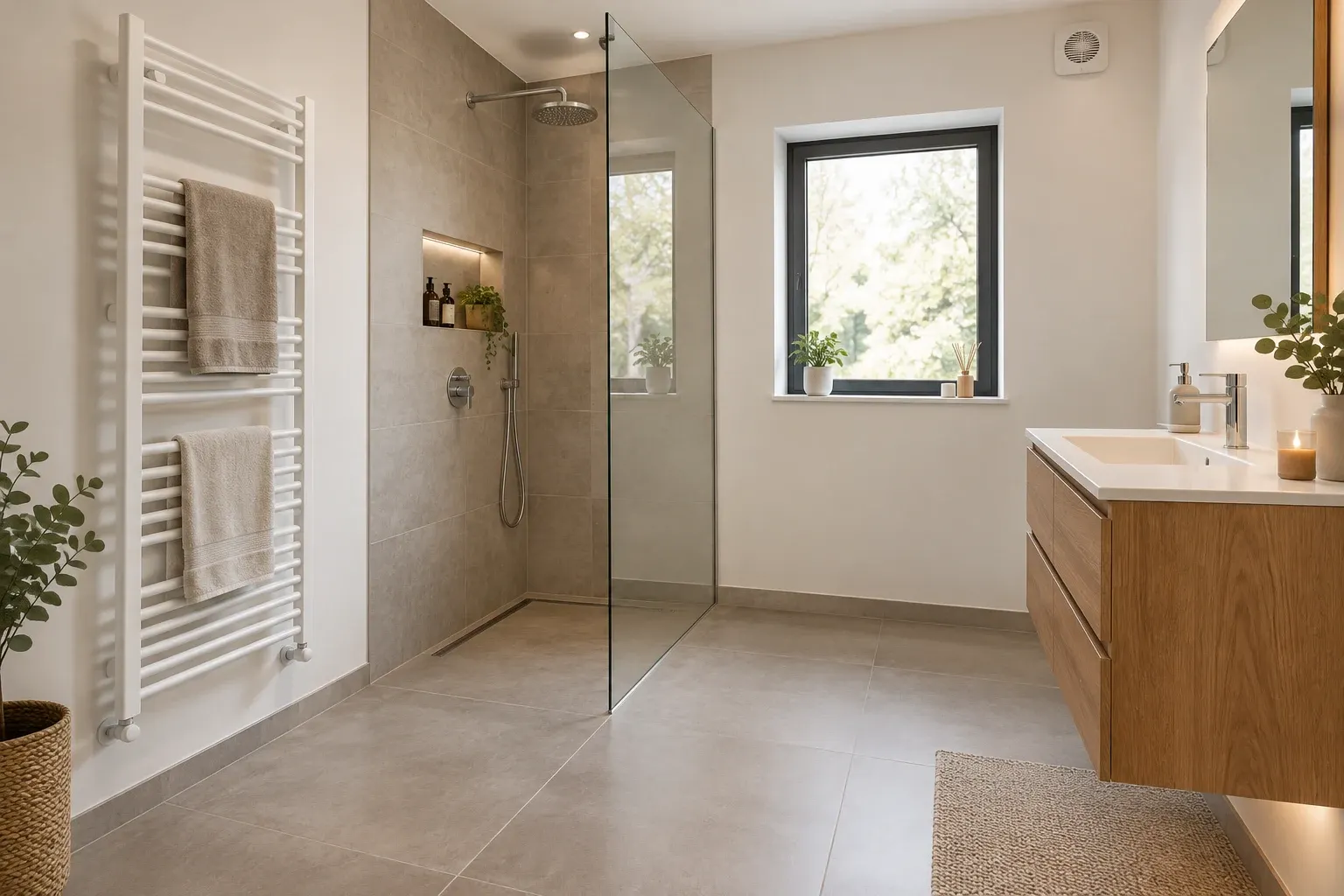
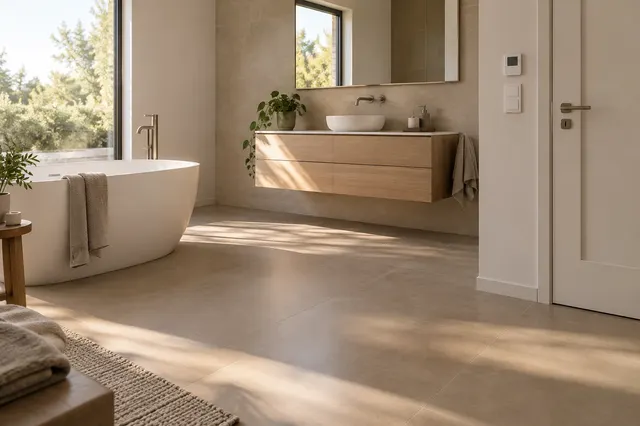
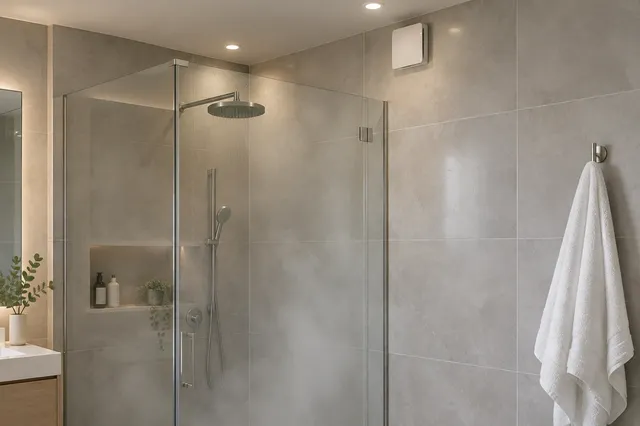
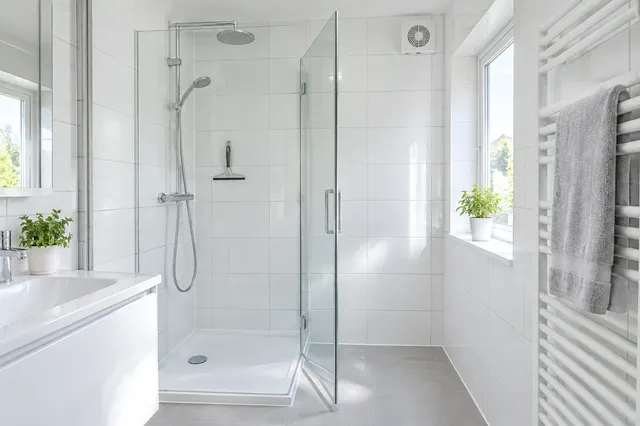
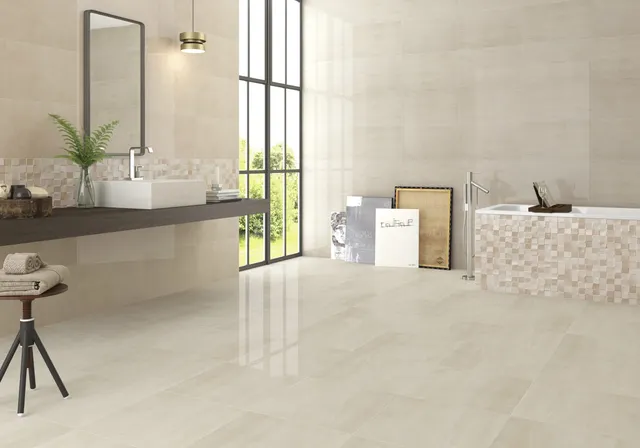
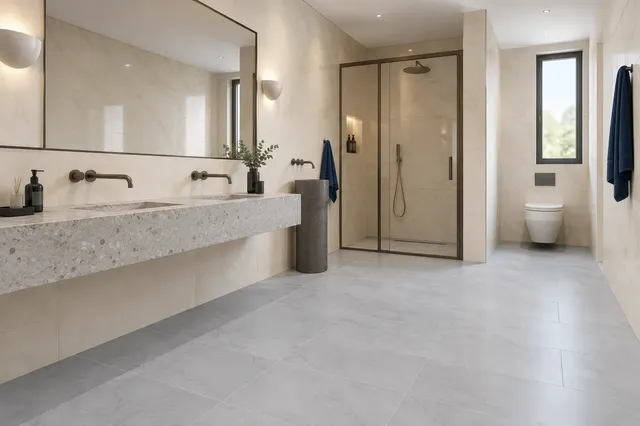
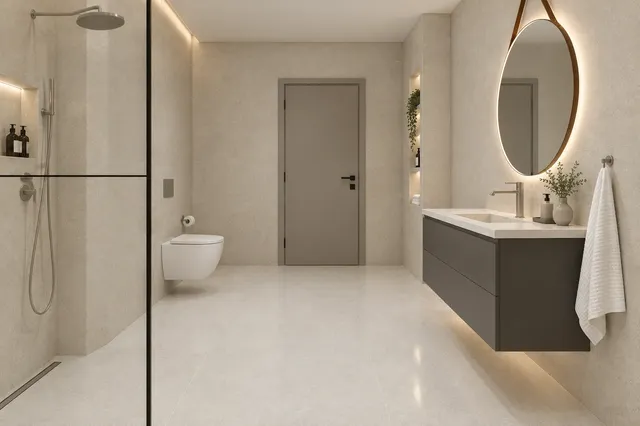
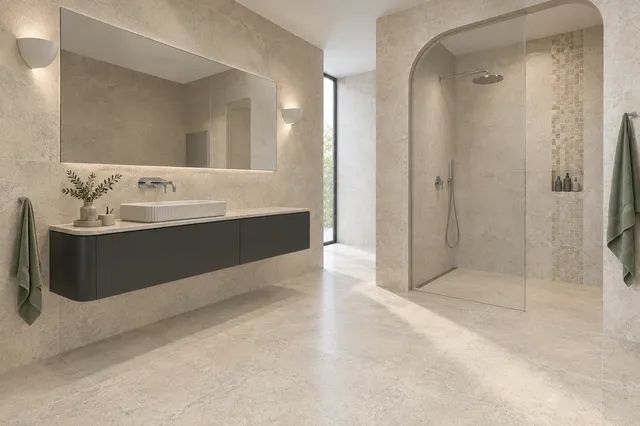
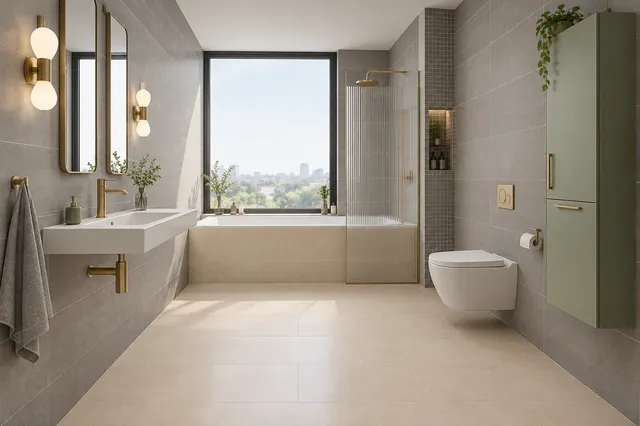
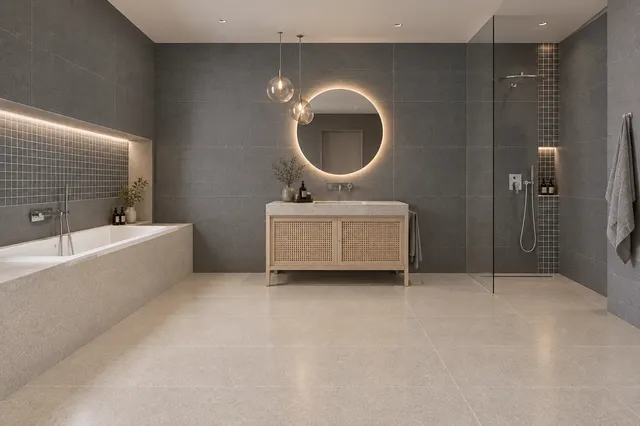
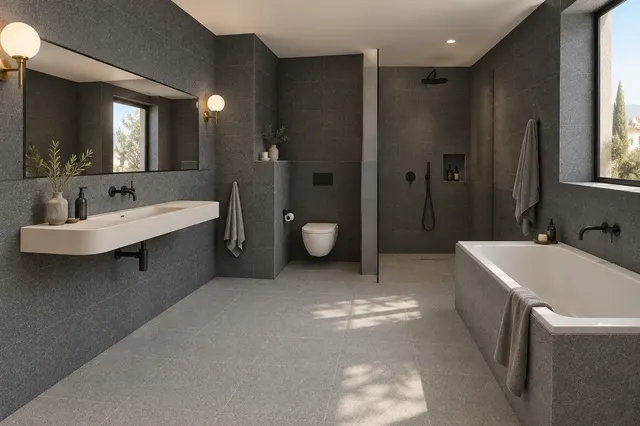
Illustrative image: bathroom with a white towel radiator, warm tiles, and a ceiling fan
Articles on heating and ventilation in the bathroom
Article
| What you will find in it | Čo v ňom nájdete |
|---|---|
| Elektrický radiátor do kúpeľne | výkon na veľkosť kúpeľne, spotreba v eurách, termostat, zóny a krytie IP, kombinovaný rebrík |
| Rebríkový radiátor do kúpeľne | výpočet výkonu, výška a šírka, farby a nerez, napojenie, sušiak na uteráky, ako ho naplniť |
| Podlahové kúrenie v kúpeľni | elektrické alebo teplovodné, rohož pod dlažbu, termostat s čidlom, spotreba |
| Ventilátor do kúpeľne | why it occurs, how to safely remove it, and how to prevent it |
| Mould in the bathroom | prečo vzniká, ako ju bezpečne odstrániť a ako jej predísť |
| Kúrenie a Vetranie v sprievodcovi | What temperature and humidity does the bathroom need |
Akú teplotu a vlhkosť kúpeľňa potrebuje
Kúpeľňa je jediná miestnosť, v ktorej sa zdržiavate bez oblečenia a s mokrou pokožkou. Preto sa v nej počíta s vyššou teplotou ako v obytných izbách – európska norma na výpočet vykurovania udáva pre kúpeľne 24 °C. Teplo navyše pomáha: na teplej stene para nekondenzuje tak ľahko ako na studenej.
Druhá polovica úlohy je vlhkosť. Pri sprchovaní sa do vzduchu uvoľní veľa pary a ak sa neodvedie, zráža sa na najchladnejších miestach – v rohoch, na strope a za nábytkom. Americká agentúra EPA odporúča držať vlhkosť v byte pod 60 %, ideálne medzi 30 a 50 %. V kúpeľni po sprchovaní vlhkosť krátko vystúpi vyššie, dôležité je, aby rýchlo klesla. To je úloha vetrania.
Four ways to heat your bathroom
| Solution | When it's suitable and what to consider |
|---|---|
| Water heated towel rail for central heating | flats and houses with central heating; heats only during the heating season, output depends on the water temperature in the system |
| Electric towel rail | bathrooms without a heating connection or as an addition; requires an electricity supply from an electrician, consumption is billed according to hours of operation |
| Combined towel rail (water + heating rod) | heats from central heating in winter, the rod dries towels in summer; the rod must be suitable for the radiator |
| Underfloor heating (electric or water) | warm tiles to the touch; electric mats are suitable for renovations, water heating for new builds with low water temperature sources |
The most common and comfortable combination is towel rail and electric mat under the tiles: the towel rail covers most heat losses and dries towels, the mat warms the floor in the morning and evening when you are in the bathroom. Details about towel rail types and their connections can be found in the article Towel radiator for the bathroom, about underfloor heating in the article Underfloor heating in the bathroom.
How much power does the bathroom need
This is determined by a calculation of heat losses made by a heating engineer or designer. For a rough estimate, a simplified rule is sufficient: room volume times 40 to 100 W per m³ – insulated flats closer to the lower limit, older uninsulated houses closer to the upper. A bathroom in a panel building measuring 2 × 1.6 m and 2.5 m high has 8 m³, so it needs approximately 320 to 800 W.
For a water heated towel rail, check the water temperature at which the manufacturer states the output. The output in the catalogue applies to water at 75/65 °C and a room at 20 °C. With low-temperature heating, for example with a heat pump, and at 24 °C in the bathroom, the same towel rail will provide less than half. How to recalculate this is shown in the example in the article about towel radiators.
Ventilation: fan and air supply
A bathroom without a window always needs a fan, a bathroom with a window will appreciate it in winter when the window is only opened briefly. Professional tables recommend at least 50 m³ per hour for bathroom extraction, ideally 90 m³/h, for a separate WC 25 to 50 m³/h. For a windowless bathroom, a fan with a hygrostat is most beneficial, which turns on automatically at high humidity, or with a timer that runs after the light is turned off.
However, the fan will only extract air if there is new air to flow in. Leave a gap under the door or install a ventilation grille in the door. How to calculate the power, why a quiet fan at 31 dB is better than 42 dB, and how to run ducting through the roof is described in the article Fan for the bathroom.
Mould: heating and ventilation work together
Mould in the bathroom almost always means that moisture lingers on a cold surface for too long. A fan alone won't help if the wall is cold, and heating alone won't help if the humid air has nowhere to go. Therefore, both are needed in the bathroom – warm walls and moisture extraction. How to safely remove mould and when it indicates a fault that needs fixing can be found in the article Mould in the bathroom. There is a separate article on mould in silicone and in shower grout Mould and leaks in the shower.
What to prepare for during renovation and when
| What | When and who |
|---|---|
| heating connections for the water heated towel rail | during installations, heating engineer; spacing of connections according to the selected towel rail |
| supply for the electric towel rail or rod | during installations, electrician; fixed connection or socket outside zones |
| electric mat and thermostat sensor | after screeding and waterproofing, before laying tiles; sensor in a protective tube |
| ducting and air supply for the fan | during installations; ducting leads to a shaft, through a wall or through the roof |
| air supply | when choosing doors: gap under the door or ventilation grille |
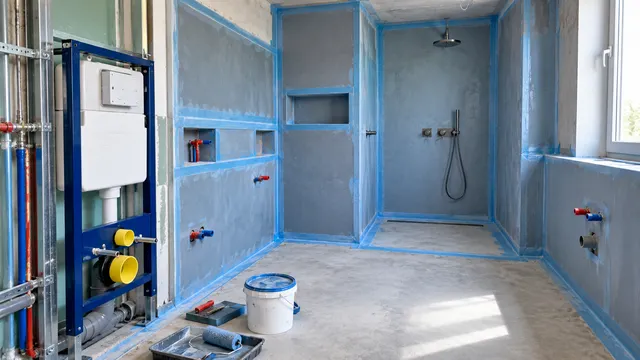
Heating and ventilation are addressed in the installation step – before plastering, waterproofing, and tiling. The entire sequence of work can be found in the article Bathroom renovation step by step. All circuits in the bathroom must be protected by a residual current device up to 30 mA, and what is allowed in which zone is determined by the electrician – more in the chapter Electricity and zones.
Typical solutions
- Bathroom in a panel building without a window: towel rail or original radiator for central heating, electric mat under the tiles, fan with hygrostat to the ventilation shaft and grille in the door. Discuss any interventions in the shared shaft and heating installations in advance with the building manager. More about panel buildings in the article Bathroom in a panel building.
- Family house with central heating: combined towel rail with heating rod for summer, in new builds water underfloor heating, fan with ducting through the roof or facade.
- Small bathroom without a heating connection: electric towel rail with thermostat and timer, sufficient for drying towels and for warming. Tips for small spaces can be found in the article Small bathrooms.
Indicative prices
| Product | Example from vkupelni.sk (as of November 2026) |
|---|---|
| water heated towel rail | Mereo, straight, white 450 × 970 mm for 72 €, 600 × 1 850 mm for 145 € |
| electric towel rail | Mereo, straight, white 450 × 970 mm for 188 €, 600 × 1 330 mm (700 W) for 215 € |
| heating rod with thermostat | SAPHO KTX or MOA 200 to 800 W for 129 to 139 € |
| electric underfloor mat | SAPHO Warm Tiles 0.8 m² (130 W) for 48.99 €, 3.0 m² (500 W) for 125 € |
| fan | CATA B-10 PLUS for €24.50, X-MART 10T timer for €55.01, E-100 GTH automation for €149 |
Add the cost of the plumber and electrician to the price of the products. You can find the entire range in the Heating and Ventilation category. We will provide you with an exact price in the studio or after measuring.
Heating and ventilation with TGB Kúpeľne
We handle both heating and ventilation for bathrooms – from selecting the towel rail, heating rod, electric underfloor mat, and fan to installation during a complete renovation. Come consult us at the TGB Kúpeľne studio at Bratislavská 71 in Senec (Mon–Fri 8:00–12:00 and 12:30–17:00, Sat 9:00–12:00). During renovations, we will measure your bathroom on-site and suggest where to place the towel rail, fan, and thermostat.
Related: Electric radiator for the bathroom · Towel radiator · Underfloor heating in the bathroom · Bathroom fan · Mould in the bathroom · Bathroom equipment
Sources: STN EN 12831 (calculation temperature for the bathroom 24 °C), US EPA – A Brief Guide to Mold, Moisture and Your Home (humidity below 60%), tables of ventilation requirements for apartments (tzb-info.cz, according to ČSN EN 15665/Z1), Korado Koralux catalogue (outputs at various water temperatures), e-shop vkupelni.sk, category Heating and Ventilation (models, parameters, and prices, November 2026).
Frequently Asked Questions
What temperature should be in the bathroom?
When calculating heating, a bathroom is set to 24 °C, which is higher than in living rooms. Warmer walls also reduce the risk of condensation and mould.
Is a towel radiator sufficient for the bathroom?
Usually yes, if it has sufficient output for the bathroom volume and the water temperature in your heating system. However, the towel radiator will not provide warm flooring – that is the job of underfloor heating.
What is better for the bathroom – a towel radiator or underfloor heating?
The most comfortable option is a combination: the towel radiator covers heat losses and dries towels, while underfloor heating warms the tiles. If you must choose one, the towel radiator is more versatile.
Does the bathroom need a fan?
In a bathroom without a window, yes, otherwise the humidity after showering has nowhere to go. Even with a window, a fan helps in winter when you only open the window briefly.
When should heating and ventilation be addressed during renovation?
At the stage of installations, before plastering, waterproofing, and tiling. This is when heating outputs, electricity supplies, and fan ducts are prepared.
Does TGB Kúpeľne also handle heating and ventilation?
Yes. During bathroom renovations, we also address the bathroom radiator, electric underfloor heating, and ventilation. We can advise you at our studio at Bratislavská 71 in Senec.
AI Advisor
Have a question on the topic? Ask the advisor – they will respond based on TGB Kúpeľne articles.
AI advisor – answers are generated by artificial intelligence from TGB Kúpeľne articles and may contain errors.
Bathroom design
These are tips. We will draw your bathroom for you.
In the 3D bathroom planner, you can design your bathroom yourself – for free and without registration. If you want assurance, we will prepare a photorealistic custom visualisation based on actual dimensions and specific tiles in the studio. It's free with a purchase.
Online design for free Custom visualisation
TGB Kúpeľne Studio · Bratislavská 71, Senec · Mon–Fri 8:00–12:00 and 12:30–17:00, Sat 9:00–12:00 · Map