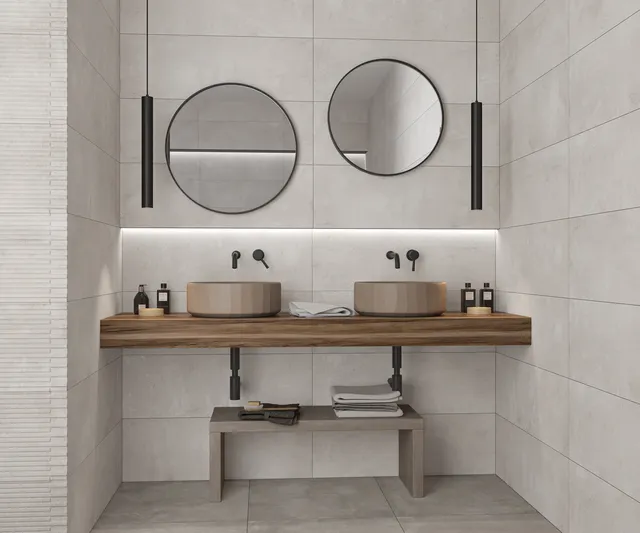
Tiles
Floor tiles 60 × 60 cm: where it fits, grout joint, substrate and installation
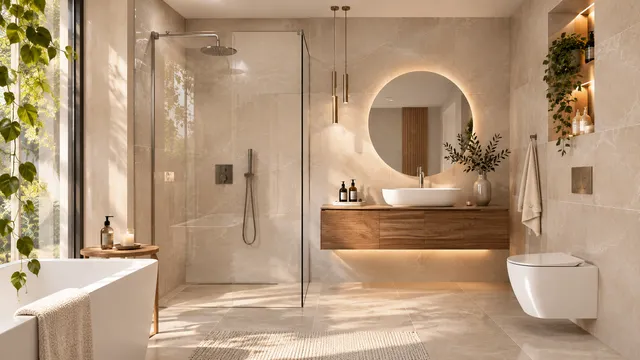
Floor tiles 60 × 60 cm are the most versatile square for flooring – suitable for bathrooms, kitchens, hallways and entire apartments. Approximately 2.8 tiles and 3.3 metres of grout joints are needed per m², rectified tiles are laid with a grout joint of about 2 mm, and one tiler can easily handle one tile. They are most commonly combined with wall tiles 60 × 120 cm from the same series.
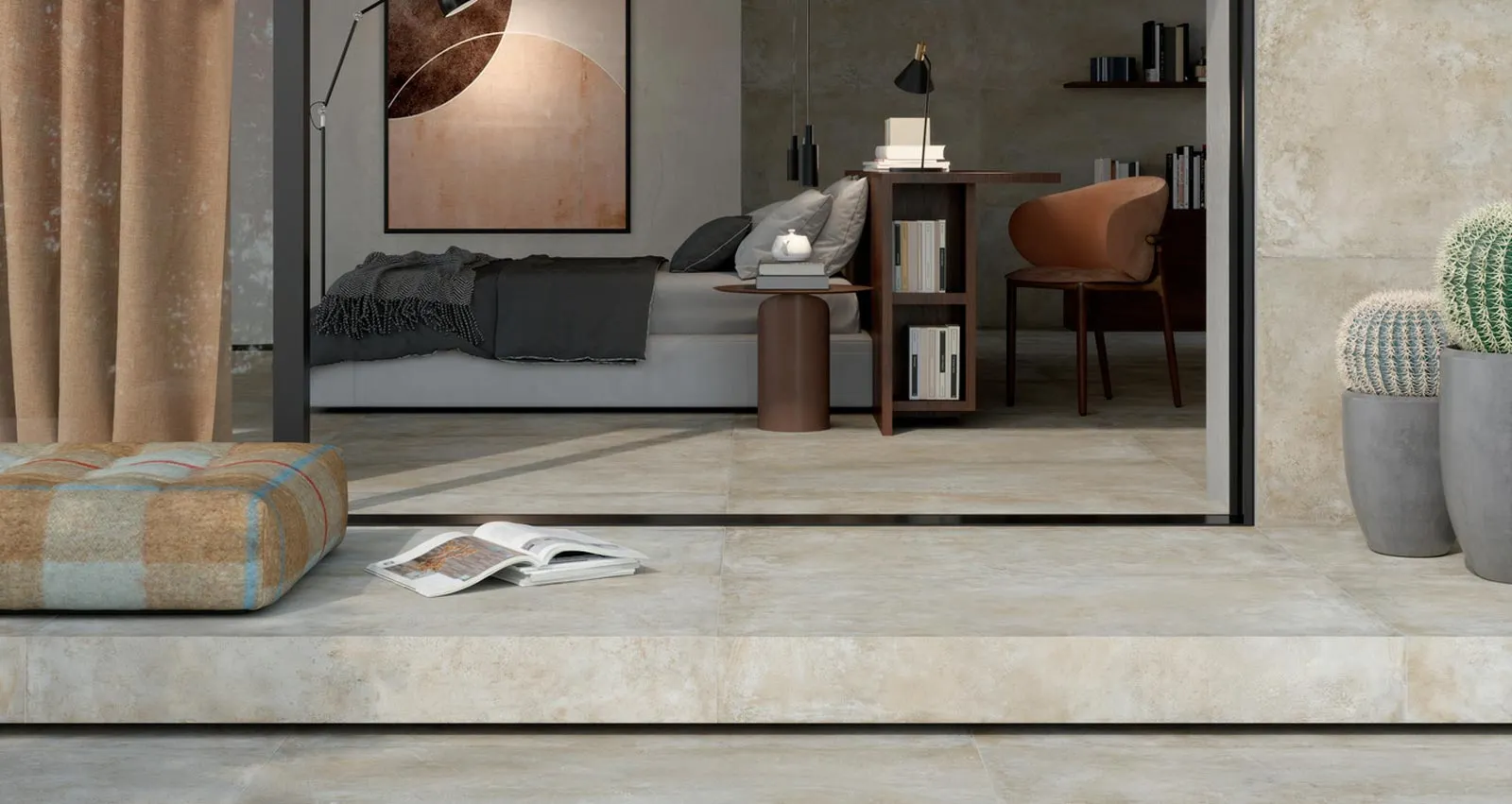
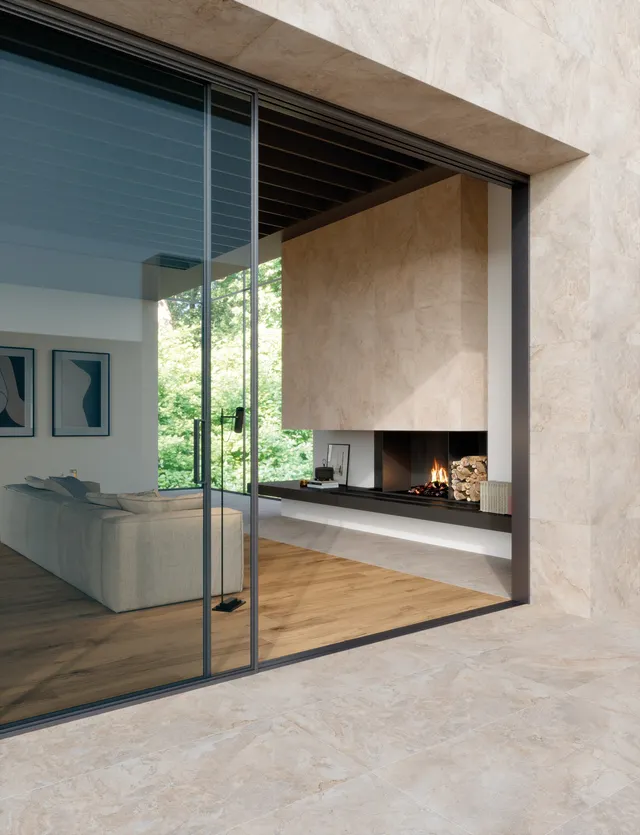
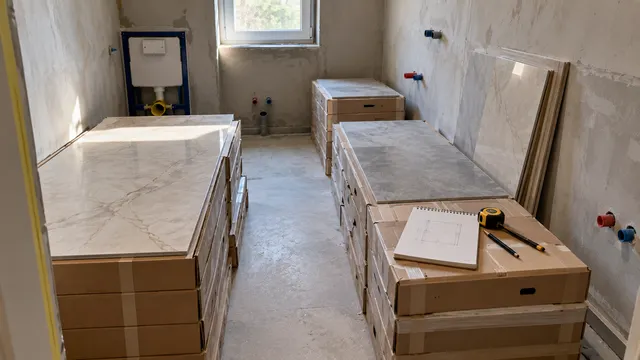
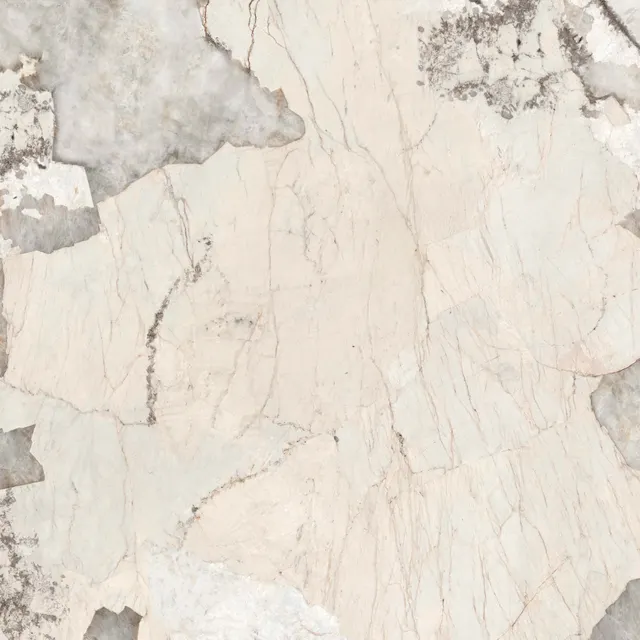
In the photo: Marazzi Plaza
Square 60 × 60 cm – also recorded in online shops as 60x60 or 600 × 600 mm – is now the basic format for flooring. It is large enough to create a calm floor appearance, yet small enough to work well in bathrooms with corners, doors, and soil stacks. As of November 2026, there are over 800 wall and floor tiles in this size available on vkupelni.sk, so you can choose practically any design – from concrete to stone and marble to solid-coloured tiles. An overview of all formats with a table can be found in the article Tile and floor formats.
Floor tiles 60 × 60 cm in numbers
The numbers are calculated for an area without grout joints and without cutting. They show how many tiles and grout joints will be on the floor and are useful for comparing formats with each other.
| Data | Tile 60 × 60 cm | For comparison |
|---|---|---|
| area of one tile | 0,36 m² | 60 × 120 cm: 0,72 m² |
| pieces per 1 m² | 2,78 | 30 × 60 cm: 5,56 |
| grout joints per 1 m² | 3,33 m | 30 × 60 cm: 5 m, 60 × 120 cm: 2,5 m |
| for 10 m² of flooring | 28 tiles and 33 m of grout joints | 60 × 120 cm: 14 tiles and 25 m of grout joints |
| actual size | for example 598 × 598 mm or 600 × 600 mm | it is stated on the box in millimetres |
| thickness | usually 8 to 10 mm, for example 9 mm | thin slabs 6 mm |
The number of pieces is the area divided by the area of one tile. The length of grout joints per 1 m² is 100 divided by the width plus 100 divided by the height of the tile in centimetres – for 60 × 60 cm, this is 1.67 + 1.67 = 3.33 m. The actual number of tiles with cutting and reserve is calculated by the calculator in the article How much tile and flooring to buy.
Where floor tiles 60 × 60 fit and where they don't
A square has no direction, making it adaptable to rooms of any shape. It is most beneficial in areas with many corners, transitions, and door frames – a cut from one tile is often used on the opposite side of the room.
- Bathroom floor from 2 to 8 m² – in a flat bathroom, 2 to 4 tiles will fit across the width of the room, creating a calm appearance even without large formats.
- Kitchen, hallway, and entire flat – using the same floor tiles in the bathroom, hallway, and kitchen visually connects the flat. Choose a matte finish with slip resistance R10.
- Attics and irregular rooms – with slopes, niches, and corners, there is less waste than with long tiles 60 × 120 cm.
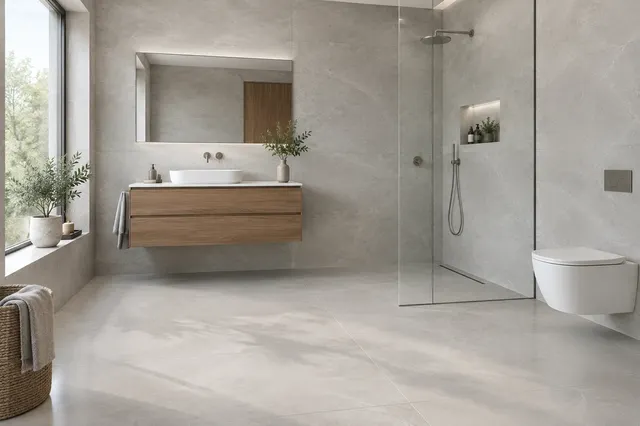
- Shower with a drain – the floor slopes in one direction towards the drain, so the tile is only cut straight, and 60 × 60 cm can also be used in the shower.
- A shower with a central point drain is less suitable – the floor slopes in four directions, and the tiles must be cut diagonally into an 'envelope'. Mosaic or smaller formats are more practical here, see Small tiles.
- Large open spaces – in a living room combined with a kitchen over 40 m², floor tiles 80 × 80 cm or 120 × 120 cm create a calmer look with fewer grout joints.
Before purchasing, draw a floor plan. If the room is 170 cm wide, two full tiles will fit, leaving a 50 cm remainder. Instead of one 50 cm strip along one wall, it is better to place one full tile in the centre and two strips of 55 cm on either side – the floor will be symmetrical, and there will be no narrow cuts at the walls. Full tiles should be placed where you look the most, i.e., at the doors and in front of the sink.
Grout, rectification, and calibre
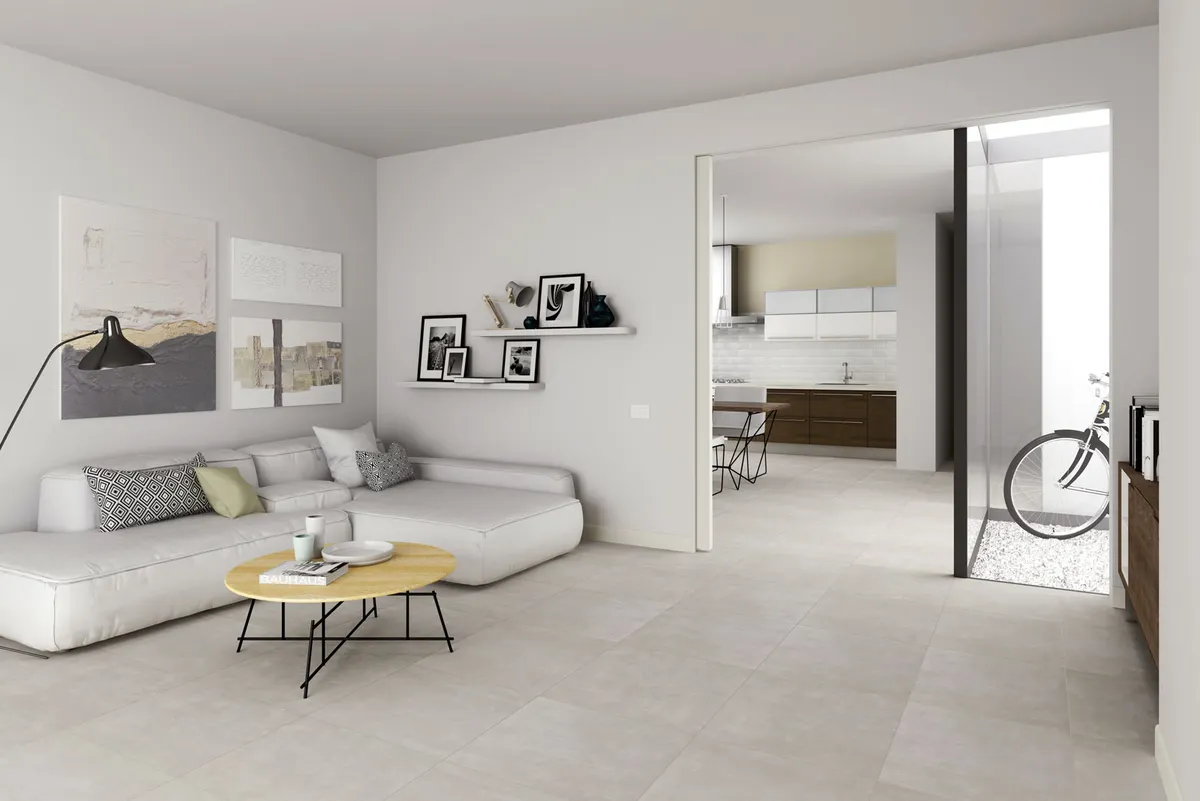
For floor tiles 60 × 60 cm, the width of the grout joint depends on whether it is rectified. A rectified tile has edges ground to a right angle after firing, and all pieces are nearly the same size. RAKO specifies a minimum grout joint of 2 mm for rectified products, and Tubądzin states the same minimum joint. Non-rectified tiles have slightly rounded edges and are laid with a joint of 3 to 5 mm. The American standard ANSI A108.02 allows a minimum joint of 3 mm for porcelain stoneware tiles – if the technical sheet of a specific series specifies a wider joint, it takes precedence over the norm. Tiles are never laid completely without a joint: they move with temperature changes, and grout would not fit into a narrow gap. More in the article Rectified tiles.
On the box, you will also find the calibre – the actual size in millimetres – and the shade code. Tiles with different calibres or shades should not be placed on the same surface, so buy the entire quantity at once from one batch. For stone and concrete imitations, it is also worth monitoring the variability grade V1 to V4 and taking tiles from multiple boxes during installation. All important details are in the article Batch, calibre, and shade of tiles.
Straight, staggered, or diagonal
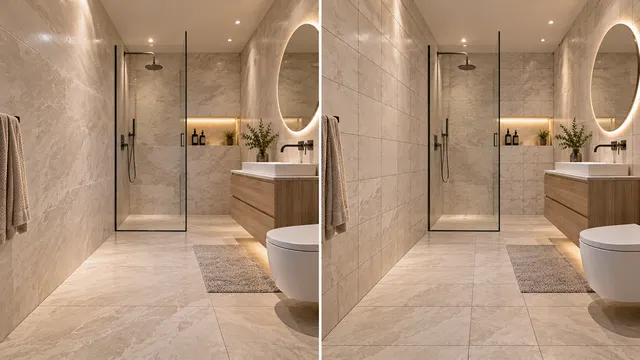
- Straight, joint to joint – the most common and calmest laying method. Joints create a regular grid, so they require straight walls and precise alignment from the room's axis.
- Staggered bond – squares can also be laid 'like bricks'. However, the 60 cm side is longer than 38 cm, and for such tiles, the American standard ANSI A108.02 allows a maximum stagger of 33%, i.e., one-third – for 60 × 60 cm, this is 20 cm, unless the manufacturer specifies otherwise. The reason is the slight bowing of the tiles: with a half-stagger, steps would form at the edges.
- Diagonal – squares rotated 45° visually expand the floor and conceal the fact that the room does not have right angles. However, there will be angled cuts at each wall, and waste is higher, so plan for a reserve of 15 to 20%. We compare patterns in the article Laying patterns.
Substrate, adhesive, and grout
Floor tiles 60 × 60 cm are among those where the flatness of the substrate matters. The ANSI A108.02 standard allows a deviation of the substrate of no more than 3 mm over 3 m and 1/16 inch, or about 1.6 mm, over 60 cm for tiles with at least one side of 38 cm. For smaller tiles, it is 6 mm over 3 m. Therefore, level out any unevenness with self-levelling compound or screed before gluing, not with a thicker layer of adhesive.
- Adhesive: for standard porcelain stoneware, a cement adhesive of class C2T according to STN EN 12004 is sufficient; for underfloor heating and a substrate that moves, use flexible C2TE S1. For tiles over 30 cm, Ceresit recommends using CM 11 Plus adhesive with a 12 mm notched trowel and a consumption of approximately 4.8 kg per m² – for a 10 m² floor, this means about 48 kg, or two bags of 25 kg each.
- Full coverage: according to the ANSI A108.5 standard, the adhesive should cover at least 80% of the tile's back in dry areas and 95% in wet areas, such as in the shower. For larger formats, adhesive should also be applied to the back of the tile.
- Grout: for the bathroom, use cement class CG2 with reduced water absorption, and for the shower, also epoxy grout. For tiles 9 mm thick and a 2 mm joint, the consumption is approximately 0.1 kg per m² according to Mapei's formula, so for 20 m² of floor, about 2 kg is sufficient. You can calculate the amount for your area using the adhesive and grout calculator.
- Leveling clips align the edges of adjacent tiles while the adhesive sets – they are always worthwhile for rectified tiles with narrow joints.
Cutting and waste
You can cut a 60 × 60 cm tile straight even on a smaller manual cutter – for example, the Bosch PTC 640 has a cutting length of 64 cm according to the manufacturer. However, this is insufficient for diagonal cuts; it can only handle 45 × 45 cm diagonally. The Rubi HIT-850 N cuts up to 85 cm and diagonally 60 × 60 cm. Holes for drains and pipes are drilled with a diamond core drill. Details are in the article Cutting tiles and floor tiles.
For straight laying, plan for a reserve of around 10%, and for irregular rooms, 15%. RAKO recommends increasing the quantity by up to 25% for large formats from 45 × 45 cm. Keep one box for later repairs – you may not be able to buy the same batch years later.
Combinations with other formats
- 60 × 60 cm on the floor and 60 × 120 cm on the walls – the most common arrangement. If both are from the same rectified series, they have the same module of 60 cm and the wall joints can continue into the floor joints.
- 60 × 60 cm and 30 × 60 cm – smaller wall tiles for uneven walls, square for the floor; RAKO explicitly states the option to combine formats for rectified products.
- 60 × 60 cm and mosaic – mosaic in the same colour on the shower floor with a point drain or in a niche.
- 60 × 60 cm and metro tiles – a calm floor and a striking wall behind the sink or in the kitchen.
How to match the colour of the floor and walls is described in the articles How to match wall tiles and floor tiles and Combinations of wall tiles and floor tiles.
What to look for on the box and in the e-shop
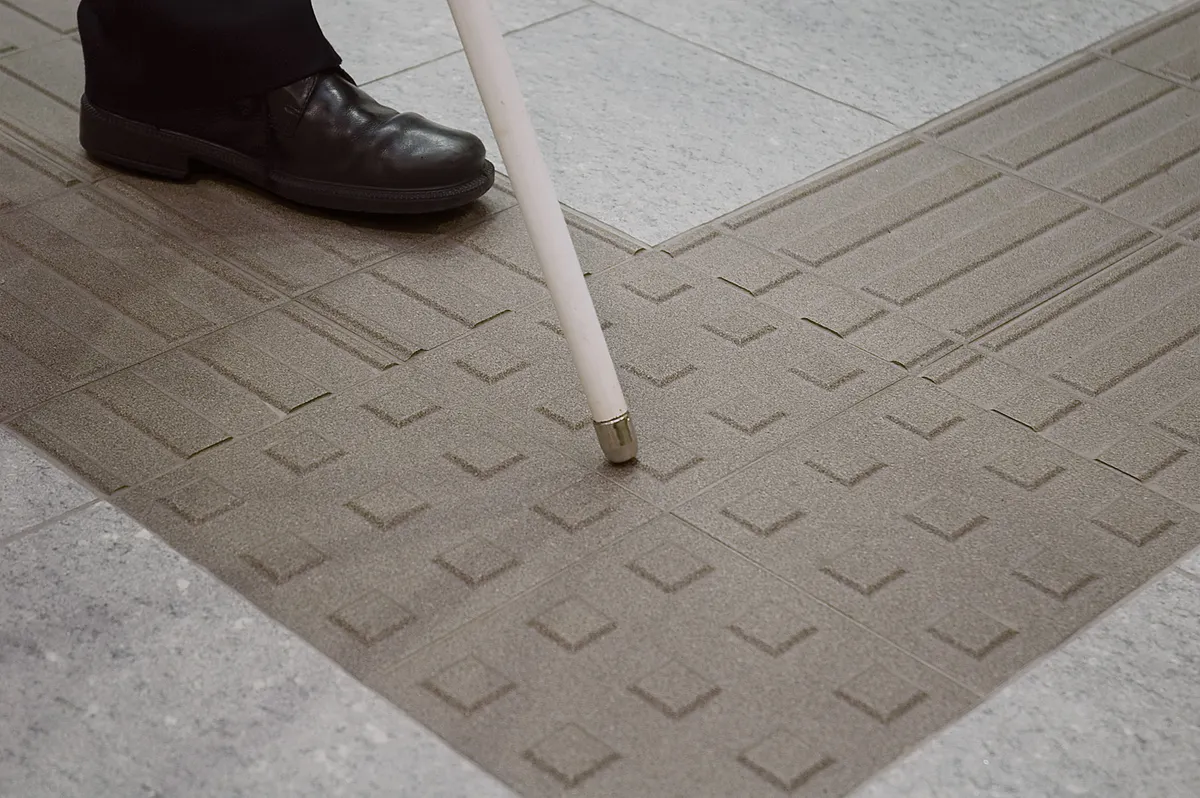
- Slip resistance: for bathroom floors R10 or class A for bare feet, for level-access showers R11 or class B (DIN 51130 and DIN 51097).
- Water absorption: porcelain stoneware group BIa has a water absorption of up to 0.5 % according to EN 14411, is frost-resistant and suitable for hallways and balconies.
- abrasion resistance PEI: for a home bathroom, PEI II to III is sufficient, for hallways with street access a higher class.
- Rectification and thickness – these are stated in the technical data sheet and for products also in the e-shop.
For an idea of how the parameters look in practice: floor tiles Made by RAKO Solid DAK62480 measure 600 × 600 × 9 mm, are rectified, matte, with slip resistance R10/B and abrasion resistance PEI 4, frost-resistant and priced at 50.26 €/m² on vkupelni.sk (as of November 2026). The cheapest 60 × 60 cm tiles, such as Cersanit Brand Rock, cost 23.43 €/m² (as of November 2026). All tiles and wall tiles in this size can be found at wall tiles and floor tiles 60 × 60 cm on vkupelni.sk. The meaning of the individual data is explained in the article Tile parameters.
Tiles 60 × 60 cm in the photos
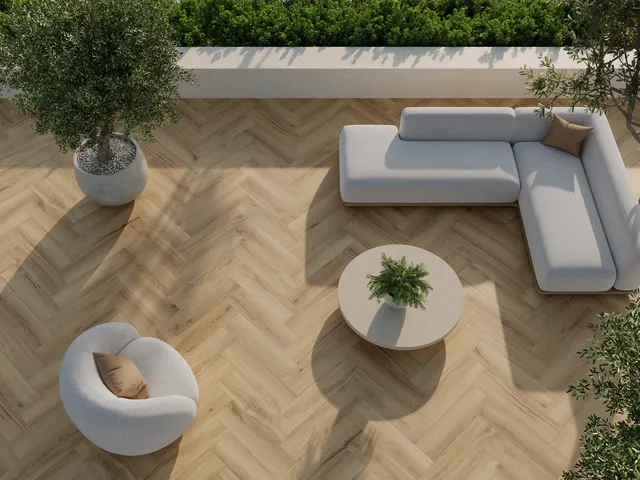
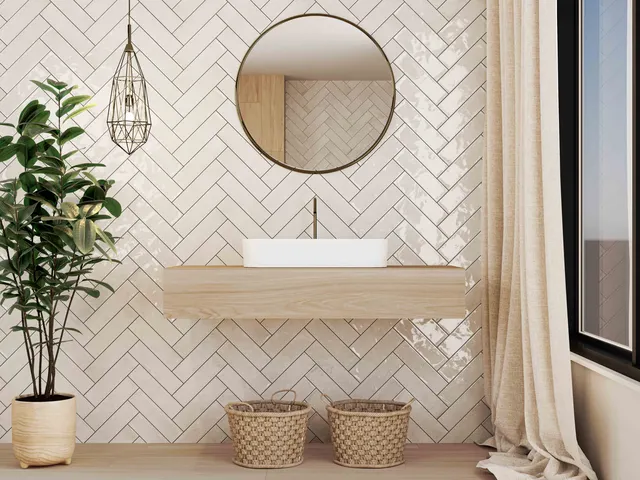
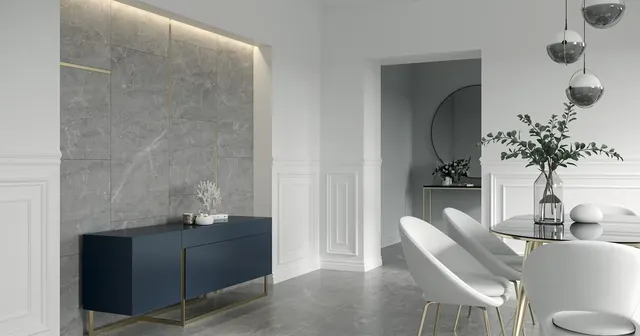
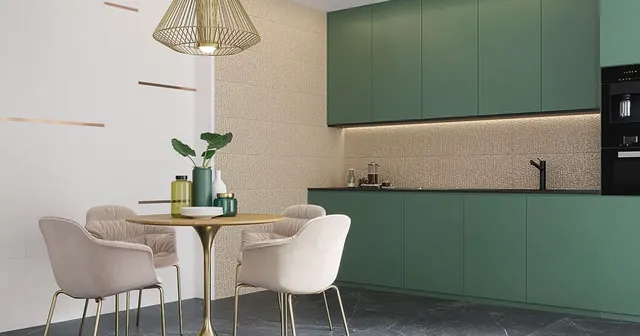
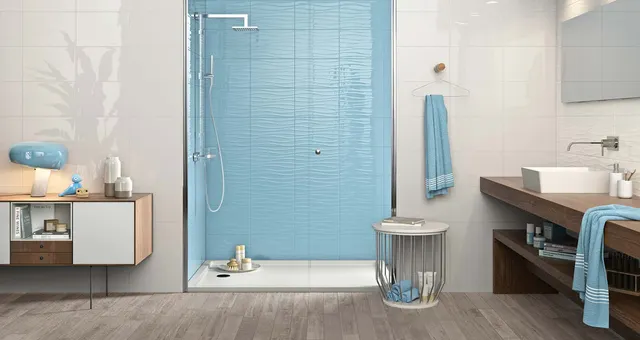
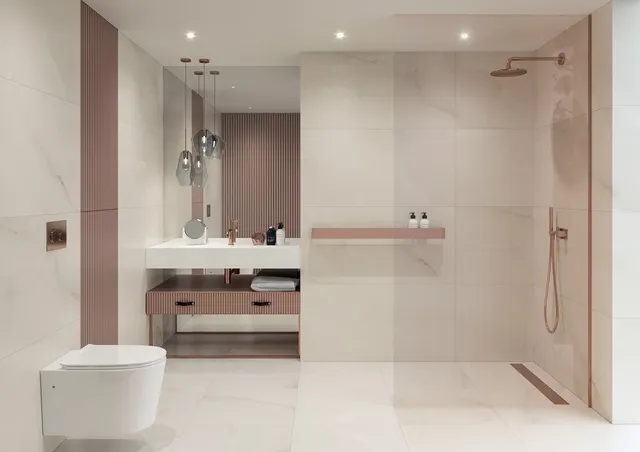
Collections from the photo gallery and completed visualisations, where the format 60 × 60 cm is on the floor or wall. Photos of the collections are from the manufacturers.
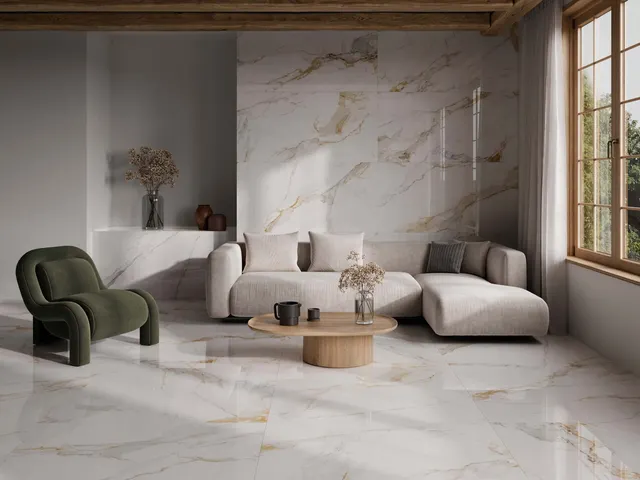
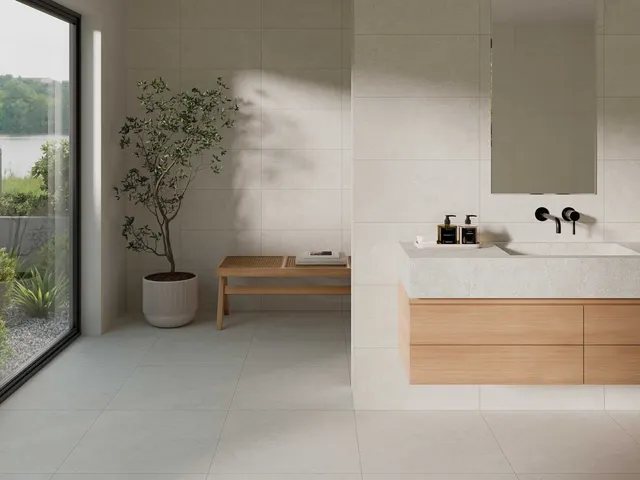
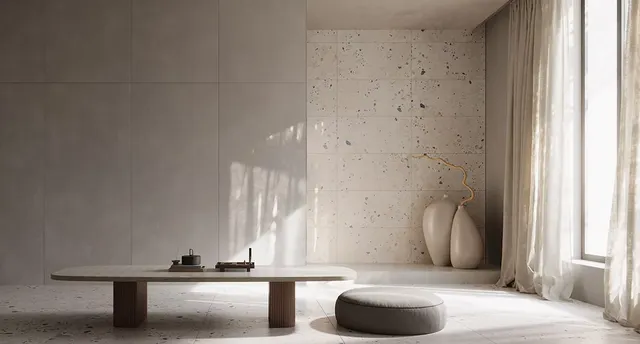
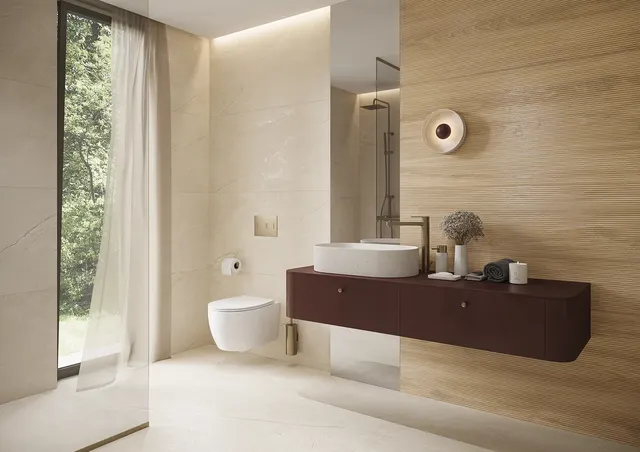
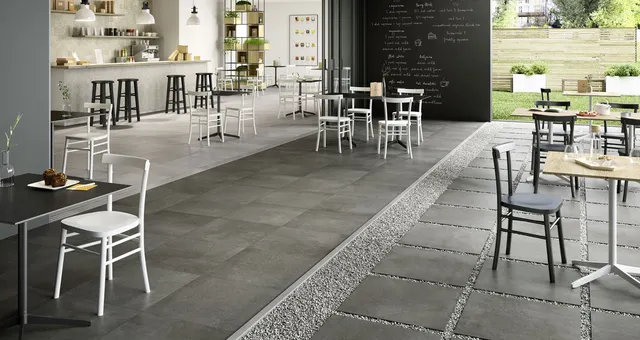
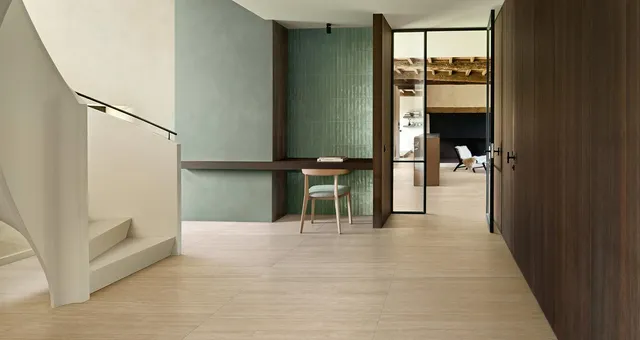
In the e-shop vkupelni.sk in the size 60 × 60 cm: Outdoor, Marazzi ALLMARBLE, Outdoor, Rako KAAMOS, Rako QUARZIT, Stargres QUBUS, Marazzi ESSENCE OF JURA. Further: all wall tiles and floor tiles 60 × 60 cm on vkupelni.sk · all collections 60 × 60 cm in the photo gallery.
Common mistakes
- No layout – narrow strips will remain at the walls and cut tiles at the doors.
- Half offset – with tiles measuring 60 cm, steps will form at the edges.
- Uneven floor levelled with adhesive – voids will remain under the tile and the edge may crack later.
- Two batches on one surface – a difference in shade is visible on the finished floor as a band.
- Glossy tiles without slip resistance in the shower – slip resistance is determined by the surface and class R, not the format.
Try the 60 × 60 cm tiles on the dimensions of your bathroom in the 3D bathroom planner and compare it with the 60 × 120 cm format – you will see the change in the number of joints immediately. We will gladly show you samples at our store in Senec.
What next
- 1. View
- 3D bathroom planner – compare 60 × 60 and 60 × 120 cm tiles on the dimensions of your bathroom
- 2. Calculate
- calculation of the amount of wall tiles and floor tiles with a reserve and consumption of adhesive and grout
- 3. Samples
- view samples at the TGB store in Senec, Bratislavská 71 – arrange a visit
Colours in this format: white · light grey · anthracite · black · beige · brown and wood · green · blue · terracotta – and colour combination table.
Sources: Floor Trends – ANSI A108.02: flatness of the substrate, joint, offset and edge overhang; Floor Trends – ANSI A108.02: flatness for tiles shorter than 38 cm; Ceramic Tile Foundation – adhesive contact 80 % and 95 % (ANSI A108.5); RAKO – customer information sheet; technical data sheet Ceresit CM 11 Plus (consumption according to tile size and trowel notches, combined method); technical data sheet Mapei Ultracolor Plus (grout consumption formula); Bosch PTC 640 and Rubi HIT-850 N – cutting length according to manufacturers (our article Cutting wall tiles and floor tiles); STN EN 12004 (adhesives C1, C2, T, E, S1, S2), STN EN 13888 (grouts CG2), STN EN 14411 (groups by water absorption), DIN 51130 and DIN 51097 (slip resistance), EN ISO 10545-7 (PEI); offer and parameters of products vkupelni.sk (as of November 2026); our articles Rectified tiles, Batch, calibre and shade and Laying patterns.
Terms in the dictionary: Soil stack (riser) · Large-format tiles · Slip resistance R9 to R13 · Linear shower drain · Floor drain (point drain) · Rectified tiles
Frequently Asked Questions
How many pieces of tile 60 × 60 are in 1 m²?
Approximately 2.78 tiles without joints and cutting. For 10 m² of flooring, that’s 28 tiles, plus add a reserve of around 10 %, in a complex room 15 %.
Is tile 60 × 60 suitable for a small bathroom?
Yes. A square 60 × 60 cm looks calm even in a bathroom under 4 m² and with many corners and doors, it will waste less than long tiles. Before purchasing, draw a layout to avoid narrow strips at the walls.
What joint for tiles 60 × 60?
For rectified tiles around 2 mm – this is the smallest joint specified by RAKO, for non-rectified 3 to 5 mm. The technical data sheet of the specific series determines this.
Can tiles 60 × 60 be laid with an offset?
Yes, but no more than a third, that is, 20 cm. For tiles with a side of 38 cm or more, the American standard ANSI A108.02 allows an offset of up to 33 %, unless the manufacturer specifies otherwise. Most squares are laid straight, joint to joint.
How much adhesive is needed for tiles 60 × 60?
According to the technical data sheet Ceresit CM 11 Plus, approximately 4.8 kg per m² with a 12 mm notched trowel. For 10 m², that’s about two bags of 25 kg, more for uneven substrates and double application.
Can tiles 60 × 60 also be used on walls?
Yes, if the manufacturer states use on walls in the technical data sheet. For walls, adhesive with reduced slip is used, marked T according to STN EN 12004.
AI Advisor
Have a question on the topic? Ask the advisor – they will respond based on TGB Kúpeľne articles.
AI advisor – answers are generated by artificial intelligence from TGB Kúpeľne articles and may contain errors.
Bathroom design
These are tips. We will draw your bathroom for you.
In the 3D bathroom planner, you can design your bathroom yourself for free. We will prepare a custom visualisation with specific wall tiles for you in the studio – free of charge with your purchase.
Online design for free Custom visualisation
TGB Kúpeľne Studio · Bratislavská 71, Senec · Map