Tiles
Unconventional shapes of wall tiles: hexagon, rhombus, metro tiles, zellige, and herringbone
Hexagons, rhombuses, metro tiles, or handmade zellige add character to the bathroom even in small areas. All have more joints and cuts than regular tiles, so they require good planning, suitable grout, and an experienced tiler. They work best as accents – on the shower floor, behind the sink, or on one wall – next to a calm large format.
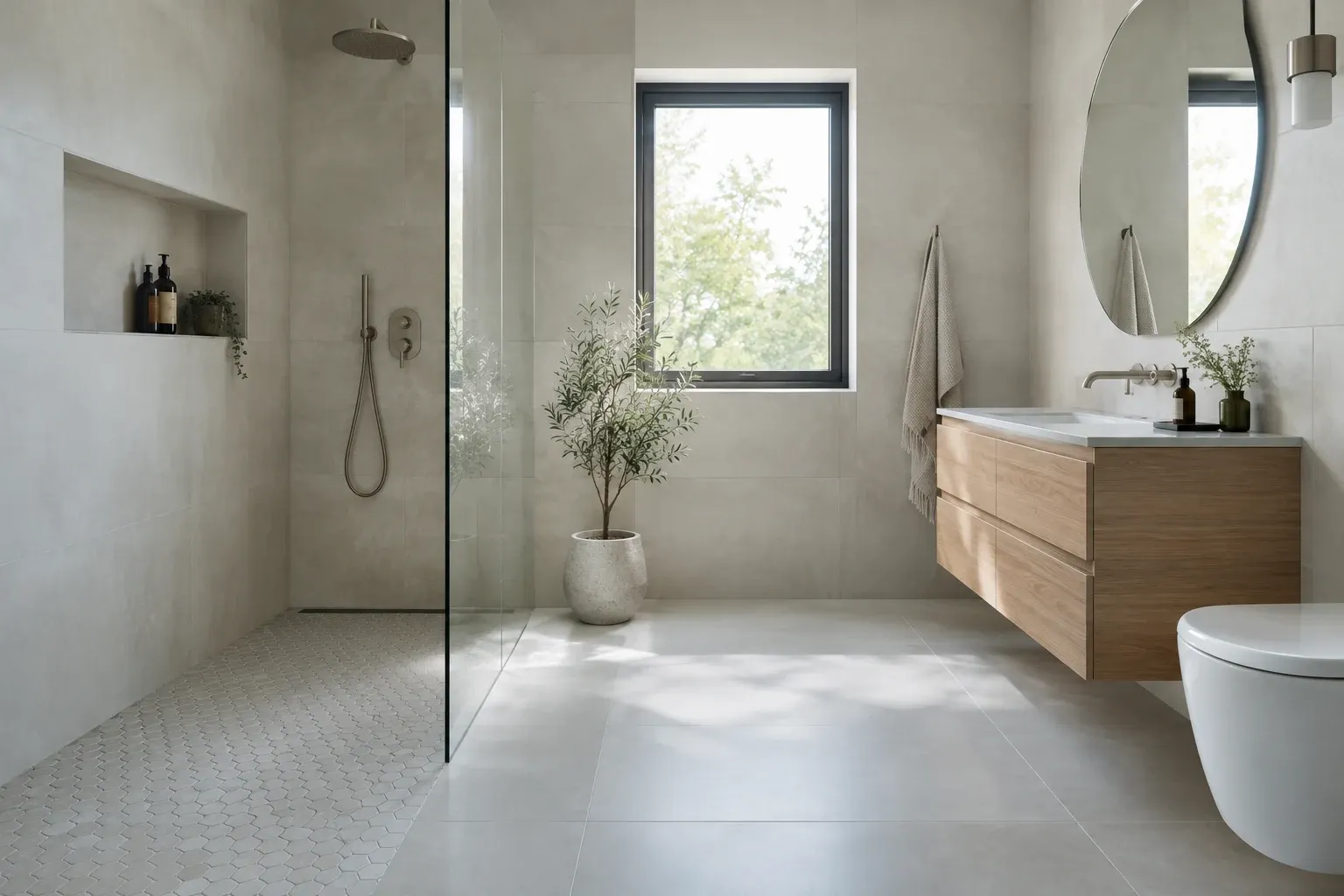
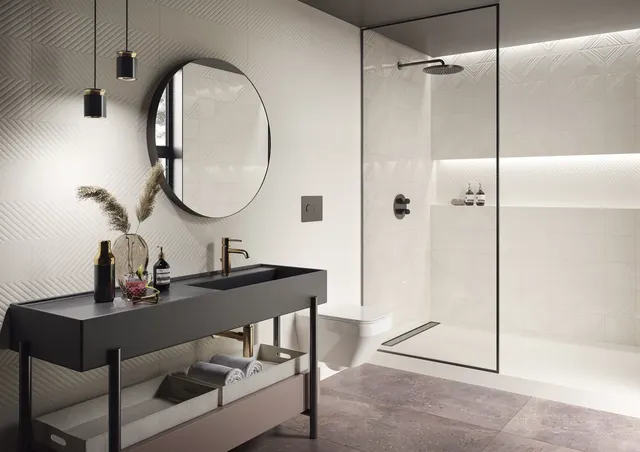
Illustrative image: bathroom with hexagonal floor tiles in the shower and large-format wall tiles
An unconventional shape is the quickest way to give a bathroom a distinctive look without bold colours. It works best in combination with calm large formats – the shape should stand out, not overcrowd the room. Collections with patterns and shapes can be found in the Patterns and Decors section, other wall tiles in the photo gallery Wall and floor tiles.
Overview of shapes
| Shape | Where it fits | What to watch out for |
|---|---|---|
| hexagon | shower floor, accent wall, transition between two floor tiles | cuts at the walls, finish and transition to other floor tiles |
| rhombus | accent wall, strip behind the sink | precise laying, otherwise the pattern will 'drift' |
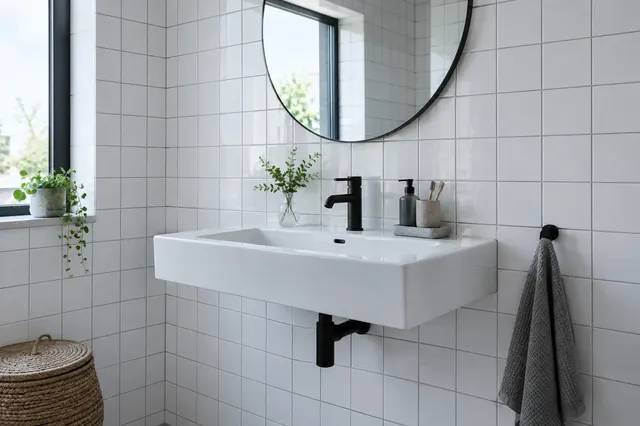
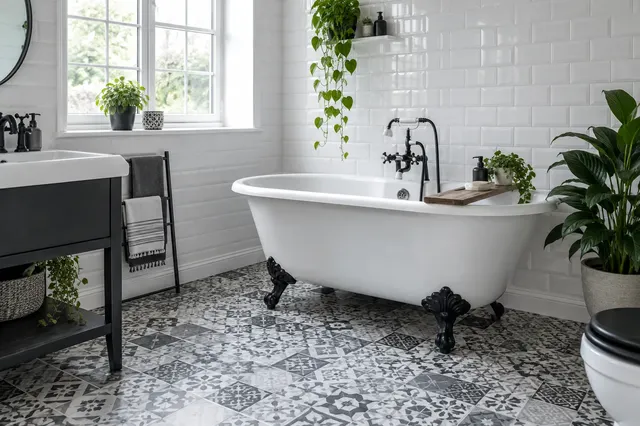
| metro wall tiles | wall behind the sink, shower, kitchen, retro bathrooms | many joints, choice of grout colour |
| zellige | accent wall, shower, kitchen | uneven surface, experienced tiler, true zellige is challenging to lay |
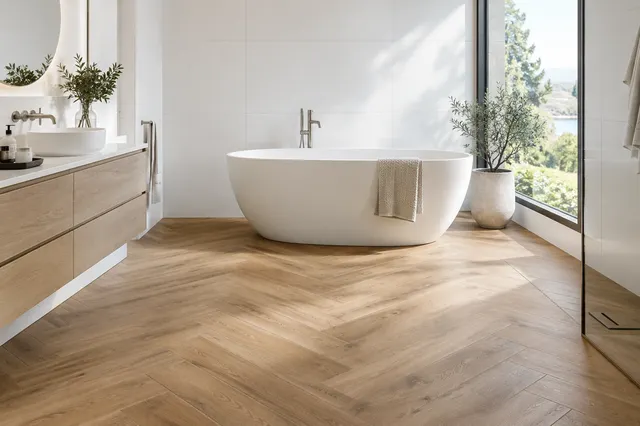
| herringbone and chevrons | wall behind the bath, floor in wood imitation | more cuts and intersections |
Hexagon
The hexagon is produced as a mosaic on a mesh and as a standalone tile. For example, in the Mosaic category of the e-shop vkupelni.sk, there is a hexagonal tile 40.8 × 28.3 cm. A small hexagon on the shower floor adapts well to the fall towards the drain, while a large hexagon makes a statement on the entire bathroom floor or wall.
With hexagons, the edge matters. At the walls, each tile needs to be cut, and where the hexagon meets another floor tile, you have two options: a straight edge with a trim or a deliberately 'broken' edge, where the hexagons gradually fade into the main floor tiles. The second method looks striking but requires precise planning and more cutting.
Rhombus
Rhombuses can be laid in a single colour as a subtle diagonal structure or in three shades – light, medium, and dark – creating the illusion of three-dimensional cubes. Such a pattern is very striking, so it belongs on one wall or strip. It would overcrowd the entire bathroom. Rhombuses are laid from the axis of the wall to ensure that the cuts on the sides are symmetrical.
Metro tile
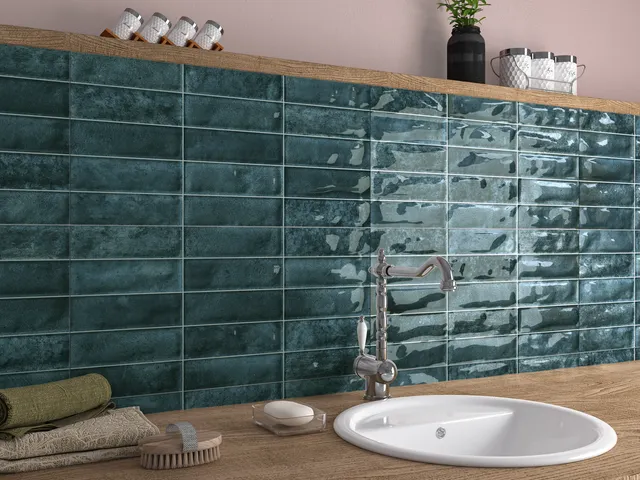
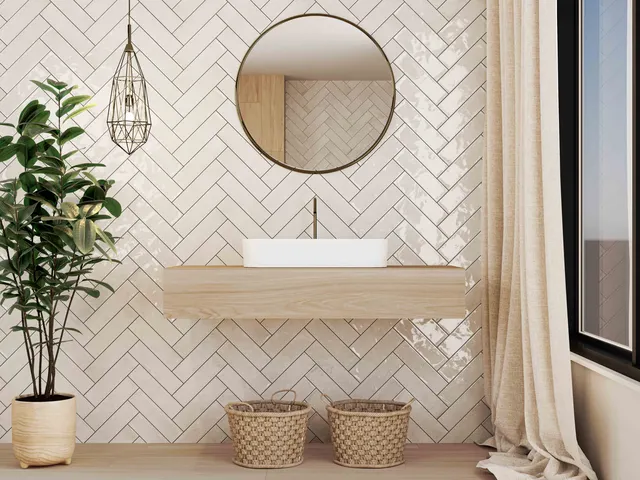
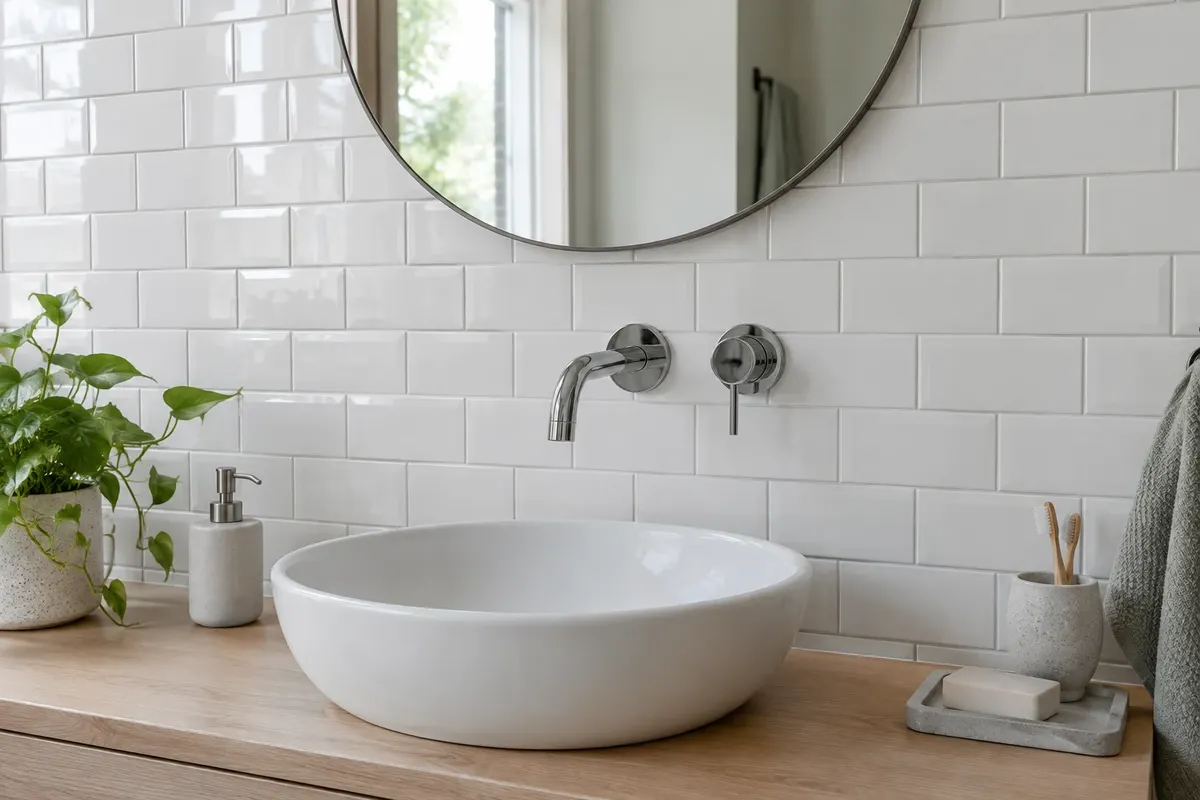
The Metro tile (subway tile) is named after the New York subway. When it opened in 1904, architects George C. Heins and Christopher Grant La Farge covered the stations with white glazed rectangles measuring 3 × 6 inches, or about 7.5 × 15 cm. The glossy white glaze was easy to clean and reflected light underground. Today, metro tiles are produced in many sizes, most commonly with a 1:2 aspect ratio.
In the e-shop vkupelni.sk, for example, Equipe Metro 7.5 × 15 cm is priced at 21.45 €/m² and 10 × 20 cm at 42.90 €/m² (as of November 2026), with the Ecoceramic Subway collection featured in the photo gallery. Traditionally, they are laid in a half bond, but modern styles include vertical or herringbone patterns – more in the article Patterns of Laying.
Zellige
Zellige are traditional Moroccan tiles made from clay from the Fez region. Authentic zellige are handmade, glazed, and fired. Manufacturers point out that variations in colour, size, and thickness, uneven edges, and fine hairline cracks in the glaze (craquelé) are part of their character. They are traditionally laid tightly or with very narrow grout joints, and slight height differences between tiles are normal. Laying is slow and requires an experienced tiler.
An easier option is ceramic tiles with a zellige appearance. For example, Equipe Artisan is a wall tile with a white body inspired by zellige, available in sizes 6.5 × 20 and 13.2 × 13.2 cm, priced at 26.95 €/m² (size 6.5 × 20 cm, as of November 2026). It resembles handmade tiles but is a ceramic tile with regular dimensions.
Herringbone and Chevron
Herringbone can be assembled from ordinary rectangles – metro tiles or long tiles imitating wood. Chevron requires tiles with angled ends, such as Equipe Arrow in the shape of a 5 × 25 cm arrow. The difference and the process are explained in the article Patterns of Laying Wall and Floor Tiles.
Grout: Colour and Type
- More grout joints, more maintenance – small shapes have multiple grout joints per m² compared to large formats. In the shower and on the floor, choose a cement grout with reduced water absorption (CG2 WA) or epoxy grout.
- Colour – a grout joint in the colour of the tiles enhances the surface, while a contrasting joint highlights the shape. A white grout joint with white metro tiles appears subtle, while anthracite is graphic – every imperfection in laying is visible.
- Test – for porous and glossy surfaces, test the grout first on a piece of tile.
You can find the grout colour chart in the chapter Grouts and Silicone, and how to choose a tiler in the article How to Choose a Tiler and Company.
Where to Use Unconventional Shapes
- Shower Floor – small hexagons or mosaics in the colour of the main floor tiles.
- Wall Behind the Sink – metro, zellige, or rhombus up to the height of the mirror.
- Back Wall of the Shower or Niche – one striking surface, with the other walls in large format.
- Retro Bathroom – metro tiles and small shapes feel at home here, see Retro Bathroom.
Mosaics and shaped tiles can be found in the e-shop under the category Mosaics, with more small formats in the article Small Tiles.
Sources: Apartment Therapy – the history of metro tiles; TileBar – What is subway tile; Clay Imports – All about zellige tiles; Zellige – laying guide; Material Bank – Riad Tile zellige; Equipe Cerámicas – Artisan brochure (2023); Mapei – technical sheet Ultracolor Plus (CG2WA); Equipe Cerámicas – Arrow catalogue; offer from vkupelni.sk (Equipe Metro, Artisan, Arrow, mosaics – November 2026); our articles Small Tiles, Patterns of Laying, and the chapter Grouts and Silicone.
Terms in the Glossary: Large-format tiles · Fall (gradient) · Floor drain (point drain) · Grout · Water absorption · Epoxy grout (RG)
Frequently Asked Questions
Where does hexagon fit in the bathroom?
On the shower floor, where the small hexagon adapts to the fall, on an accent wall, or as a transition between two floor tiles. Consider cuts at the walls and the finish at the other tiles.
Why is metro tile called metro?
White glazed rectangles 3 × 6 inches, about 7.5 × 15 cm, were designed by architects Heins and La Farge for the New York subway opened in 1904. They were easy to clean and reflected light underground.
What is zellige?
Traditional handmade glazed tiles made from clay from Fez, Morocco. Variations in colour and size, uneven edges, and fine cracks in the glaze are intentional. Simpler ceramics with a zellige appearance can be laid like regular wall tiles.
What grout for mosaic and small shapes?
In the shower and on the floor, use cement grout with reduced water absorption (CG2 WA) or epoxy grout. Small shapes have many joints, so the durability of the grout matters more than with large formats.
Can the entire bathroom be tiled with unconventional shapes?
Yes, but it often looks overcrowded and is challenging to lay and maintain. It works best with one striking area next to a calm large format.
AI Advisor
Have a question on the topic? Ask the advisor – they will respond based on TGB Kúpeľne articles.
AI advisor – answers are generated by artificial intelligence from TGB Kúpeľne articles and may contain errors.
Bathroom design
These are tips. We will draw your bathroom for you.
In the 3D bathroom planner, you can design your bathroom yourself for free. We will prepare a custom visualisation with specific wall tiles for you in the studio – free of charge with your purchase.
Online design for free Custom visualisation
TGB Kúpeľne Studio · Bratislavská 71, Senec · Map