How it is made · Wall and floor tiles
How porcelain stoneware tiles are made: from clay and sand to the finished tile
Porcelain stoneware tiles are made from natural raw materials – clays, sands and feldspars. They are ground with water, dried into a fine powder, pressed under high pressure and fired at temperatures above 1,200 °C. During firing, the grains fuse into a dense, almost non-absorbent body – porcelain stoneware according to manufacturers absorbs less than 0.5% water. Therefore, it is frost-resistant, hard, and suitable for bathrooms as well as terraces. Let’s take a look at what happens to the tile step by step.
Porcelain stoneware is now one of the most common floor tiles in bathrooms. It is hard, non-absorbent, frost-resistant, and is produced in sizes ranging from small tiles to large slabs. The production process is largely the same as it was decades ago – the main changes have been in precision, line sizes, and the method of applying patterns to the tiles. In this article, you will find the entire journey from raw material to pallet in the warehouse.
What is porcelain stoneware made from
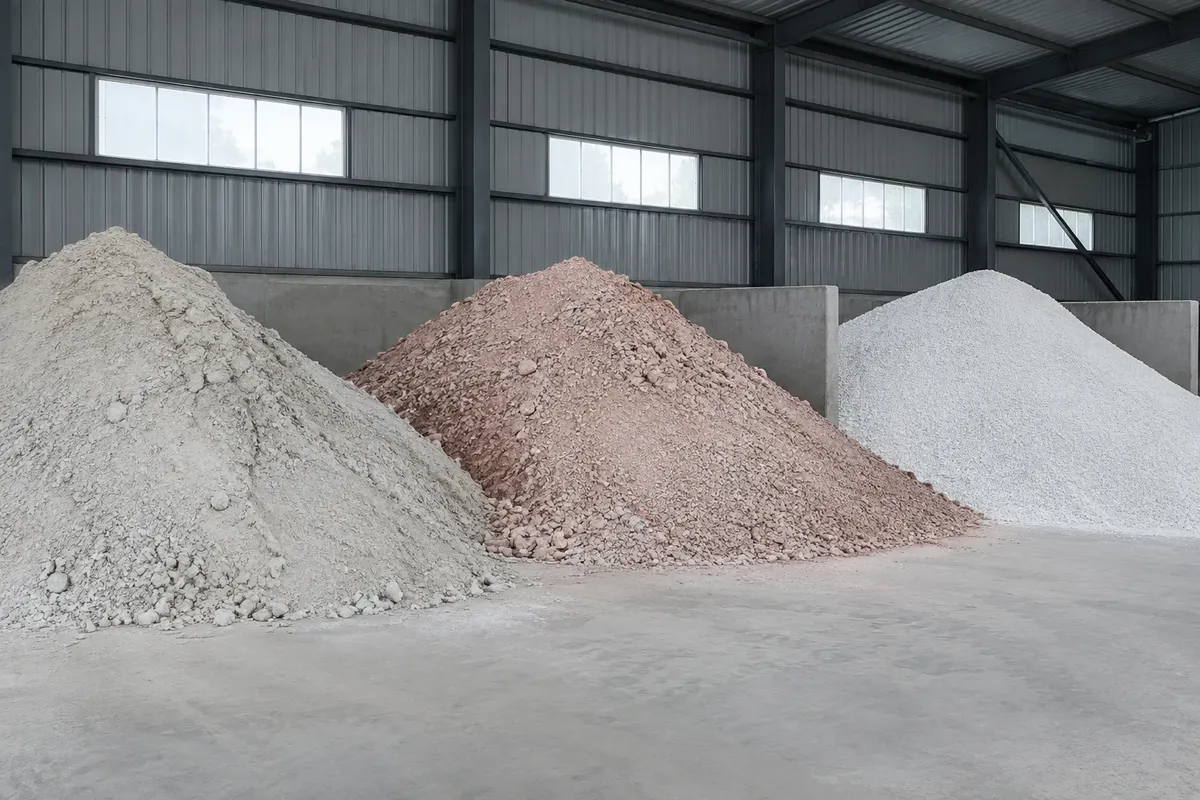
According to the manufacturer Florim, porcelain stoneware is made from selected natural raw materials – sands, clays, and feldspars – mixed with water. Each raw material has its role:
| Raw material | Purpose | What would happen without it |
|---|---|---|
| clays and kaolin | provide cohesion to the mass so it can be shaped and pressed | the powder would crumble after pressing |
| feldspars | melt during firing and bond the other grains into a dense body | the body would remain porous |
| quartz sand | the skeleton of the mass, maintains dimensions and shape during firing | the tile would warp and shrink more during firing |
The raw materials are mined in quarries, transported to the factory, and checked before production. The ratio of raw materials is the recipe for each production facility and determines the colour of the body, strength, and behaviour during firing.
Grinding and atomization: from mud to fine powder
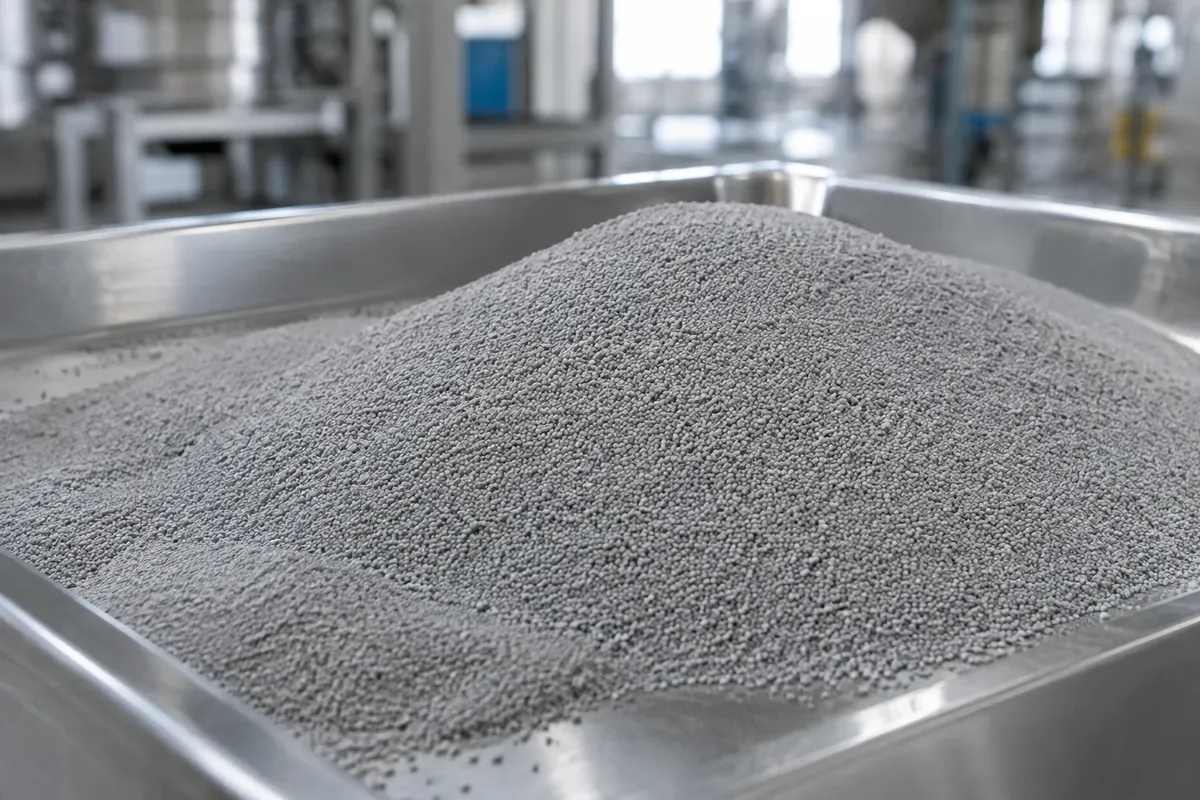
The raw materials are ground together with water in ball mills into a thick liquid suspension. This is then injected into an atomizer – a tall tower where it meets hot air. The water evaporates immediately, and droplets form small rounded grains. The manufacturer Fiandre states that the suspension is injected at a pressure of 25 to 30 atmospheres and the air in the atomizer is at 500 to 600 °C. The resulting powder has a moisture content of 7 to 9% and grains of suitable size for pressing.
Why such a complicated process? The granular powder from the atomizer evenly fills the mold of the press. The tile then has the same density across its entire surface and does not warp during firing. Manufacturers like Fiandre return water and waste from raw materials back into production.
Pressing: 400 kilograms per centimetre
The powder is poured into the hydraulic press mold and compressed. Florim states a pressure of approximately 400 kg/cm². The pressed tile already has its shape but is still fragile – it can be broken by hand.
If the tile is to be coloured throughout, colour pigments are added to the powder. In standard glazed porcelain stoneware, the body is a single colour and the pattern is only on the surface. You will see the difference on the edge – in coloured porcelain stoneware, the edge is the same colour as the surface, which is useful for stairs, for example.
Drying, glazing, and digital printing
Before firing, any remaining water must be evaporated from the tile, so it goes through a dryer. Then, an engobe and glaze are applied, followed by the pattern. In the past, patterns were printed with rollers or screen printing, but today they are often printed digitally – similar to an inkjet printer, but with ceramic colours. This allows each tile in a series to look slightly different, making the imitation of wood, marble, or travertine appear natural and the pattern often does not repeat.
Additional layers can also be applied to the surface – glossy or matte glaze, texture for touch, slip-resistant treatment. We describe how matte and glossy floor tiles differ in the article Matte or glossy floor tiles.
Firing: above 1,200 °C in a kiln longer than a football pitch
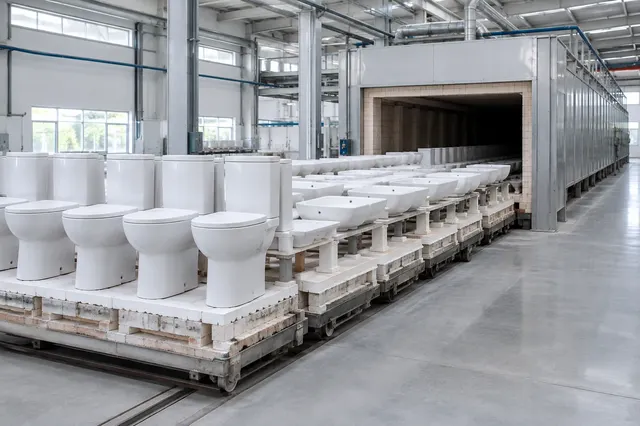
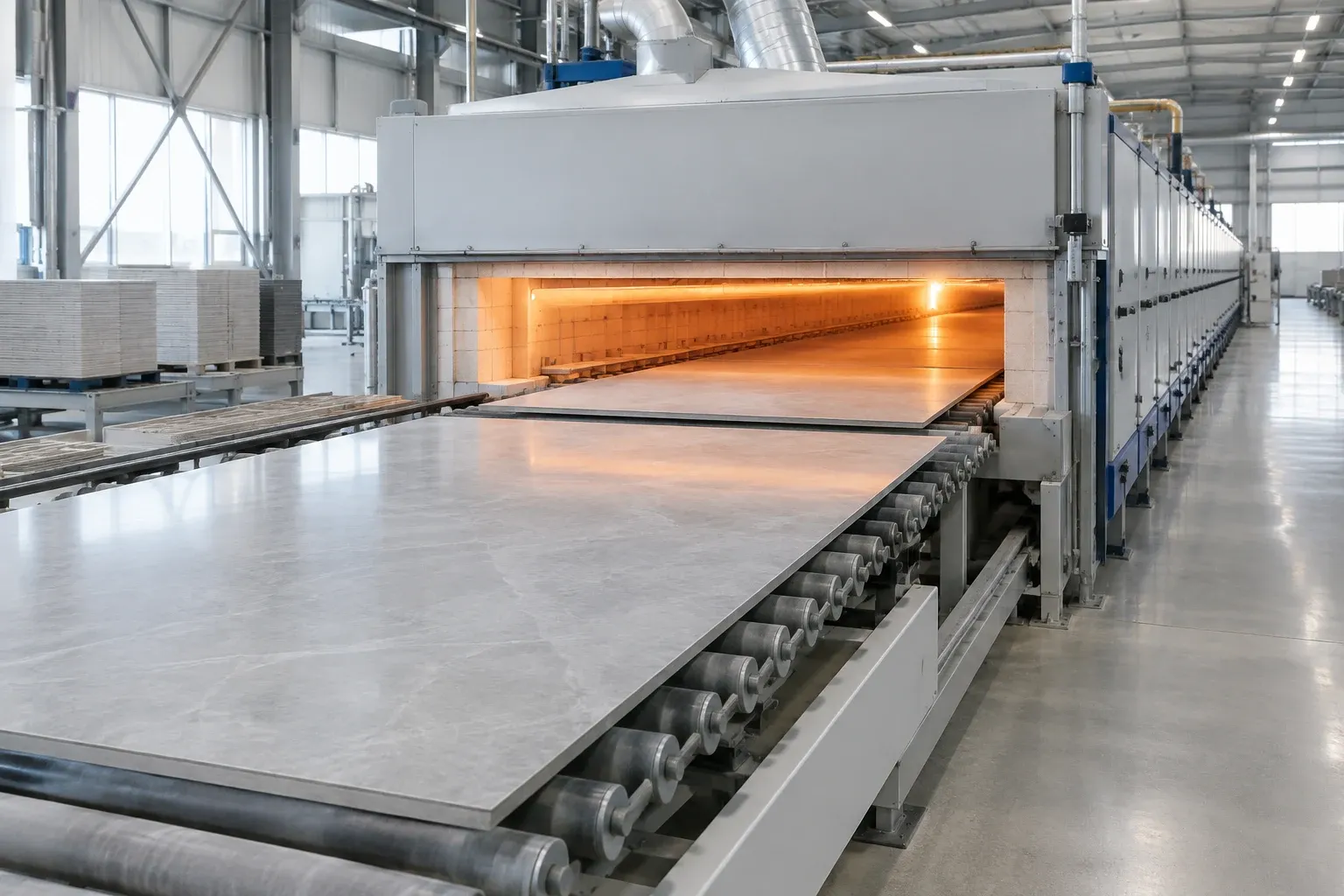
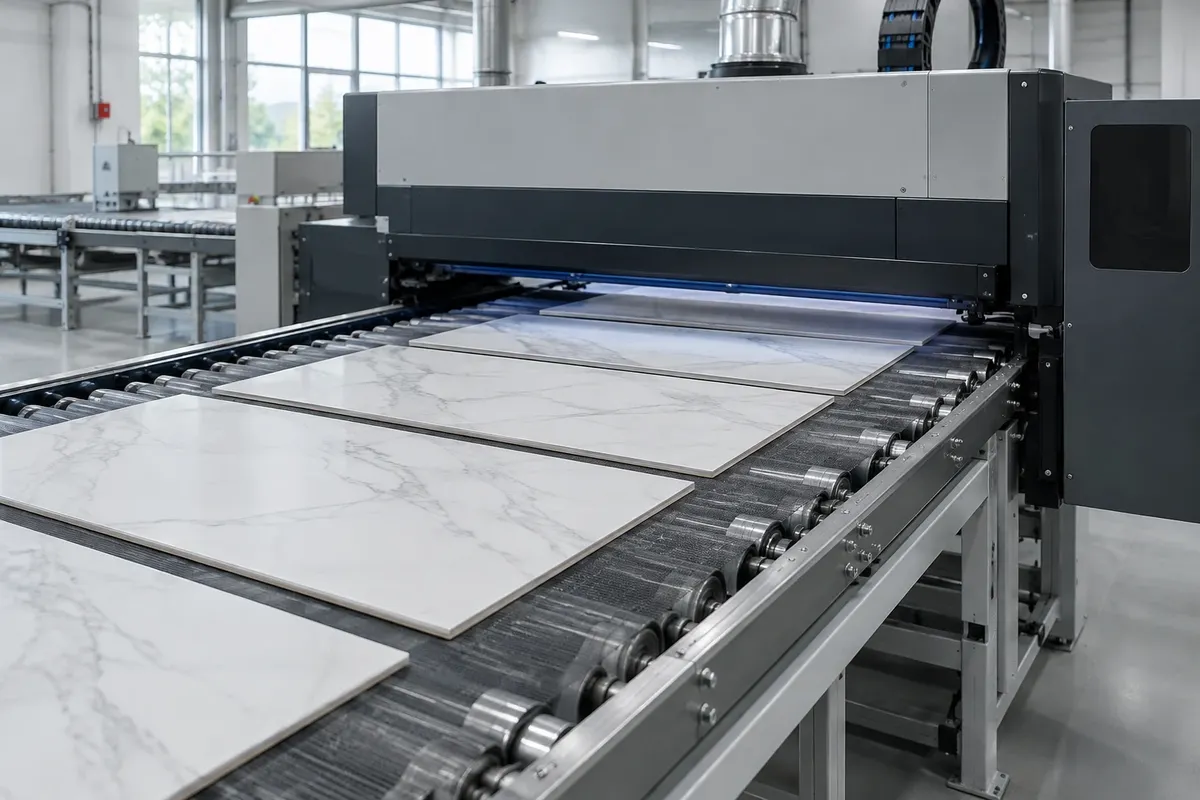
The most important step is firing. The tiles pass through rollers into a kiln, which according to the manufacturer Florim is up to 150 meters long. The highest temperature is above 1,200 °C, with Fiandre stating 1,220 to 1,230 °C. In the kiln, the tile is gradually heated, briefly passes through the hottest zone, and then cools slowly to avoid cracking.
At this temperature, the feldspars melt and fill the spaces between the grains. The body densifies and has almost no pores. The tile shrinks during this process – the press molds are therefore larger than the finished product. Florim states that it is the firing that gives porcelain stoneware its exceptional durability.
| Step | What is happening | Manufacturer's data |
|---|---|---|
| atomization | the suspension turns into powder | air 500 – 600 °C, powder moisture 7 – 9 % (Fiandre) |
| pressing | the powder takes the shape of the tile | approximately 400 kg/cm² (Florim) |
| firing | grains bond into a dense body | above 1 200 °C (Florim), 1 220 – 1 230 °C (Fiandre) |
| result | almost non-absorbent body | water absorption below 0,5 %, often below 0,1 % |
What does water absorption below 0,5 % mean
The EN 14411 standard classifies ceramic wall tiles and floor tiles based on how much water they absorb. Porcelain stoneware belongs to group BIa with a maximum water absorption of 0.5% – this is how RAKO labels tiles from the Quarzit series. For comparison: a standard ceramic wall tile absorbs more than 10%. Low water absorption means that water does not penetrate the body, it does not freeze in winter, and the tile does not crack. Therefore, porcelain stoneware is also suitable for balconies and terraces.
Other properties of floor tiles – slip resistance, PEI abrasion, and frost resistance – are explained in the article Tile parameters, choosing porcelain stoneware in the article Porcelain stoneware tiles.
Rectification, sorting, and packaging
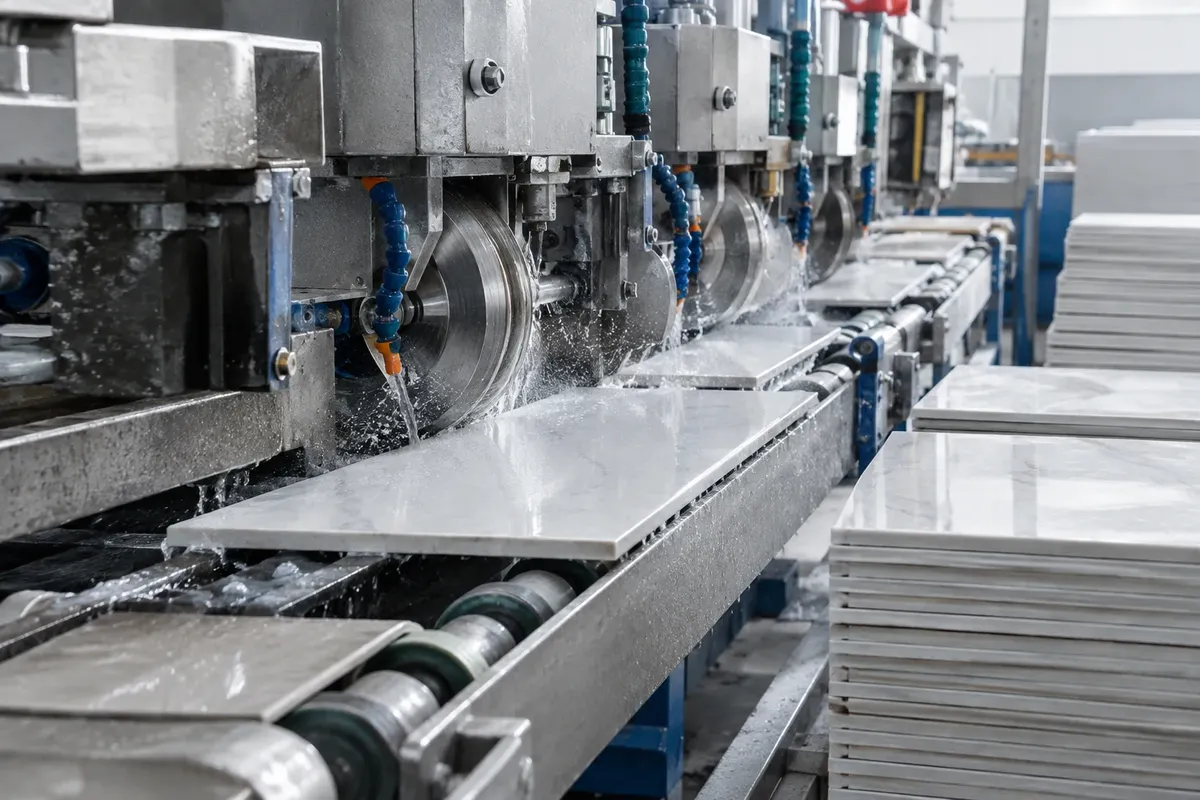
After firing, the tiles can be rectified – ground to precise dimensions with straight edges. Such floor tiles can be laid with a narrow joint, for example, 2 mm. More in the article Rectified tiles. Large slabs are also cut into smaller formats or sheets after firing – Fiandre shapes them with a water jet using abrasive sand at pressures of up to 700 bars.
At the end of the line, machines and people check the flatness, dimensions, and surface. Tiles are sorted by quality, calibre, and shade. The shade is marked on the box with a batch number – therefore, when purchasing, it is essential to take the entire quantity from one batch and set aside a reserve.
What does this mean for your bathroom
- Batch and reserve: additional floor tiles from a different production may have a slightly different shade. How much to buy is described in the article How much wall and floor tiles to buy.
- Pattern variability: when imitating stone and wood, tiles are mixed from several boxes before laying to create a natural appearance.
- Hardness: dense porcelain stoneware is harder to cut than wall tiles – for large formats, a quality cutter or wet saw is required. See Cutting wall and floor tiles.
- Large slabs: modern lines also press slabs of 160 × 320 cm – read more in the article Large slabs 160 × 320 cm.
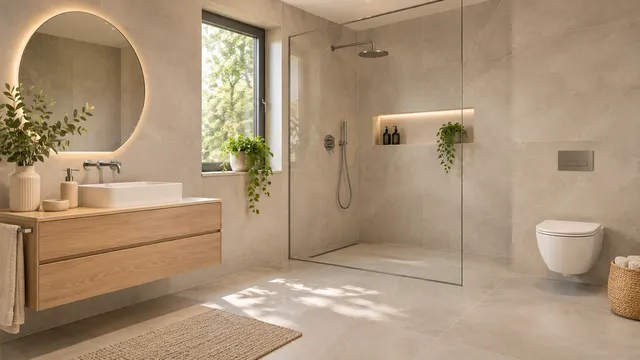
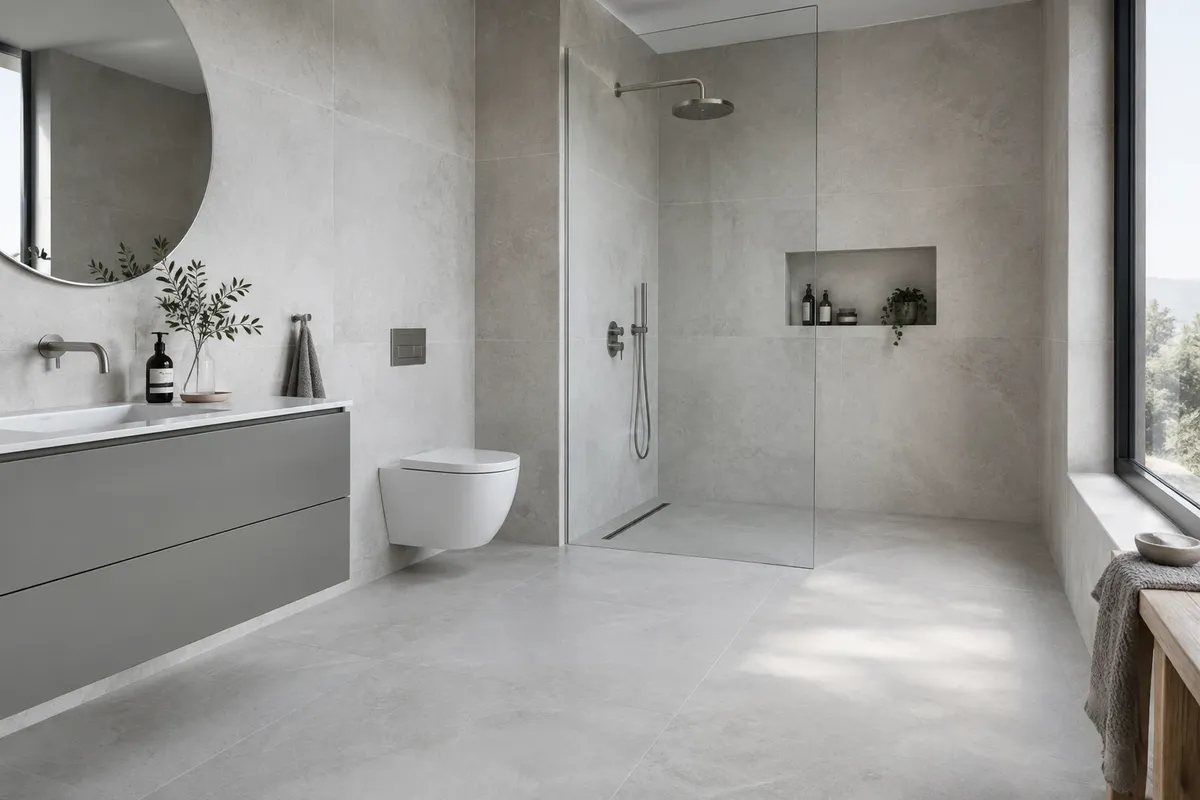
You can try how porcelain stoneware tiles would look in your bathroom using the 3D bathroom planner. Inspirations can be found in the gallery Wall and floor tiles and in the styles travertine, wood, and concrete.
Frequently Asked Questions
What is porcelain stoneware made from?
From natural raw materials – clays and kaolins, feldspars and quartz sand. They are ground with water, dried into powder, pressed and fired at temperatures above 1,200 °C.
At what temperature is porcelain stoneware fired?
Above 1,200 °C. The manufacturer Florim states firing above 1,200 °C in kilns up to 150 meters long, Fiandre 1,220 to 1,230 °C.
Why does porcelain stoneware not absorb water?
At high temperatures, feldspars melt and fuse the grains into a dense body with almost no pores. Porcelain stoneware according to standard EN 14411 absorbs a maximum of 0.5% water, often less than 0.1%.
What is the difference between porcelain stoneware and ceramic wall tiles?
Porcelain stoneware is pressed under higher pressure and fired at higher temperatures, making it dense and able to absorb a maximum of 0.5% water. Ceramic wall tiles have a porous body with an absorption rate above 10% and are not frost-resistant.
What is coloured porcelain stoneware?
Porcelain stoneware that has colour throughout the body – pigments are added to the powder before pressing. The edge has the same colour as the surface, making it suitable for steps, for example.
Why does the shade of tiles differ from different boxes?
Tiles are sorted by shade and calibre after firing and marked with a batch number. Tiles from different productions may have different shades, so buy the entire quantity from one batch and keep a reserve.