How it is made
How ceramic sinks and toilets are made: casting, glazing and firing
Ceramic washbasins and WCs are not pressed like floor tiles, but cast. Liquid ceramic material made from kaolin, clay, feldspar, and quartz sand is poured into a plaster or pressure mold, which absorbs the water. The product is then dried, sprayed with glaze, and fired in a tunnel kiln at temperatures up to 1,250 °C. During drying and firing, it shrinks by up to 12%, which is why the molds are larger than the finished piece.
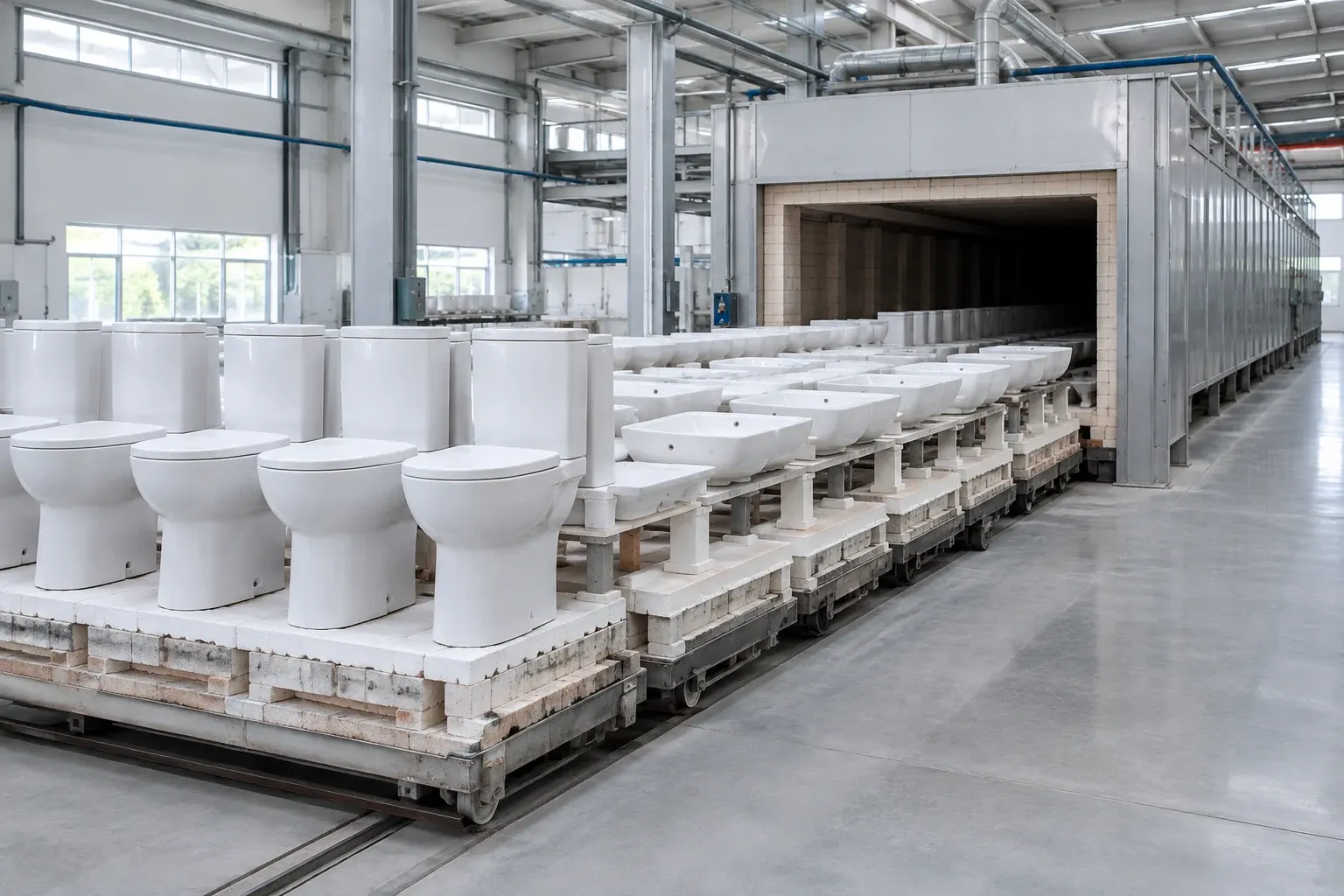
Illustrative image: white glazed WC bowls and washbasins in front of the tunnel kiln
A WC bowl or washbasin is among the most challenging ceramic products to manufacture. It is large, has thick walls, and for WCs, complex internal channels. Additionally, it shrinks by a tenth of its size during firing, yet it must fit well against the wall and flush effectively at the end. This process is described according to the Swiss manufacturer Laufen and reports from the Hungarian plant of Villeroy & Boch.
Raw materials: kaolin, clay, feldspar, and quartz
Laufen states that the base consists of kaolin, clay, feldspar, and quartz sand. Clays and kaolin provide plasticity to the mass, feldspar melts during firing and binds the other components, while quartz forms the structure. Ground scraps from fired pieces are also added. The raw materials are mixed with water and electrolytes to liquefy the mass. The mixture is sieved, and magnets remove iron particles. The preparation of the mass takes about 20 hours at 28 °C in Laufen.
Casting: plaster or pressure
The mass is poured into the mold. The porous mold absorbs water, and a layer of ceramics settles on its walls – the future wall of the product. Laufen uses three methods:
| Method | How it works | Data from Laufen |
|---|---|---|
| classic casting | hand-cast into plaster molds | 5 – 10 % of production |
| battery casting | multiple plaster molds at once in a row | 60 – 70 % of production |
| pressure casting | machine presses the mass into a synthetic mold | 12 – 16 bars, washbasin every 12 – 15 minutes |
Plaster molds range from two parts for simple shapes to 24 parts for complex ones and can withstand 80 to 120 casts. Synthetic molds for pressure casting can last for 20,000 to 25,000 casts. According to reports, WCs are also pressure cast at the Villeroy & Boch plant in Hungary. After being removed from the mold, holes are cut and edges are finished.
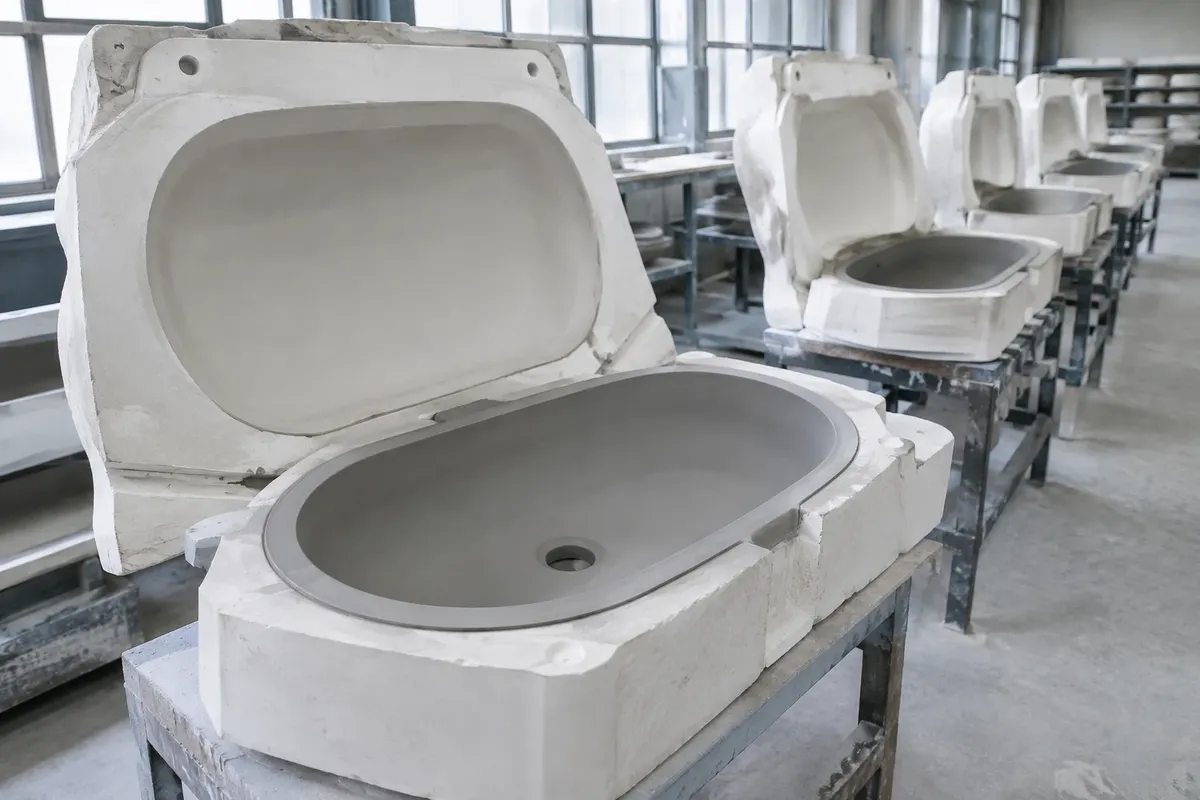
Shrinkage of 12 %: the mold is larger than the finished piece
Ceramics shrink during drying and firing. Laufen states that a product cast at 1 meter measures 0.88 meters after firing. The shrinkage is also not uniform, so modelers adjust the master mold based on test casts until the finished piece has precise dimensions.
Drying and glazing
A fresh cast contains a lot of water and must be dried slowly, or it will crack. In Laufen's continuous dryers at 60 °C, moisture drops from 15 – 18 % to 1 % in four to six hours.
The dried product is sprayed with glaze – a layer that forms a smooth, shiny, and impermeable surface during firing. In Laufen, about 95% of products go through an automatic glazing line, while complex and very large pieces are glazed manually. The glaze layer is 0.6 to 0.8 mm thick. According to reports, industrial robots also glaze at Villeroy & Boch.
Firing: up to 1 250 °C in a tunnel kiln
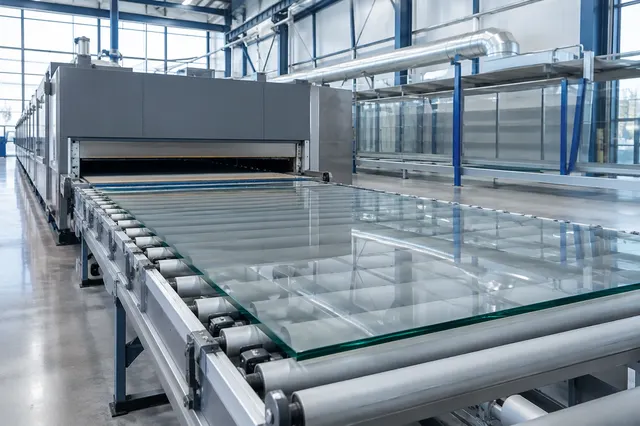
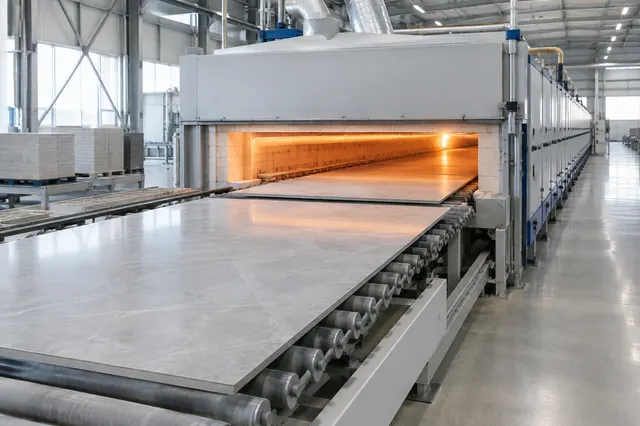
Products are transported on trolleys to the tunnel kiln. In Laufen, the kiln is over 100 meters long, reaches up to 1,250 °C, and one trolley cycle lasts 20 to 22 hours. The clay body densifies during firing, and the glaze melts to form a vitreous surface. Care is taken when cooling from 1,250 °C – at 573 °C, the structure of quartz changes, and too rapid a temperature change could damage the product. Villeroy & Boch states that in their Hungarian plant, the firing lasts 20 hours at a maximum temperature of 1,200 °C.
Control and flushing test
After firing, each piece undergoes inspection. Laufen checks the shape, glaze, surface defects, impermeability, and for WCs, the flushing. Pieces with minor surface defects are repaired and fired again, while those with significant cracks are ground and returned to the material. From raw material to finished product, the process at Laufen takes up to one week.
What this means when choosing
- Small dimensional deviations are natural in ceramics. Check the dimensions for installation, such as the distance between the fixings for the WC or washbasin, in the technical sheet of the specific product.
- Glaze is glass – it is smooth and non-absorbent, but can chip with a hard impact. Clean it with products designed for ceramics, not with steel wool.
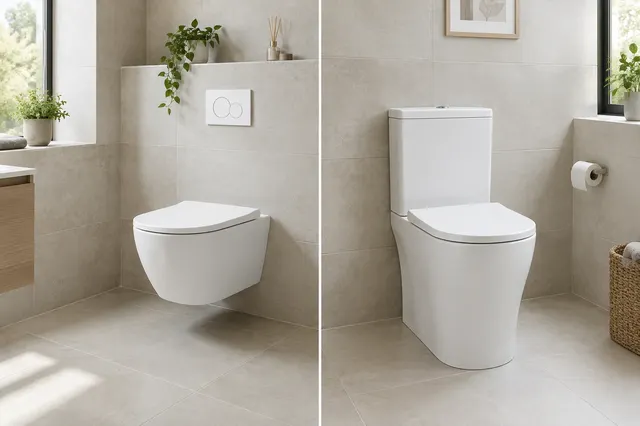
- Shape of the bowl and flushing are determined by the design. We compare rimless bowls and flushing methods in the article Wall-hung or close-coupled toilets.
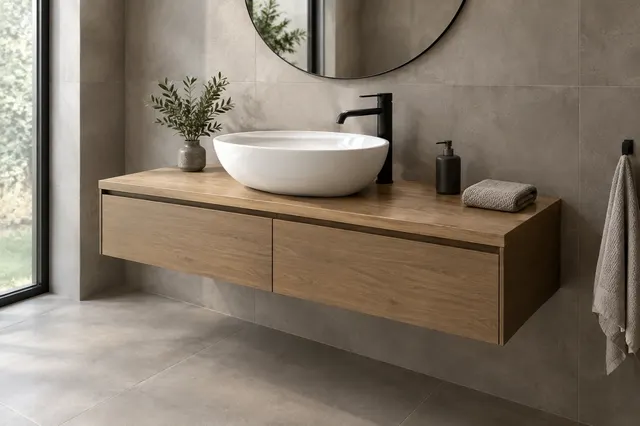
- Choose the washbasin based on size, overflow, and tap hole – in the articles Washbasin for the bathroom and Countertop washbasin.
You can find washbasins and toilets in the e-shop under the category Washbasins, Toilets and Sinks. You can try how they fit into your bathroom in the 3D bathroom planner.
Sources: Laufen – Earth, water, fire; Gizmodo – at the Villeroy & Boch factory in Hódmezővásárhely; EPD – sanitary ceramics Vitreous China and Fine Fire Clay; our articles Washbasin for the bathroom and Wall-hung or close-coupled toilets.
Terms in the dictionary: Water absorption · Close-coupled toilet · Overflow
Frequently Asked Questions
What are ceramic toilets and basins made from?
From kaolin, clay, feldspar and quartz sand, to which ground fired shards are added. The raw materials are mixed with water into a liquid mass, which is poured into a mould, dried, glazed and fired.
How is a basin cast?
The liquid mass is poured into a plaster or synthetic mould, which absorbs water, and a layer of ceramics settles on the walls. Laufen produces a basin every 12 to 15 minutes using pressure casting at pressures of 12 to 16 bars.
At what temperature is sanitary ceramics fired?
Around 1,200 to 1,250 °C. Laufen mentions a tunnel kiln over 100 meters long with a temperature of up to 1,250 °C and a cycle of 20 to 22 hours, Villeroy & Boch 1,200 °C and 20 hours.
How much does the WC shrink during firing?
Up to 12%. According to Laufen, a piece cast at 1 meter in length measures 0.88 meters after firing. Therefore, the molds are larger and adjusted based on test casts.
Is every WC checked?
Yes. Laufen checks the shape, glaze, surface defects, impermeability, and for WCs, the flushing after firing. Pieces with minor defects are repaired and fired again, while those with cracks are ground back into the material.
AI Advisor
Have a question on the topic? Ask the advisor – they will respond based on TGB Kúpeľne articles.
AI advisor – answers are generated by artificial intelligence from TGB Kúpeľne articles and may contain errors.
Bathroom design
These are tips. We will draw your bathroom for you.
In the 3D bathroom planner, you can design your bathroom yourself for free. We will prepare a custom visualisation with specific wall tiles for you in the studio – free of charge with your purchase.
Online design for free Custom visualisation
TGB Kúpeľne Studio · Bratislavská 71, Senec · Map