How it is made
How a laminate bath is made: model, mould, gelcoat and manual laying of glass mat
A laminate bath is created manually in an open mould. Gelcoat – the future glossy surface of the bath – is sprayed onto the separated surface of the mould, and layers of glass mat with polyester resin are laid on top, which are pressed down with rollers. This is how TGB PLAST, spol. s r.o. manufactured laminate baths in Senec from 1991 to 2024. We describe the entire process from model and mould to finished bath and compare it with today's acrylic bath at the end.
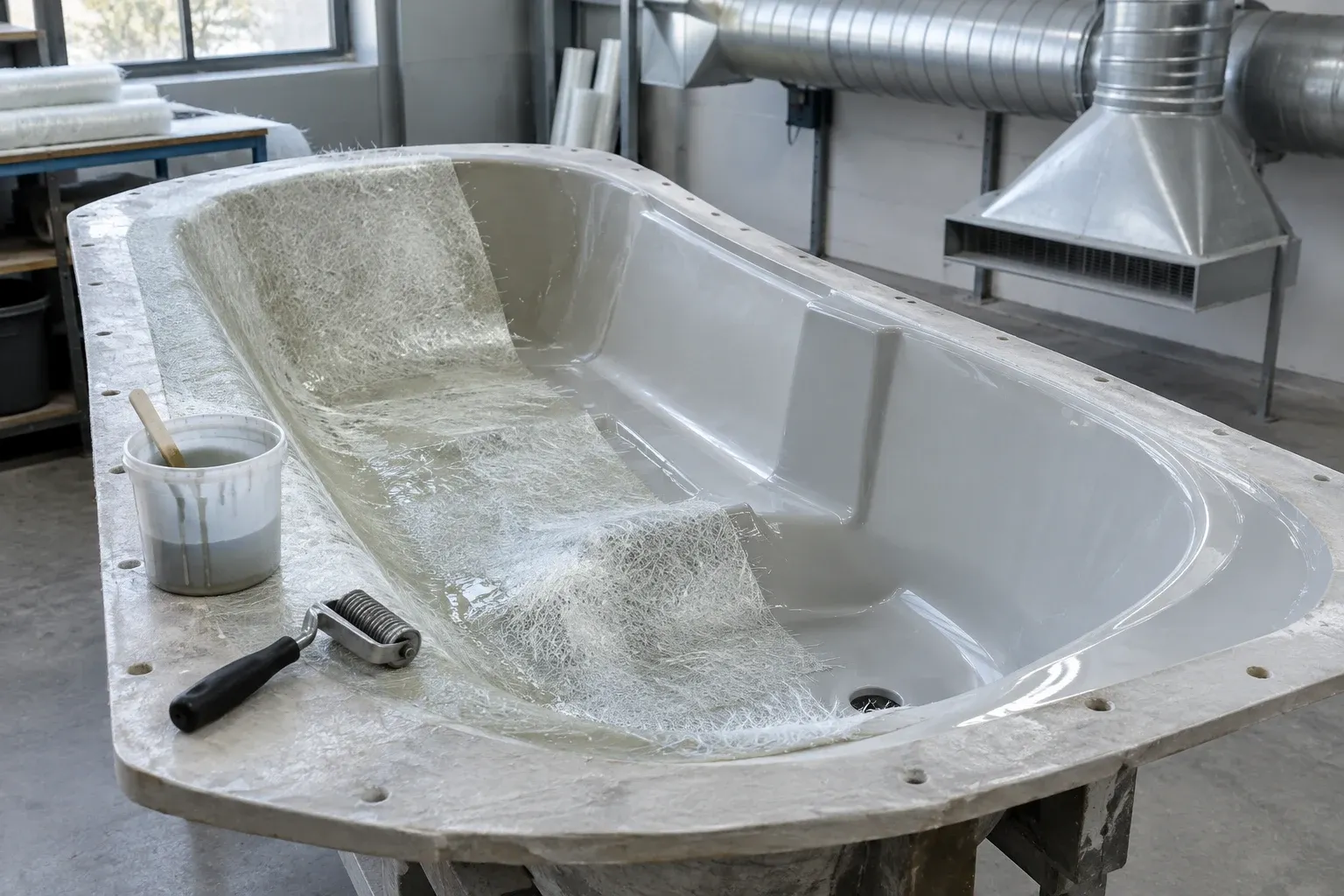
Illustrative image: Glass mat saturated with resin in an open bath mould
Laminate – more precisely fibreglass laminate – is a plastic reinforced with glass fibres. It is used to make boats, tanks, and baths. TGB PLAST, spol. s r.o. from Senec manufactured laminate baths from 1991 to 2024 when it ceased its own production. Today, TGB PLAST sells and designs baths and complete bathrooms at the TGB Kúpeľne studio in Senec. Parts of the article about our production are written based on the experience of TGB PLAST, while others are based on technical sheets and professional manuals for manual laminating.
Summary of steps
| Step | What is done |
|---|---|
| 1. model (plug) | the precise shape of the bath – in TGB PLAST made from sololite, filled and sprayed with spray filler, sanded and polished to a shine |
| 2. mould | a moulding gelcoat and laminate with a base layer is applied to the separated model |
| 3. mould break-in | the new mould is waxed several times and PVA is applied |
| 4. gelcoat of the bath | a layer of about 0.4 – 0.6 mm is sprayed onto the separated mould |
| 5. laminating | layers of glass mat with polyester resin, pressed down with rollers |
| 6. reinforcement | board at the bottom (in TGB PLAST 18 mm beech) and frame |
| 7. finishing | trimming in a rubbery state, sealing edges, complete curing |
Model (plug): shape and gloss of the future bath
Everything starts with a model, also known as a mould. It has the precise shape and dimensions of the future bath. In TGB PLAST, the model was made from sololite, then filled and sprayed with filler (spraygit). The model is sanded and polished to a high gloss because any unevenness will transfer to the mould and from there to each bath. The FAO manual on the production of laminate boats states it in one sentence: the surface of the model determines the surface of the mould.
Mould: separation, moulding gelcoat and laminate
The model is used to create a mould – a negative, into which the baths are then produced. Process:
- Separation. The model is coated with a release wax and a layer of PVA (polyvinyl alcohol) is applied, creating a thin film. This allows the mould to separate from the model. Wax and PVA are commonly used as release agents in mould production, for example by East Coast Fibreglass.
- Moulding gelcoat. A gelcoat designed for moulds is applied to the model. FAO recommends a light moulding gelcoat that heats up less. The Crystic guide from manufacturer Scott Bader suggests a slightly thicker layer for moulds than for products – 0.5 to 0.6 mm.
- Mould laminate with base plate. Layers of glass mat with resin are laid on the gelcoat. The mould must withstand repeated demoulding without deformation, which is why it is thicker than the bath and a base plate is added to maintain its shape. FAO recommends wide flanges for rigidity and advises against laminating the mould too quickly – rather one layer in the morning and another in the afternoon.
- Curing on the model. The mould is allowed to cure thoroughly while still on the model. If removed too early, it may deform (East Coast Fibreglass).
- Split mould. For complex shapes that cannot be removed in one piece, the mould is made from several parts joined by flanges. FAO describes a dividing flange on the model from which a split mould will be created.
- Breaking in a new mould. A new mould is waxed several times before the first products are made – Fiberglass Warehouse suggests 3 to 5 layers of wax – and PVA is applied.
Bath production step by step
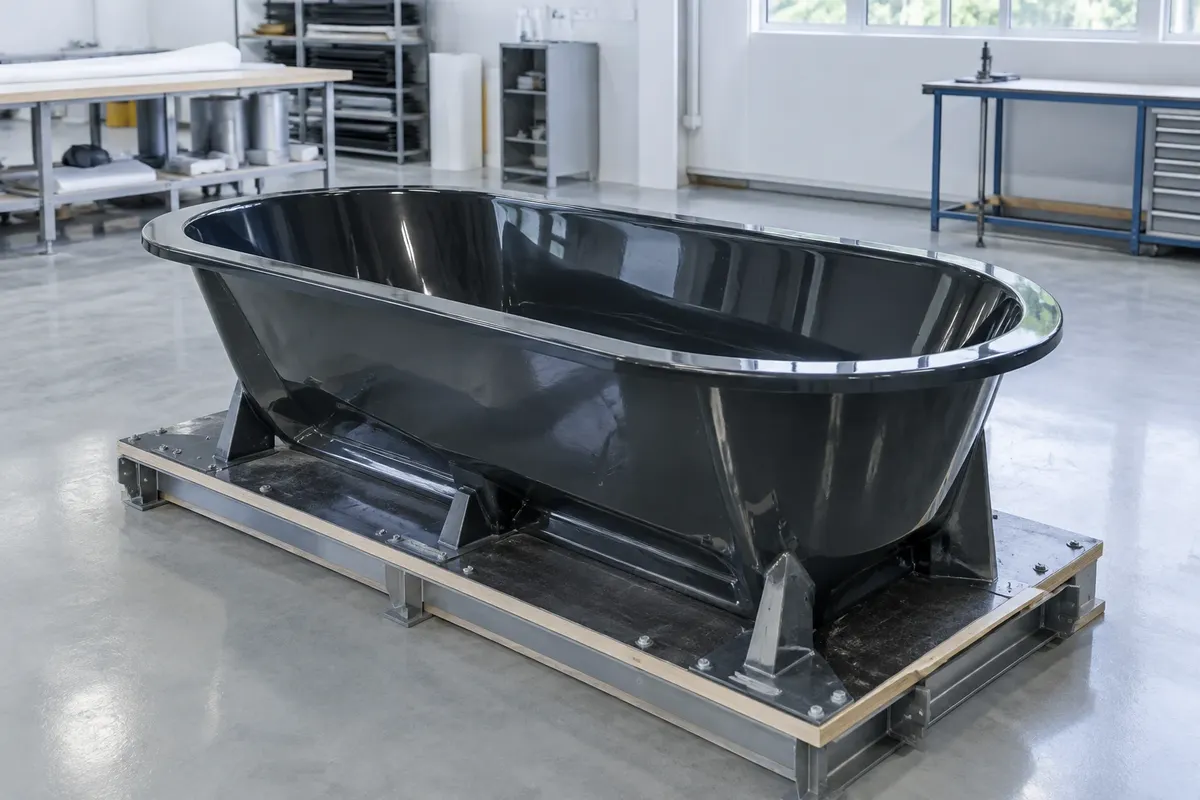
At TGB PLAST, baths were produced by hand laying into an open mould, without vacuuming. Gelcoat was sprayed onto the separated surface of the mould, then layers of glass mat with polyester resin were manually applied and pressed down with rollers. Individual steps:
1. Gelcoat: the future surface of the bath
Gelcoat is a pigmented polyester resin that creates the smooth coloured surface of the bath – the one you touch while bathing. It is sprayed onto a separated mould. The standard colour of TGB PLAST baths was white, with other colours available for an additional charge. Manufacturer Scott Bader states a wet layer thickness of 0.4 to 0.6 mm for the Crystic 6100PA gelcoat. According to the Crystic manual cited by a study from the University of Plymouth, a layer thinner than 0.4 mm may not fully cure and may allow the structure of the mat to show through.
2. When to start laminating
Laminating begins when the gelcoat is partially cured. Scott Bader describes a simple test: touch the gelcoat with a finger – it should be tacky but not stick to the finger.
3. Glass mat and resin
Glass mat is laid on the gelcoat – a felt made of chopped glass fibres held together by a binder. It is coated with polyester resin, which dissolves the binder, allowing the mat to conform to the shape of the mould (East Coast Fibreglass). The resin is pressed into the mat and air bubbles are rolled out.
For the mat, a larger amount of resin than glass is expected – the resin to glass ratio is about 2:1 to 3:1. For example, Fibreglass Direct states that for a 450 g/m² mat, the resin consumption is 2.25 times the weight of the glass. Pieces of mat are torn and their torn edges are overlapped to avoid areas without reinforcement in the bath shell.
4. A maximum of about 4 layers at once
Polyester resin generates heat during curing. The more layers applied at once, the more heat is generated, and the laminate can overheat. Therefore, a maximum of about 4 layers of mat are laid at once, with additional layers applied only after partial curing. TGB PLAST baths had 3 to 4 layers of mat. Similarly, FAO recommends not laminating too quickly when working with moulds.
5. Reinforcement of the base and frame
The bottom of the bath supports both water and a person, so it is reinforced with a board. In TGB PLAST, the bottom of each bath was reinforced with 18 mm thick beech. The bath also receives a frame on which it stands. Without reinforcement, the bottom would sag under load.
6. Trimming in a rubbery state
The edges of the bath are trimmed when the laminate is already firm but still rubbery. East Coast Fibreglass refers to this phase as the "green stage" – at this point, the laminate can be cut with a knife. Later, after curing, a knife will no longer suffice.
7. Sealing edges and complete curing
The trimmed edges are sealed with resin to enclose the glass fibres and create a smooth edge. The bath is then removed from the mould and allowed to cure completely – the final properties of the laminate are achieved only after complete curing, not at the moment it hardens.
Ventilation and protective equipment
Polyester resin and gelcoat contain styrene, which evaporates during manual laminating in an open mould. The UK Health and Safety Executive (HSE) states a styrene exposure limit of 100 ppm over 8 hours and 250 ppm over 15 minutes. Therefore, effective extraction and workshop ventilation are required during manual laminating, and where this is insufficient, a respirator is necessary. This includes gloves and eye protection.
Laminate and acrylic baths: what are the differences
In the e-shop vkupelni.sk, most baths today are made of acrylic. An acrylic bath also contains laminate, but only as reinforcement: the surface is formed from an acrylic sheet shaped into the bath, onto which a layer of glass mat with polyester resin is applied from below, which is manually smoothed (Polysan). Cast acrylic sheets for baths must have a minimum thickness of 2.7 mm according to standard EN 263.
| Laminate bath | Acrylic bath | |
|---|---|---|
| Surface | gelcoat – a layer of pigmented polyester resin approximately 0.4 – 0.6 mm thick | acrylic sheet, at least 2.7 mm thick before shaping (EN 263) |
| Construction | the entire bath is made of laminate: gelcoat and layers of glass mat with polyester resin, base reinforcement and frame | acrylic shell reinforced from below with laminate |
| Scratch repair | fine scratches can be sanded wet and polished, deeper ones are filled with gelcoat paste and sanded – just like on laminate boats | for scratches, there are care products for acrylic surfaces (Duravit); abrasive cleaning agents will scratch acrylic (Polysan) |
| Weight | TGB PLAST baths weighed around 15 – 20 kg; the weight depends on size, number of layers, and reinforcement | for example, Polysan Marlene 170 × 80 cm weighs 27.3 kg according to the manufacturer |
For comparison: a steel enamelled bath Kaldewei Saniform Plus 170 × 75 cm weighs about 50 kg according to vendor data, and a freestanding bath made of cast marble POLYSAN NIGRA 158 cm weighs 140 kg. How a steel bath is made is described in the article How a steel enamelled bath is produced. We compare bath materials when choosing in the article Bath for the bathroom: how to choose, and coloured and black baths in the article Black and coloured baths.
Sources: TGB PLAST, spol. s r.o. – own production of laminate baths 1991 – 2024 (model, number of layers, bottom reinforcement, colours, weight); Scott Bader – technical data sheet Crystic Gelcoat 6100PA; University of Plymouth – study on gelcoat thickness (Crystic manual); FAO – Training manual on the construction of FRP boats; East Coast Fibreglass – glossary of terms; East Coast Fibreglass – mould production; Fiberglass Warehouse – mould production; Fiberglass Direct – glass mat 450 g; HSE – styrene in hand laminating; Polysan – guide to acrylic baths; Polysan – maintenance of acrylic baths; Polysan – Marlene, technical data sheet; Duravit – care instructions for acrylic; Discover Boating – gelcoat repair; QS Supplies – Kaldewei Saniform Plus (weight); EN 263; our article Bath for the bathroom: how to choose.
Terms in the glossary: Gelcoat · Vinyl flooring (SPC) · Acrylic bath · Freestanding bath · Cast marble
Frequently Asked Questions
How is a laminate bath made?
Manually in an open mould. Gelcoat is sprayed onto the separated surface of the mould, layers of glass mat with polyester resin are laid on top and pressed down with rollers. The base is reinforced, the edges are trimmed in a rubbery state, and the bath is left to fully cure.
What is gelcoat and how thick is it?
Pigmented polyester resin that forms the smooth coloured surface of the bath. Scott Bader states the thickness of the wet layer is 0.4 to 0.6 mm. A thinner layer may not fully cure and the mat may show through it.
Why are about 4 layers of mat laid at once?
Polyester resin heats up during curing. The more layers at once, the more heat, and the laminate can overheat. Additional layers are therefore laid only after partial curing of the previous ones.
What is the difference between a laminate and an acrylic bath?
A laminate bath is entirely made of laminate with a gelcoat surface. An acrylic bath has a surface made of acrylic sheet, which is reinforced with laminate underneath. They differ in surface, method of scratch repair, and construction.
Can a scratch on a laminate bath be repaired?
Yes. Fine scratches can be sanded wet and polished, deeper ones can be filled with gelcoat paste and sanded – just like repairing laminate boats.
How much does a laminate bath weigh?
TGB PLAST laminate baths weighed around 15 to 20 kg. For comparison: the Polysan Marlene acrylic bath 170 × 80 cm weighs 27.3 kg according to the manufacturer, and the Kaldewei Saniform Plus steel bath 170 × 75 cm weighs about 50 kg according to retailers.
What colour were TGB PLAST laminate baths?
The standard colour was white, with other colours available for an additional charge. The bath's colour is provided by a pigmented gelcoat that forms its surface.
Does TGB PLAST still manufacture laminate baths?
No. TGB PLAST, spol. s r.o. manufactured laminate baths from 1991 until 2024 when it ceased its own production. Today, it sells and designs baths and complete bathrooms at the TGB Kúpeľne studio in Senec.
AI Advisor
Have a question on the topic? Ask the advisor – they will respond based on TGB Kúpeľne articles.
AI advisor – answers are generated by artificial intelligence from TGB Kúpeľne articles and may contain errors.
Bathroom design
These are tips. We will draw your bathroom for you.
In the 3D bathroom planner, you can design your bathroom yourself for free. We will prepare a custom visualisation with specific wall tiles for you in the studio – free of charge with your purchase.
Online design for free Custom visualisation
TGB Kúpeľne Studio · Bratislavská 71, Senec · Map