Tiles
Floor for underfloor heating: floor tiles, vinyl or laminate and layer composition
Almost any covering is suitable for underfloor heating, but not all are equally effective. Floor tiles conduct heat best, while vinyl and laminate require products designated for underfloor heating and a lower surface temperature. The thermal resistance of the entire composition, moisture of the screed before installation, and the procedure for the first activation are crucial.
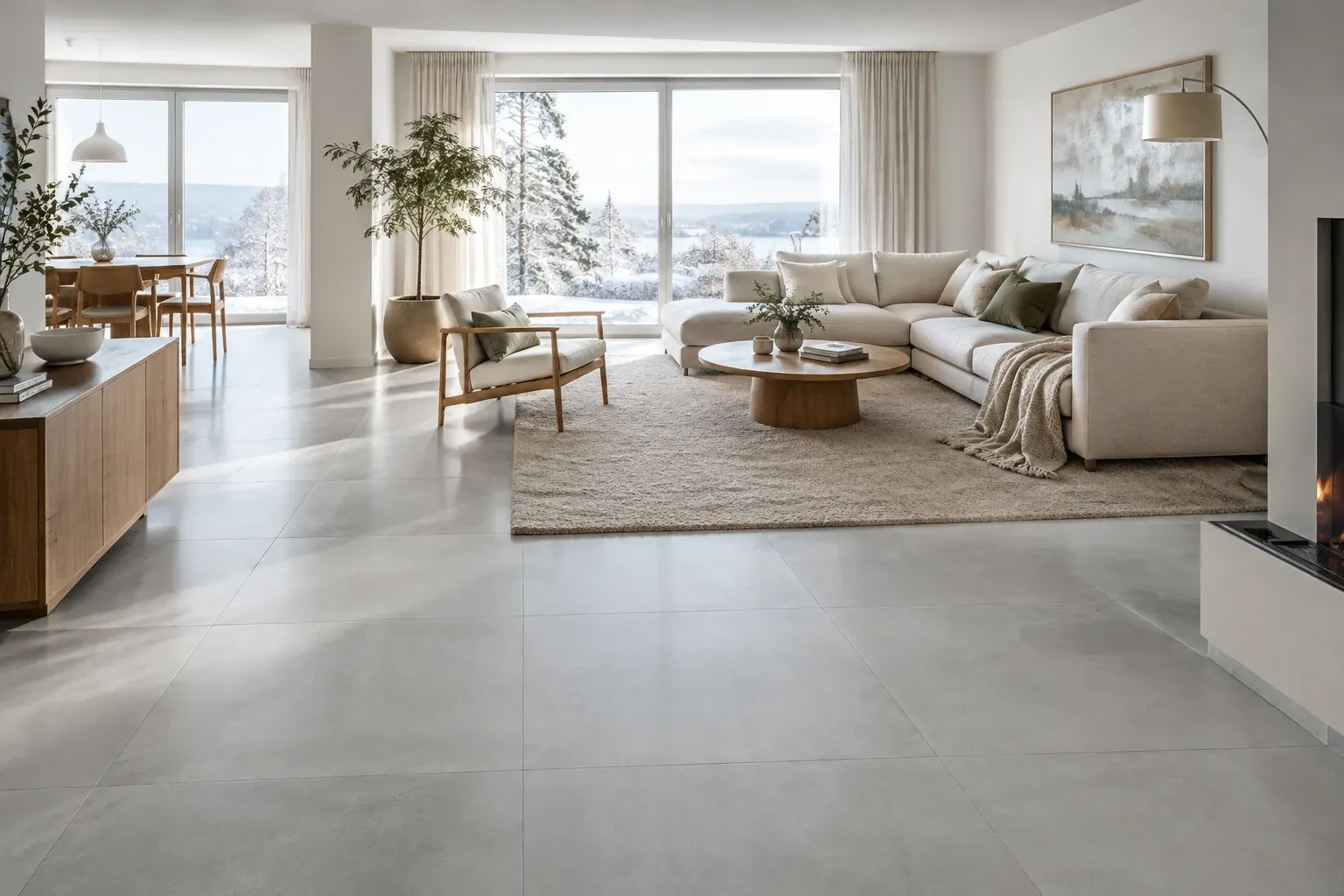
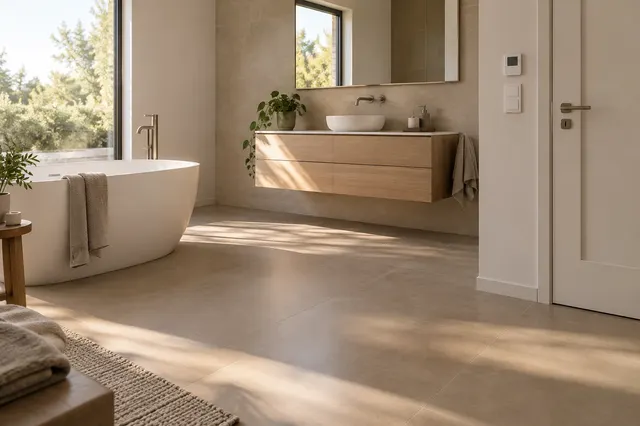
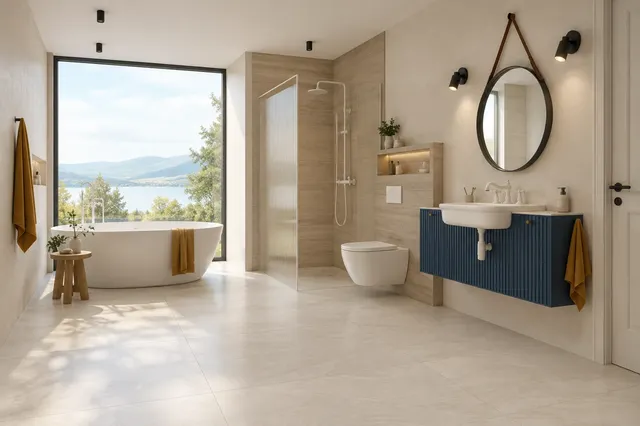
Illustrative image: large-format tiles on underfloor heating in the living room
Underfloor heating warms the entire surface, and the covering above it acts as a layer through which heat must pass. The less it obstructs, the faster it heats the room, and the lower the water temperature or power can be. We describe how to choose the heating for the bathroom in the articles Underfloor heating in the bathroom and Electric underfloor heating. Here we address the floor above it.
Thermal resistance: the number that matters
Each covering has a thermal resistance R in m²K/W – the higher it is, the more it obstructs heat. The EN 1264 standard for underfloor heating assumes that the thermal resistance of the covering above the heating does not exceed 0.15 m²K/W. This value is referenced by flooring manufacturers and their association EPLF. It is important that the entire composition is considered – covering, underlay, and adhesive.
You can find the value in the technical data sheet of the covering and underlay. For example, Coretec states 0.0318 m²K/W for the Pro Core range and 0.066 m²K/W for the 8 mm thick Sound Core. Simply add the values of the covering and underlay and compare them with the limit.
Comparison of coverings for underfloor heating
| Covering | How it conducts heat | Surface temperature according to manufacturers | For bathrooms |
|---|---|---|---|
| ceramic and porcelain stoneware tiles | best, thermal resistance is very low | without restriction from the covering, the heating design and comfort according to EN 1264 apply | yes |
| vinyl (SPC and glued) | good, if it is thin and has a suitable underlay | usually up to 27 °C (Aspecta, BerryAlloc, Rimatex), Coretec up to 29 °C | yes, if it is waterproof |
| laminate | worse, depends on thickness and underlay | for example, Skandor up to 26 °C | only a product that the manufacturer has designated for the bathroom |
EN 1264 also restricts the surface temperature of the floor for comfort – in the living area to 9 K above room temperature. However, for vinyl and laminate, there is a stricter limit for the covering itself.
Tiles for underfloor heating
Tiles are the simplest choice for underfloor heating. They conduct heat, are not affected by higher temperatures, and are water-resistant in the bathroom. To ensure durability, several rules must be followed:
- Adhesive – flexible tile adhesive specified by the manufacturer for underfloor heating, applied over the entire surface without voids. A void under the tile can result in cracking when heated and cooled.
- Expansion joints – around the perimeter of the room and in larger areas also according to the project. Expansion from the screed is also transferred to the tiles.
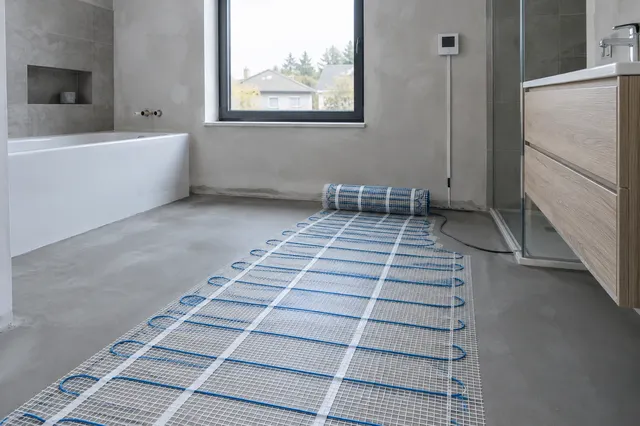
- Electric mat – laid in adhesive or under a thin screed under the tiles. How to connect and measure it is described in the article Electric underfloor heating. You can find mats in the online shop in the category Electric underfloor heating.
Vinyl and laminate on underfloor heating
Vinyl and laminate can be installed on underfloor heating if the manufacturer explicitly states so. The differences are mainly in surface temperature and underlay:
- Surface temperature – for vinyl usually a maximum of 27 °C, for laminate for example Skandor 26 °C. The heating regulation must ensure that their floor does not exceed this – for electric heating, a floor sensor helps.
- Underlay – only one that the covering manufacturer allows for underfloor heating, with low thermal resistance. A thick insulating underlay would stop the heat.
- Before laying – turn off the heating. For PVC coverings, instructions state to completely turn it off at least 2 days before laying, allowing the covering to acclimatize in the room.
- After laying – for example, Barlinek allows heating to be turned on no sooner than 48 hours after installation for the Next Step vinyl.
Whether vinyl is suitable for the bathroom and how to lay it is described in the article Vinyl flooring in the bathroom. You can find vinyl floors in the online shop in the category Vinyl floors.
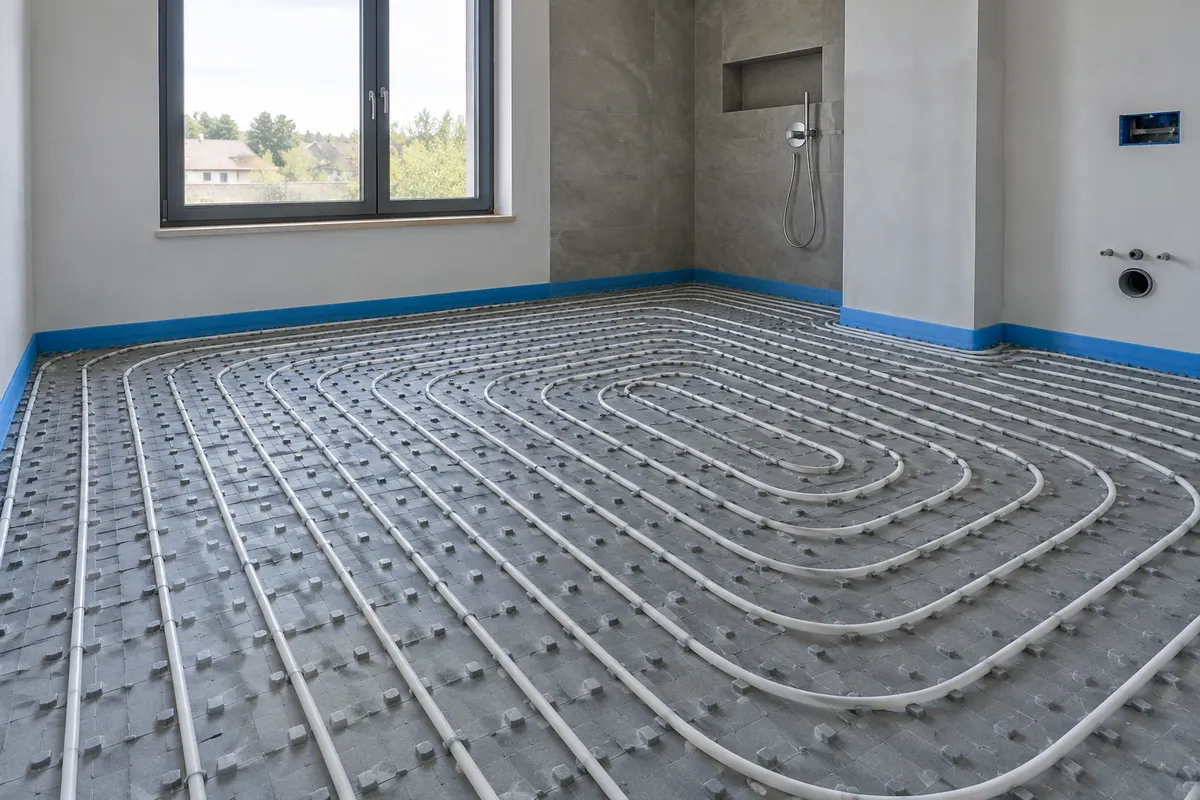
Layer composition for water-based heating
| Bottom layer | Purpose | Data from technical sheets (example) |
|---|---|---|
| support board | ceiling or base concrete | – |
| thermal insulation, system board | heat rises, not into the ceiling | according to the heating project |
| heating pipes | hot water distribution | according to the heating project |
| screed | distributes heat and load | Stavmat W410: at least 40 mm above the top edge of the pipes |
| expansion strip around the perimeter | screed expands when heated | Stavmat W410: perimeter strip at least 8 mm thick |
| waterproofing (in the bathroom) | protects the screed from water | according to the manufacturer's system |
| adhesive and floor tiles or underlay and vinyl | wear layer | thermal resistance of no more than 0,15 m²K/W |
With electric heating in the bathroom, the structure is thinner – the mat goes directly into the adhesive or under the screed on the existing substrate. During renovation, the floor only rises by a few millimetres.
Moisture of the screed and first activation
The most common mistake with underfloor heating is laying the covering on a damp screed. Technical data sheets for levelling compounds and screeds specify these residual moisture limits before laying:
| Screed | Without underfloor heating | With underfloor heating |
|---|---|---|
| cement | up to 2,0 % CM | up to 1,8 % CM |
| anhydrite | up to 0,5 % CM | up to 0,3 % CM |
Moisture is measured by the floor installer using the carbide method CM. The first heating of the screed is done by the heating technician according to the technical data sheet – for example, Stavmat states that for screed W410, the temperature should be increased by no more than 5 °C per day. How long the screed takes to dry and where it fits in the order of work is described in the article Apartment renovation: order of work.
Common mistakes
- Thick insulating underlay under vinyl or laminate – heat does not pass through.
- Covering on damp screed – vinyl and laminate will warp, adhesive will not hold.
- Exceeded surface temperature with vinyl or laminate – the covering deforms and loses warranty.
- Voids under the tiles – cracks when heated.
- Missing expansions around the perimeter and in the area.
- Sudden activation after laying instead of gradual ramp-up.
Sources: EN 1264 (thermal resistance of covering up to 0.15 m²K/W, surface temperature in terms of comfort) according to EPLF and manufacturers' instructions; technical data for Coretec (thermal resistance, surface temperature), Aspecta, BerryAlloc and Rimatex (vinyl up to 27 °C), Skandor (laminate up to 26 °C), Barlinek Next Step (activation after 48 hours); technical sheets for Ceresit DC and AS 1 Rapid and Stavmat STline W410 (moisture of screeds, covering pipes, expansions, ramp-up of heating); instructions for laying PVC (turn off heating before laying).
Terms in the dictionary: Underfloor heating · Gres (porcelain stoneware tiles) · Vinyl floor (SPC) · Flexible tile adhesive (C2TE S1) · Screed · Waterproofing
Frequently Asked Questions
What is the best floor for underfloor heating?
Ceramic and gres floor tiles – conduct heat best and can withstand higher temperatures. Vinyl and laminate can also be used if specified by the manufacturer for underfloor heating, but with a lower surface temperature.
Can vinyl be used on underfloor heating?
Yes, if specified by the manufacturer. Surface temperature is usually limited to 27 °C, for some products, such as Coretec, to 29 °C. The underlay must be suitable for underfloor heating.
Can laminate be used on underfloor heating?
Yes, if it is designated for that purpose. The surface temperature is limited by the manufacturer, for example, Skandor to 26 °C. The thermal resistance of the laminate and underlay together also matters.
What thermal resistance can a floor for underfloor heating have?
According to EN 1264, a maximum of 0.15 m²K/W for the entire composition above the heating – covering, underlay and adhesive. Values can be found in technical sheets and should be summed up.
When can I turn on underfloor heating after installation?
According to the covering instructions. For example, Barlinek allows heating to be turned on no earlier than 48 hours after installation of vinyl, and the surface temperature must not exceed 27 °C. Heating should be turned off before installation.
How thick should the screed be above the pipes?
According to the technical sheet of the screed and the heating project. For example, Stavmat states at least 40 mm above the top edge of the pipes for screed W410.
AI Advisor
Have a question on the topic? Ask the advisor – they will respond based on TGB Kúpeľne articles.
AI advisor – answers are generated by artificial intelligence from TGB Kúpeľne articles and may contain errors.
Bathroom design
These are tips. We will draw your bathroom for you.
In the 3D bathroom planner, you can design your bathroom yourself for free. We will prepare a custom visualisation with specific wall tiles for you in the studio – free of charge with your purchase.
Online design for free Custom visualisation
TGB Kúpeľne Studio · Bratislavská 71, Senec · Map