History of Bathrooms
How the Ancient Romans Bathed: Baths Were More Than Just a Place to Wash
When we enter a wellness centre today, it’s easy to think it’s a modern invention. However, the ancient Romans built an extensive culture of public baths that combined hygiene, relaxation, sports, and social life. And we don’t have to travel all the way to Rome to find traces of it – we can find them just outside Bratislava.
Large Thermae and Small Neighbourhood Baths
The Romans distinguished between large public baths, thermae, which were state-owned and often occupied several city blocks, and smaller baths, balnea. The latter could be privately owned but were accessible to the public for a fee. The entrance fee was low – traditionally one quadrans, the smallest Roman coin – so most free Romans could afford to visit the baths.
Baths were such an integral part of the city that a list of Roman buildings from 354 counted 952 of them in Rome itself. Therefore, grand archaeological sites may distort our perception: alongside monumental imperial thermae, there existed hundreds of smaller baths, frequented much like we visit our local swimming pool or gym today.
From the Changing Room to the Cold Pool
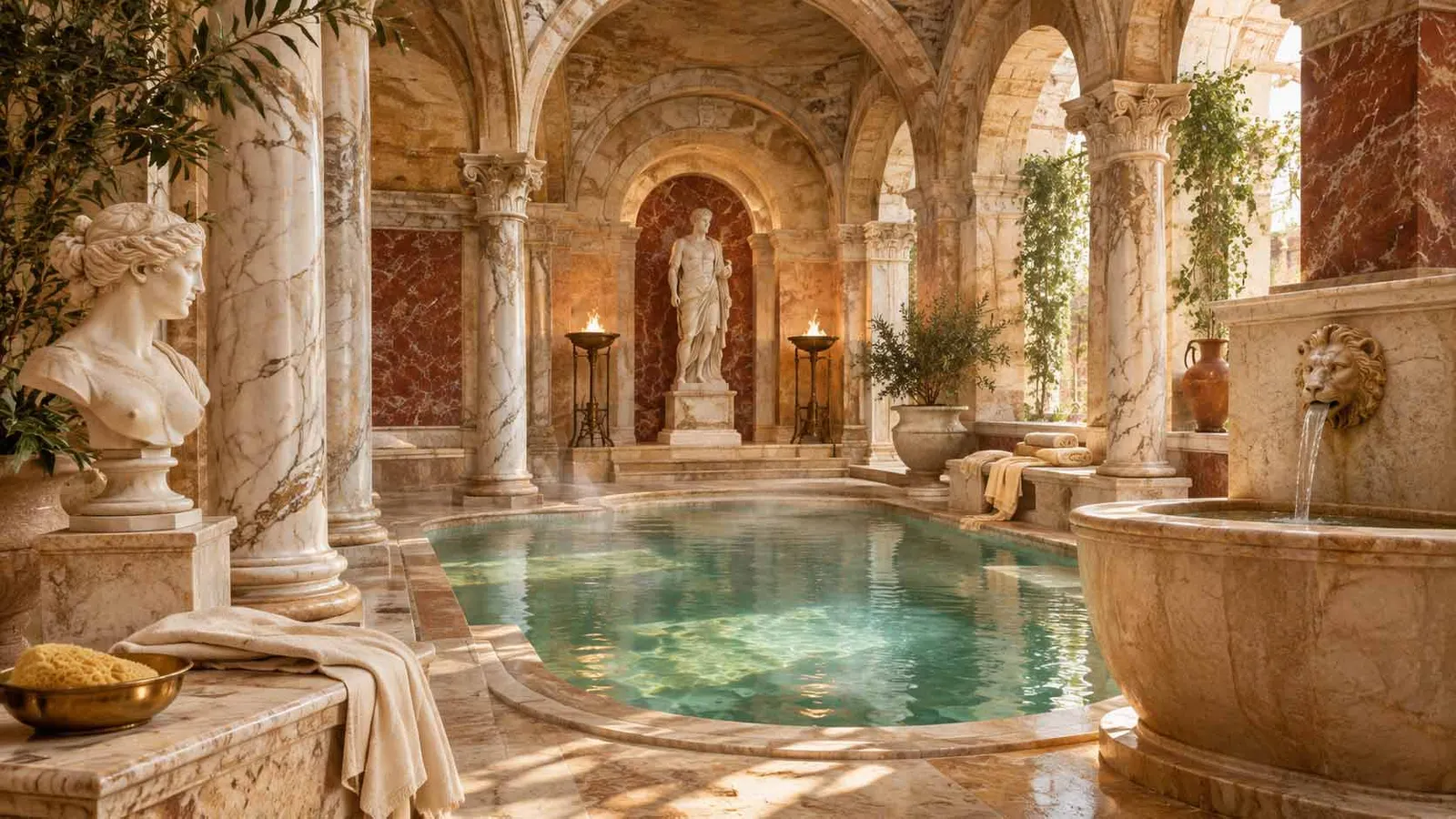
A visit usually began in the changing room, known as the apodyterium. Many then exercised in the palestra – an open-air gym often surrounded by columns. This was followed by rooms of varying temperatures: the lukewarm tepidarium, the hot kaldarium with a warm water pool, and the cold frigidarium with a cold pool. Larger baths also had separate sweating rooms, called sudatorium or laconicum.
The basis of cleansing was not soap in the modern sense, but oil. The body was anointed with it, and dirt along with sweat was then scraped off with a curved metal tool – the strigil. The order of the rooms was not fixed; it varied according to the specific baths and the customs of the visitors.
Heat from Below the Floor
The technical heart of the baths was the hypocaust. The floor of the heated rooms rested on low pillars (pilae), and hot air from a furnace, known as praefurnium, flowed beneath it. Therefore, the hottest kaldarium was located as close to the furnace as possible. In many baths, hot air was also channeled through hollow bricks embedded in the walls (tubuli), heating both the floor and the walls. The comfort of bathers came at a price: the furnaces needed to be constantly fed with wood, and this heavy work was mainly done by slaves.
A Place Where the City Met
Baths were not just a series of tubs. Exercise took place there, conversations were held, and masseurs, barbers, and food vendors worked. The philosopher Seneca complained in one of his letters to his friend Lucilius that he lived directly above the baths. He described the groans of men lifting weights, the shouting of vendors, and the constant calling of a man who was plucking customers' armpit hairs, who only fell silent when the customer shouted instead of him. At the end of the letter, he admits he would rather move away.
The most magnificent were the imperial thermae in Rome. The Baths of Caracalla, opened in 216, could accommodate approximately 1,600 people at once and could see 6,000 to 8,000 visitors daily. Even larger were the Baths of Diocletian, where up to 3,000 people could bathe at the same time.
An interesting question is who bathed with whom. In republican times, baths often had separate sections for women and men, while in the 1st century AD, ancient authors describe mixed bathing. Emperor Hadrian allegedly banned it according to ancient biographies, but historians disagree on how strictly the ban was enforced in practice.
Roman Baths Just Outside Bratislava
You don’t have to travel all the way to Italy to experience Roman bathing culture. In the archaeological park of Carnuntum in Lower Austria, near the Slovak border, reconstructed civil baths of the former Roman city stand. The original structure, covering approximately 1,800 m², was likely built in the 2nd century under Emperor Hadrian and was one of the largest public buildings in the city. Visitors pass from the entrance hall, which likely also served as a changing room, through the cold frigidarium with a pool to the heated tepidarium, kaldarium, and sweating room. The reconstruction was completed in 2011. According to the site's managers, it is a scientifically supported approximation: where findings were lacking, the builders relied on analogies from other Roman baths.
The Roman way of bathing also penetrated north of the Danube, into the Germanic environment beyond the borders of the empire. In Bratislava-Dúbravka, at the site of Veľká lúka, archaeologists uncovered the foundations of a bathing structure measuring approximately 13 × 11 meters and three semicircular projections (apses), which likely contained pools with cold, lukewarm, and warm water. The building was constructed around the first third of the 3rd century, and roof tiles were likely imported from workshops in Carnuntum or Vindobona, present-day Vienna. Who commissioned its construction remains unknown; one hypothesis suggests a Roman veteran of Germanic origin who returned home. Interestingly, the rooms designated for lukewarm and warm baths lacked underfloor heating, which was common in provincial baths – archaeologists therefore admit that the original building plan may have changed. The site is now a national cultural monument.
An Old Idea in a New Dress
The alternation of heat and cold, slow relaxation, and shared bathing experiences are returning in today’s wellness centres. The baths of the Eastern Mediterranean, which evolved into the hammam, also drew inspiration from Roman thermae. Roman history shows that the desire to indulge in time in water is not a new phenomenon.
What would it look like in your home? Design your bathroom in 3D for free or have a custom visualisation prepared at TGB Kúpeľne studio in Senec.
Sources and further information
- Carnuntum: The Civil Baths of Carnuntum – The Reconstruction of a Roman Public Bathcarnuntum.at
- Wikipedia: Ancient Roman bathingen.wikipedia.org
- Smith's Dictionary of Greek and Roman Antiquities: Balneae (quadrans, Hadrian)penelope.uchicago.edu
- Wikipedia: Baths of Caracallaen.wikipedia.org
- The Open University (OpenLearn): Seneca on baths, letter 56open.edu
- Wikipedia: Praefurniumen.wikipedia.org
- Roam in the Empire: Caldarium (tubuli not in all baths)roamintheempire.com
- Rugby Art Gallery & Museum: Hypocaust box flue tile from Tripontiumservices.rugby.gov.uk
- WorldAtlas: How the Romans heated entire cities (furnace operation)worldatlas.com
- The Archaeologist: Roman bathing culture (oil and strigil)thearchaeologist.org
- LEIZA (K. Elschek): Germanic settlement and Roman buildings at Bratislava-Dúbravkawww1.leiza.de
- Slovakia Travel: Villa Rustica (national cultural monument)slovakia.travel
- The Metropolitan Museum of Art: The Hammam (continuation of Roman baths)metmuseum.org