Travel and living
Greek Islands and Their White Bathrooms: Why This Style Never Ages
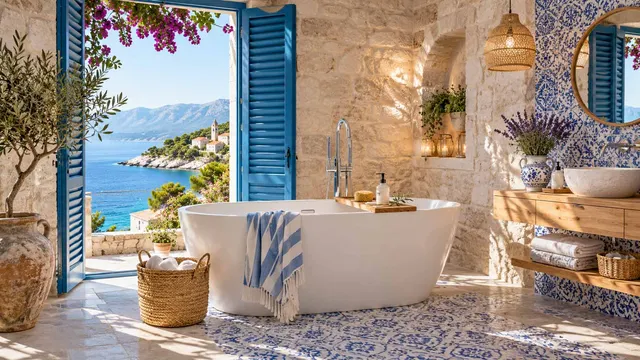
When one thinks of a Greek island, many envision white walls and blue shutters. However, this image is primarily an icon of the Cyclades, not a description of all of Greece. In the bathrooms of island homes, we truly find an interesting blend of light, simplicity, and craftsmanship – and behind the famous white lies more practicality than romance.
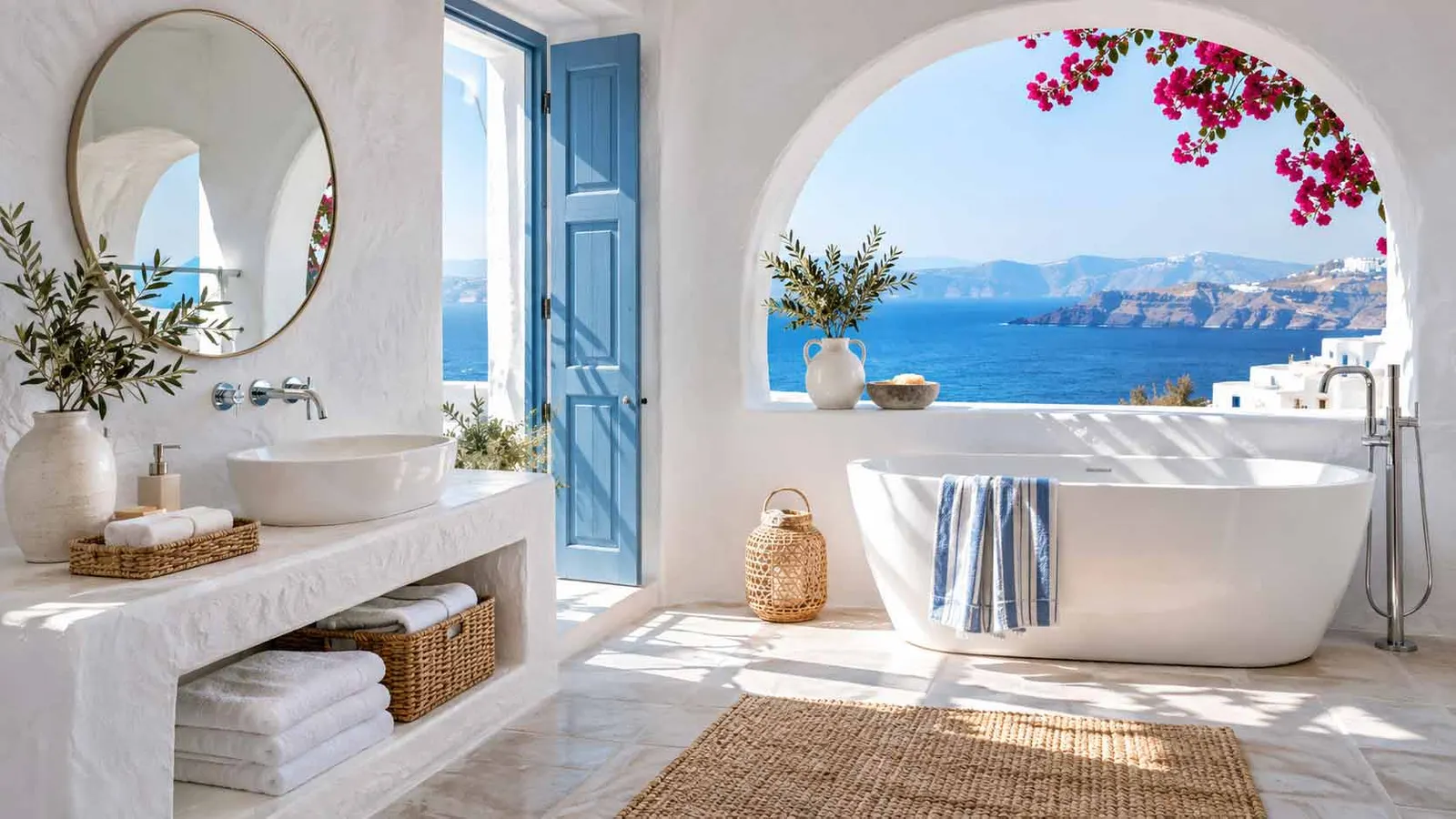
Light is the main decorator
In strong Mediterranean light, white and cream surfaces change throughout the day. Subtle shadows highlight niches, arches, and irregularities in the plaster. Therefore, a bathroom does not need many decorations to make a strong impression. Even the official Greek tourist organization associates the Cyclades with dazzling light and the duo of white and blue.
Why lime?
White in the Cyclades traditionally comes from lime. The lime coating, in Greek asvestoma, was cheap, reflected sunlight, and helped keep homes cooler in the summer. Lime was also considered a hygienic, disinfecting material. Scientific measurements show that calcium hydroxide does destroy many microorganisms, but only while it is wet and highly alkaline – in the air, this effect weakens within weeks. Thus, it is not about "permanently antibacterial walls," but rather a coating that needed regular renewal. Homes and streets were therefore whitened repeatedly, traditionally before church holidays.
Not everything is just blue and white
Alongside the well-known combination of white and blue, sandy tones, natural stone, wood, and colourful ceramics appear. Research into older layers of paint also shows that Cycladic houses were once ochre, red, black, or blue, and the nearly uniform white only prevailed in the 20th century.
Differences can already be seen among the Cyclades themselves. The islands of Kea and Kythnos have red tiled roofs, Milos has colourful boat houses (syrmata), and Ermoupoli on the island of Syros is a neoclassical town reminiscent of a European metropolis. Sifnos is known for its centuries-old pottery tradition. On the Dodecanese islands, we find mosaic floors made of river pebbles (chochlakia), for example in the captains' houses in Lindos on Rhodes. And Corfu in the Ionian Sea bears traces of approximately four centuries of Venetian rule. Therefore, the most interesting interiors often respect the house and the place in which they were created.
Water as a rarity
Behind romantic photographs lies a dry reality. The Cyclades average only around 300 mm of rainfall per year. Most homes therefore have rainwater tanks that collect water from flat roofs, and most islands today also depend on desalination plants. The Greek Ministry of Environment and Energy funded projects against water scarcity in nine island municipalities in 2026. For visitors, this is a good reminder that a long shower with an unlimited flow of water is not a given on the islands.
Why this style never ages
Simple cubic houses from the Aegean Sea have also inspired modern architecture. In 1933, a congress of modern architects CIAM was held on the ship Patris II, which was sailing from Marseille to Athens, and its participants also visited the Greek islands. Clean shapes, white surfaces, and the play of light and shadow thus belong to both tradition and modernism simultaneously – perhaps that is why they appear timeless.
What works outside Greece
White walls, simple lines, and strong daylight can be used almost anywhere. However, when transferring this to a Slovak flat, one must consider the winter months: the cool-looking white can be balanced with warmer light and softer natural shades.
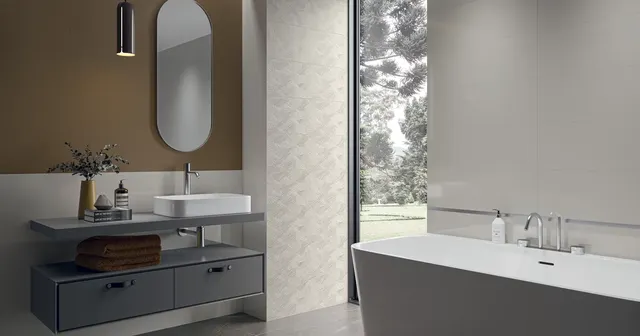
If you want authentic material, lime plasters and coatings are vapour-permeable – moisture passes through them more easily than most modern surface finishes – and are considered mildly antiseptic. However, regular lime coatings gradually wash away with water and need to be renewed. Therefore, in the part of the shower where water directly splashes, it is better to use wall tiles or a special technique such as Moroccan tadelakt; it is advisable to consult a professional about specific solutions.
Holiday mood without souvenirs
Instead of a multitude of shells and blue decorations, it suffices to choose a few quality materials. The Greek island impression is often more about airiness, light, and restraint than about a specific pattern.
What would it look like in your home? Design your bathroom in 3D for free or have a custom visualisation prepared at TGB Kúpeľne studio in Senec.
Sources and further information
- Visit Greece (Greek National Tourist Organization): Cycladesvisitgreece.gr
- Visit Greece: Syrosvisitgreece.gr
- Visit Greece: Sifnosvisitgreece.gr
- Greek News Agenda (General Secretariat for Communication): Cycladic Architecture and Whiteninggreeknewsagenda.gr
- Greek News Agenda: CIAM 1933 and Aegean Architecturegreeknewsagenda.gr
- Stenou, K. (2019), Heritage 2(2) – Colourfulness of Cycladic Housesmdpi.com
- Matsuzaki et al. (2021), Scientific Reports – Effectiveness of Calcium Hydroxidedoaj.org
- G. Venieris, En Andro / Kathimerini (26. 8. 2026): Who Whitened the Cycladesenandro.gr
- Zarikos et al. (2023), Water 15(17):3038 – Water in the Cycladesmdpi.com
- Proto Thema (24. 6. 2026): projects against water scarcity on the islandsen.protothema.gr
- Ministry of Culture of Greece: European Conservation Days 2024 (Dodecanese pebble pavements)culture.gov.gr
- Rodiaki: Lindos captain housesrodiaki.gr
- UNESCO: Old Town of Corfuwhc.unesco.org
- US NPS – NCPTT: Limewash background (archive)webarchive.library.unt.edu
- Babergh & Mid Suffolk District Councils: Limewash and paints for historic buildingsmidsuffolk.gov.uk