Without demolition
Wall panels instead of wall tiles: advantages and disadvantages
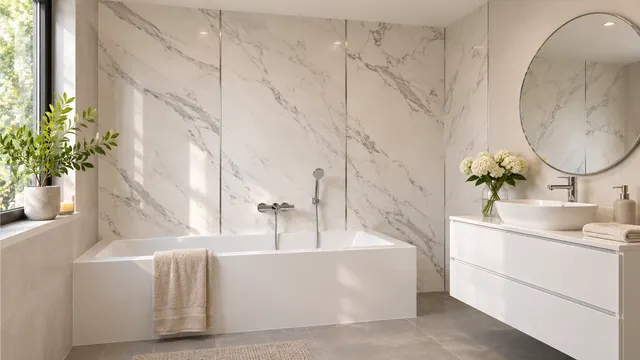
Wall panels promise a bathroom without joints, without demolition and often in just one day. However, under this common name, very different products are hidden: from thin PVC sheets less than a millimetre thick to laminate panels with a plywood core that the manufacturer also allows in the shower. We will go through how they differ, where they are suitable and what to watch out for when installing over old tiles.
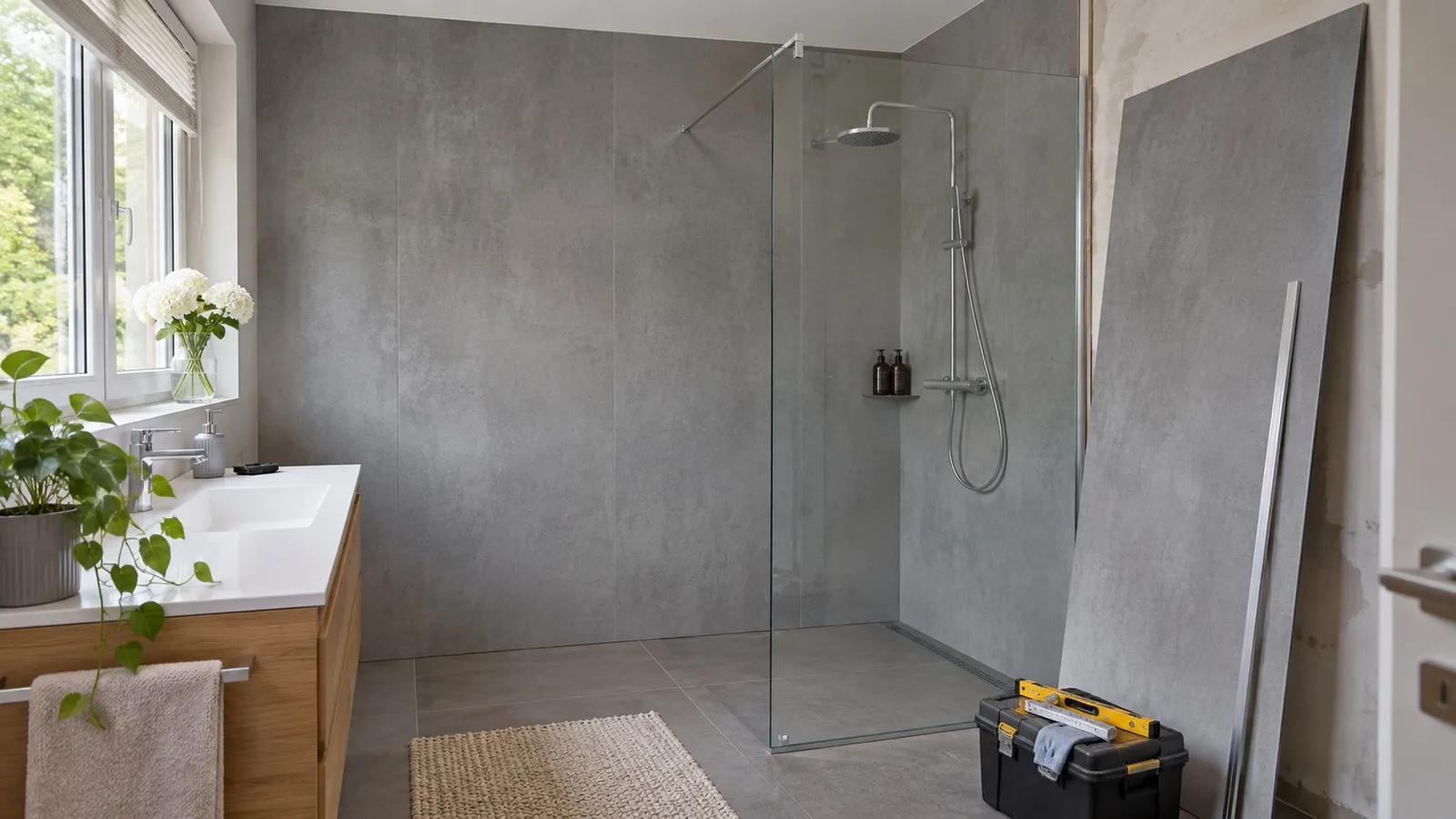
Four types of panels
The cheapest are thin decorative PVC panels a few tenths of a millimetre thick. They are glued to the wall and when used in the bathroom, according to the distributor's instructions, they are laid with an overlap to prevent water from seeping behind the panel. Thicker PVC wall panels are glued with construction adhesive based on MS polymer to almost any solid substrate.
The third group consists of SPC wall panels, which are made from a composite of stone and vinyl. They interlock and are glued with MS polymer. The strongest are laminate panels with a plywood core and a high-pressure laminate surface. For example, the Norwegian manufacturer Fibo specifies a core made of nine-millimetre seven-layer plywood and joints with a tongue and groove system that are sealed with sealant during installation.
What speaks in favour of panels
The main advantage is that they can be installed directly over old tiles, without dust and debris removal. The substrate must be dry, solid, clean, degreased and level according to the specific system's instructions. EGIBI WALL SPC allows a deviation of no more than 2 mm per 1 m. Areas where tiles have been removed and other irregularities must be levelled before gluing. Panels do not have traditional joints, so there is no need to clean darkened joints. Just wipe them with soapy water.
Installation is quick. The manufacturer Fibo states that its panels can be installed up to five times faster than tiles, and a standard panel 2,400 millimetres high covers the entire height of the wall in most bathrooms. Panels are usually easy to drill, but the method of securing mirrors and shelves is determined by the system manufacturer and the weight of the item. Heavy items require anchoring to a load-bearing substrate or prepared reinforcement. Pass-throughs and exposed cores in a waterproof system must be sealed according to the installation instructions.
Disadvantages that are less talked about
Panels are not tiles, and the difference is usually visible and felt to the touch. Cheap PVC panels are soft, easily scratched and unsuitable for areas near heat sources. The technical sheet of one PVC panel manufacturer recommends not using them where temperatures exceed 60 °C, such as near stoves or heating elements.
The waterproofness of the panels depends on the joints. Manufacturers prescribe sealant in the joints, corner profiles, and in wet areas, a bottom profile near the bath or shower tray. The manufacturer of SPC panels EGIBI states that in wet areas, the substrate must be water-resistant. Thus, the panel does not solve existing leaks. If the wall behind the old tiles is damp, the cause must be removed first.
Installation over old tiles step by step
The old tiles are checked by tapping, and loose pieces are glued or removed. The surface is washed and degreased. The flatness of the substrate is also checked according to the specific system's instructions; EGIBI WALL SPC allows a deviation of no more than 2 mm per 1 m. Areas where tiles have been removed and other irregularities are levelled before gluing. SPC panels are acclimatised in the room for 48 hours according to the manufacturer's instructions and installed at a temperature of 20 to 25 °C. Adhesive is applied in strips to the back of the panel. The manufacturer EGIBI does not recommend standard silicone adhesive or liquid nails.
For laminate panels from the Fibo system, for example, installation starts in the corner furthest from the door. First, a corner profile is installed, and sealant is applied to its grooves. The panels are clicked together, and sealant is inserted into each joint before clicking. The panels must also be secured to the substrate in a manner permitted by the manufacturer: preferably mechanically with screws, or suitable adhesive if the conditions for installation on a solid and level existing tile are met. In wet areas, a bottom profile is always used. Holes for taps and outlets are cut out and their surroundings sealed with sealant according to the manufacturer's instructions.
Where panels make the most sense
Panels are worthwhile in a bathroom that you want to refresh quickly and without demolition, for example in a rented flat with the owner's agreement, in a bathroom for seniors or at a cottage. They work excellently around the bath and behind the sink. Only systems that the manufacturer explicitly designates for use in the shower should be used, along with all profiles and seals.
If you want the look of real ceramics, consider thin ceramic slabs that can be glued over old tiles in a similar manner. Wall panels are unsuitable for the floor. There, tiling over existing floor tiles or vinyl flooring are appropriate options.
What to look for when choosing
Ask about the core material and panel thickness, the method of joining, and whether the manufacturer allows use in the shower. Request the installation manual and a list of profiles and sealants required by the system. Include them in your budget. Also check the warranty. Quality laminate panels come with long warranties, while cheap PVC panels typically have short warranties that only cover the product, not the installation.
If you prefer to stick with ceramics, take a look at wall tiles at vkupelni.sk and the guide How to choose wall and floor tiles for the bathroom. You can find inspiration by material in the gallery by appearance, such as concrete or marble.
Related guides: Large-format wall tiles for the bathroom: advantages, disadvantages, and installation, Frameless or framed shower enclosures: differences, advantages, and disadvantages, and History of the bathroom: from the baths in Mohenjo-Daro to the walk-in shower. You can design your own bathroom using the 3D bathroom planner – for free and without registration.
What would it look like in your home? Design your bathroom in 3D for free or have a custom visualisation prepared at TGB Kúpeľne studio in Senec.
Sources and further information
- Professional Builders Merchant: interview with Fibo (core of panels, waterproofness, history)professionalbuildersmerchant.co.uk
- PHPI: Installation guide – Fibo waterproof wall panels (preparation, bottom profile, panel height)phpionline.co.uk
- Professional Builder: installation of Fibo panels (degreasing the tiles, sealant in joints)probuildermag.co.uk
- RIBAJ: Fibo laminate wall panels (installation on tiles, speed, warranty)ribaj.com
- HORNBACH CZ: Guide to gluing PVC panels (thicknesses, overlap in the bathroom)media.hornbach.cz
- Alfistyle: Technical sheet for PVC wall panel (MS polymer, 60 °C, warranty)alfistyle.cz
- EGIBI: Installation manual for EGIBI WALL SPC wall panels (SK)egibi.cz
- EGIBI: Installation manual for EGIBI WALL SPC (wet areas, temperature, adhesive)egibi.cz