Planning and design
Liquid waterproofing for the bathroom: single-component or two-component, consumption and procedure
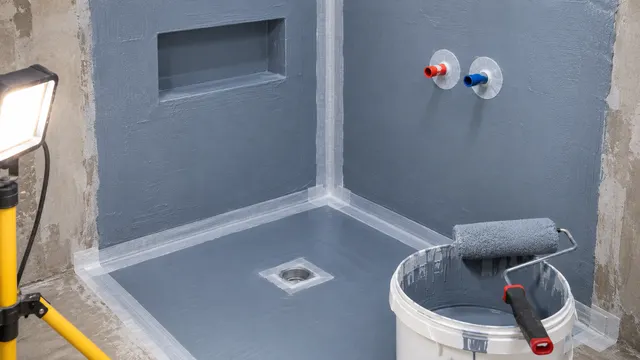
Liquid waterproofing is a coating that creates a flexible waterproof layer under the tiles once dry. A single-component dispersion coating is used for walls and standard bathroom floors, while a two-component cement coating is used in level-access showers and areas with standing water. Always apply in two layers, with tapes in corners and sleeves around pipes, with consumption according to the technical data sheet.
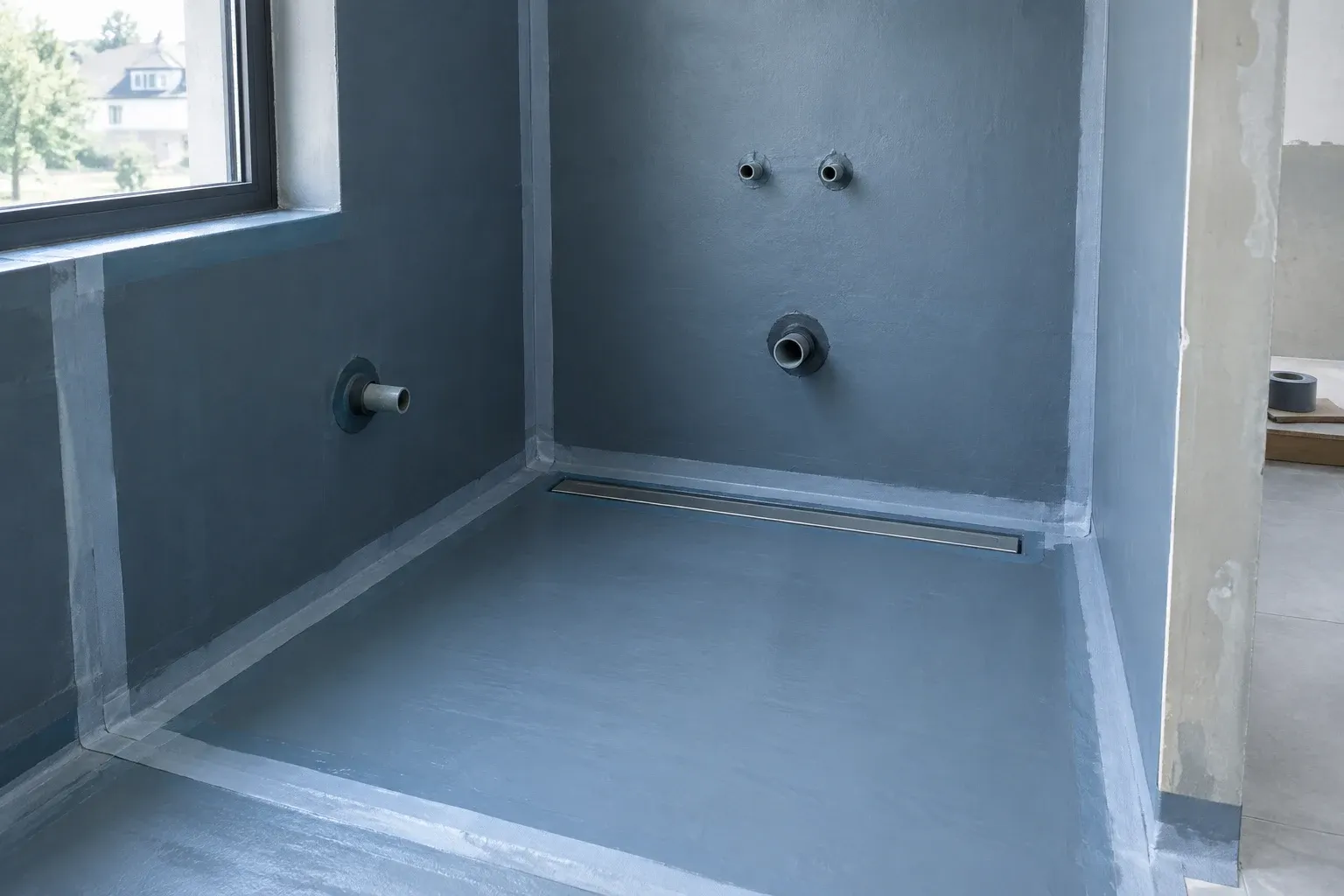
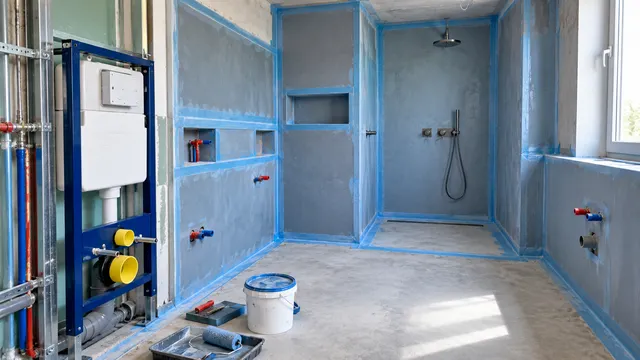
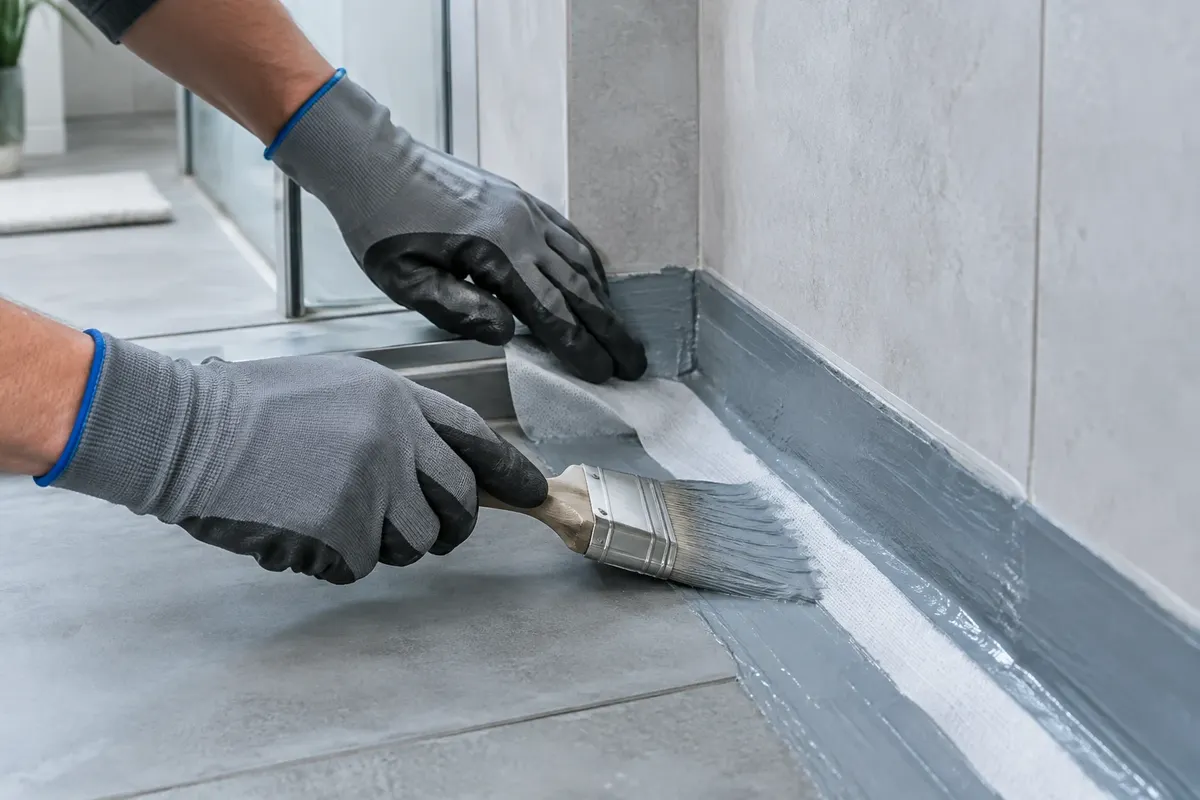
Illustrative image: shower under renovation coated with grey-blue liquid waterproofing membrane with tape in the corners
Where waterproofing is done and to what height is described in the chapter Waterproofing, with detailed information about the shower in the article Waterproofing shower enclosure. Here we focus on the material itself: what types of liquid waterproofing exist, how to read the technical data sheet, how much material is needed, and how to apply it.
Types of liquid waterproofing
Waterproofing coatings under tiles are described by standard EN 14891. They are distinguished by composition, and you can recognise them on the packaging by their markings, for example, CM for cement and DM for dispersion.
| Single-component dispersion | Two-component cement | |
|---|---|---|
| Example | Ceresit CL 51 | Ceresit CL 50 |
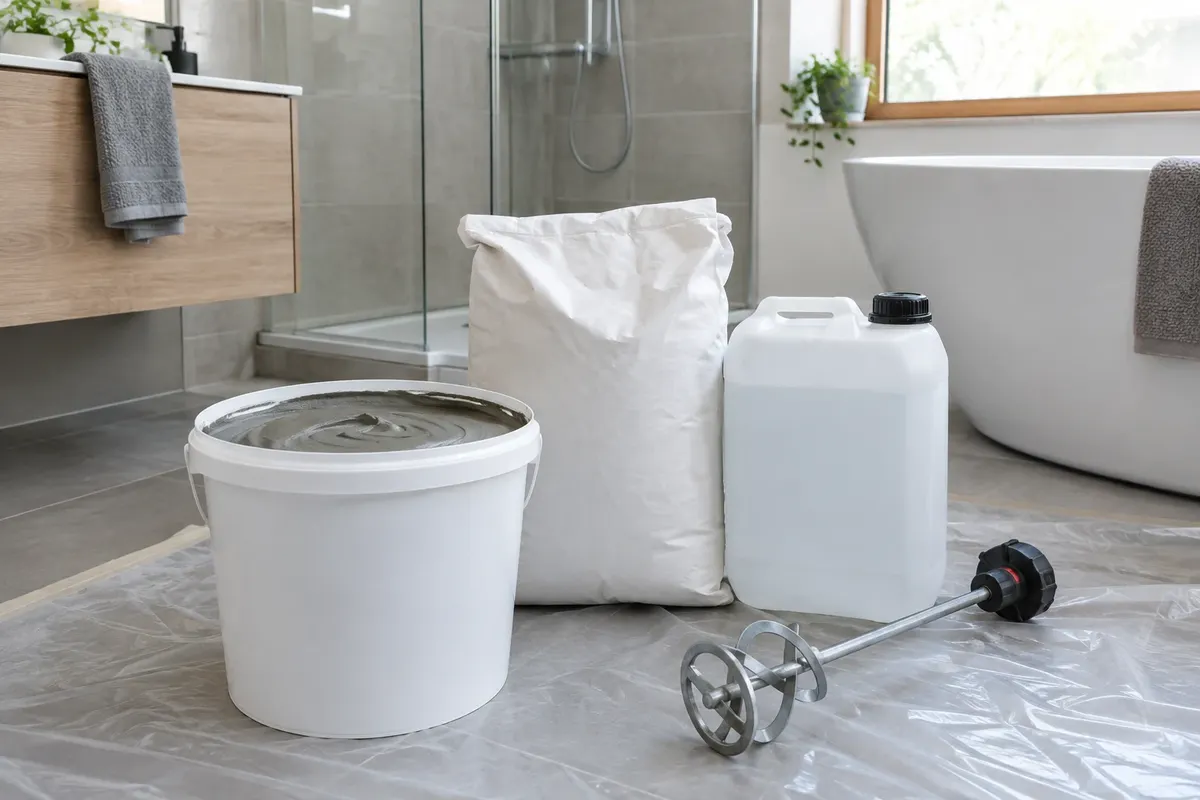
| Preparation | ready, just mix | powder and liquid component are mixed |
| Where | walls and floor of the bathroom, shower with tray | level-access shower, recessed drain, balcony, terrace, pool |
| Bridging cracks | CL 51 at least 0,75 mm | CL 50 up to 2,5 mm |
| Consumption | CL 51 around 1,1 kg/m² for two layers | CL 50 1,65 kg/m² for each 1 mm of dry layer |
Ceresit recommends two-component CL 50 for showers with recessed drains. There are also reactive waterproofings based on resins – these are used more for special requirements and must be applied exactly according to the manufacturer.
How to read the technical data sheet
- Consumption and thickness – how many kilograms per square metre and what thickness of dry layer is required. Ceresit CL 51 is applied in at least two layers with a total thickness of around 1 mm. For CL 50, one layer is a maximum of 1 mm, and at least 1.4 mm of dry layer is required for balconies.
- Drying – for CL 51, the second layer is applied approximately after 1.5 to 2 hours, and tiling can be done approximately after 4 hours. In cold and damp conditions, the times are extended.
- Working temperature – CL 51 is applied at temperatures from +5 to +25 °C.
- Waterproofness and adhesion – CL 51 indicates waterproofness at a pressure of 0.15 MPa after 7 days and adhesion of at least 0.5 MPa.
- System – which tapes, sleeves, and adhesives the manufacturer specifies for the coating. Ceresit indicates tapes CL 82 and CL 152 for them.
Data varies between manufacturers. The technical data sheet of the product you are purchasing always applies.
How much material to buy
Calculate the area of the floor, the height to the walls, and the walls in the shower. Example for a bathroom with a floor area of 5 m², height to walls of 1 m², and a shower with two walls of 1.2 × 2.0 m:
| Area | m² |
|---|---|
| floor | 5,0 |
| height to walls | 1,0 |
| shower walls 2 × 1,2 × 2,0 m | 4,8 |
| total | 10,8 |
With a consumption of CL 51 around 1.1 kg/m² for two layers, that's approximately 12 kg. Add a buffer for uneven substrates and losses. If the shower floor is made of a two-component membrane, calculate it separately based on its consumption. Consumption is also a check – if you have half a bucket left after the whole bathroom, the layer is probably thinner than it should be.
Application procedure
- Substrate – solid, level, dry, and dust-free. For absorbent substrates, plasterboard or aerated concrete, apply primer according to the system.
- First layer with a roller, brush, or trowel in one direction.
- Insert tapes, corner fittings, and sleeves into the fresh first layer – in corners, at the junction of the wall and floor, around outlets and drains – and cover them with the membrane.
- Second layer crosswise after the manufacturer's specified technological break.
- Check and tiling – after drying, check the surface and adhere the wall tiles with the adhesive specified by the manufacturer for the membrane.
How to work with plasterboard in the bathroom is described in the article Plasterboard in the bathroom, the entire sequence of work in the article Bathroom renovation – procedure.
What to look for when buying
- Marking according to EN 14891 on the packaging or in the technical data sheet.
- Complete system from one manufacturer – membrane, primer, tapes, sleeves, and adhesive.
- Quantity – area times consumption from the technical data sheet and buffer.
- Two colours of layers – with some membranes, the second layer differs in colour from the first, which makes checking easier.
- Storage – protect dispersion membranes from frost, and for two-component products, maintain the mixing ratio.
- Time – include drying in the schedule, the tiler cannot tile immediately.
What to ask the tiler after waterproofing is described in the chapter Waterproofing.
Check before tiling
- a continuous surface without holes, bubbles, and uncovered areas,
- tapes in corners and sleeves completely covered with the membrane,
- with two-colour membranes, an even colour of the second layer,
- the material used corresponds to the area.
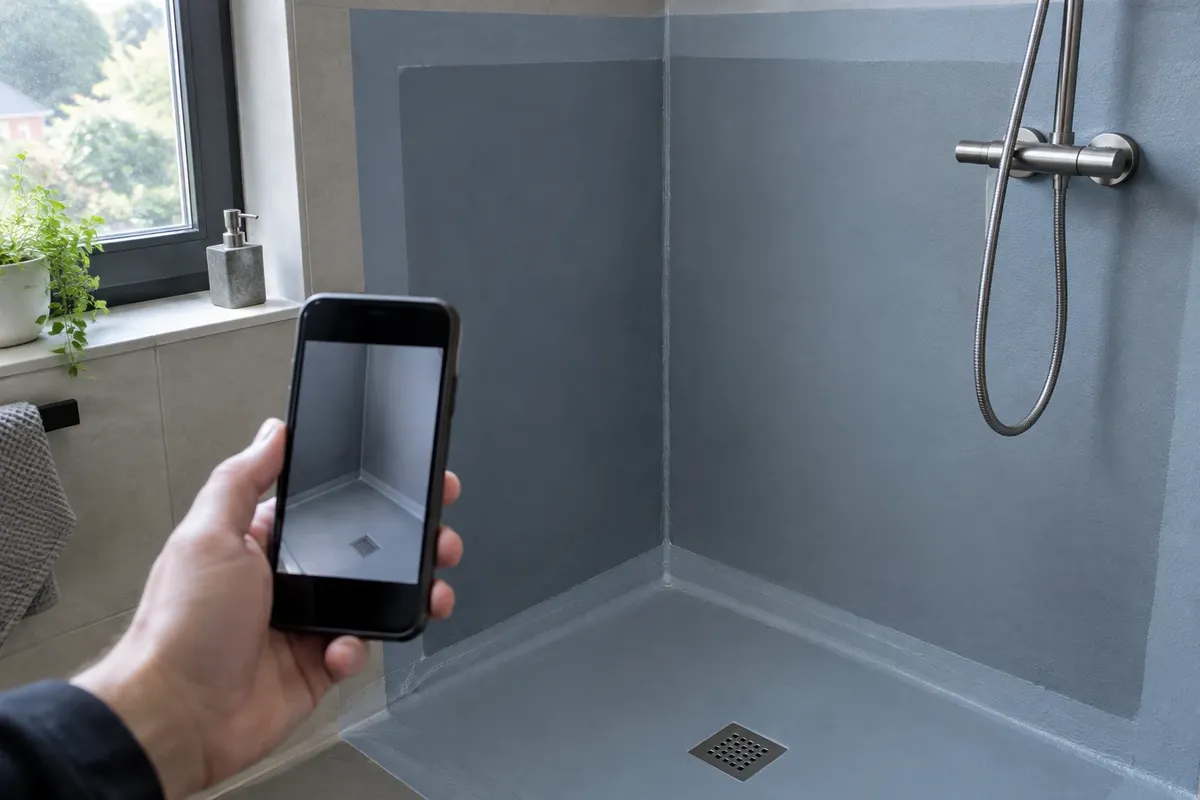
Take photos of the entire surface and details – this is the only moment when the waterproofing can be checked, and the photos will be useful for any claims.
How to carry out waterproofing outside on a balcony and terrace – with fall, edge profiles, and expansion joints – is described in the article Waterproofing a terrace and balcony.
Common mistakes
- One thick layer instead of two – it dries poorly and may easily retain pores.
- No tapes in corners – the corner moves and the membrane will crack.
- Material saving – a thinner layer than specified in the technical data sheet.
- Single-component membrane for level-access shower, where the manufacturer recommends a two-component one.
- Materials from different manufacturers – the membrane, tapes, and adhesive may not work together.
- Tiling too soon before the layer dries, or working in cold conditions.
Sources: EN 14891 (liquid waterproofing products applied under tiles), technical data sheet Ceresit CL 51 (STN EN 14891:2009 – two layers around 1 mm, consumption around 1.1 kg/m², cracks at least 0.75 mm, +5 to +25 °C, waterproofing 0.15 MPa, adhesion 0.5 MPa) and Ceresit CL 50 (1.65 kg/m² for 1 mm, layer maximum 1 mm, balconies 1.4 mm, cracks up to 2.5 mm, tapes CL 82 and CL 152); our chapters and articles Waterproofing, Shower waterproofing, and Wet bathroom.
Terms in the glossary: Waterproofing · Liquid waterproofing membrane · Shower tray · Linear shower drain · Moisture-resistant plasterboard · Primer
Frequently Asked Questions
What liquid waterproofing for the bathroom?
For the walls and floor of the bathroom, a single-component dispersion plaster is sufficient, for example, Ceresit CL 51. For a level-access shower, with a recessed drain, and on balconies, a two-component cement one, for example, Ceresit CL 50.
How many layers of waterproofing are needed?
At least two. The second is applied crosswise after the technological break indicated by the manufacturer.
How much waterproofing to buy?
Multiply the area in m² by the consumption from the technical data sheet and add a reserve. For example, with CL 51 at 1.1 kg/m² for two layers, you need about 12 kg for 10.8 m².
When can tiles be laid on waterproofing?
According to the technical data sheet. With Ceresit CL 51, approximately after 4 hours, later in cold and damp conditions.
Is a primer needed under the waterproofing?
Yes, for absorbent substrates, plasterboard, and aerated concrete – according to the manufacturer's system for the coating.
Can waterproofing be applied to plasterboard?
Yes, on moisture-resistant plasterboard after priming according to the manufacturer's system. The joints of the boards should be sealed with tape, and then two layers of the coating are applied.
What is EN 14891?
European standard for liquid waterproofing products applied under tiles. It specifies tests and markings, for example, CM for cement and DM for dispersion coatings.
AI Advisor
Have a question on the topic? Ask the advisor – they will respond based on TGB Kúpeľne articles.
AI advisor – answers are generated by artificial intelligence from TGB Kúpeľne articles and may contain errors.
Bathroom design
These are tips. We will draw your bathroom for you.
In the 3D bathroom planner, you can design your bathroom yourself for free. We will prepare a custom visualisation with specific wall tiles for you in the studio – free of charge with your purchase.
Online design for free Custom visualisation
TGB Kúpeľne Studio · Bratislavská 71, Senec · Map