Planning and design
Boiler for the bathroom: what volume (50, 80, 120 l), electric, combined or dual-purpose
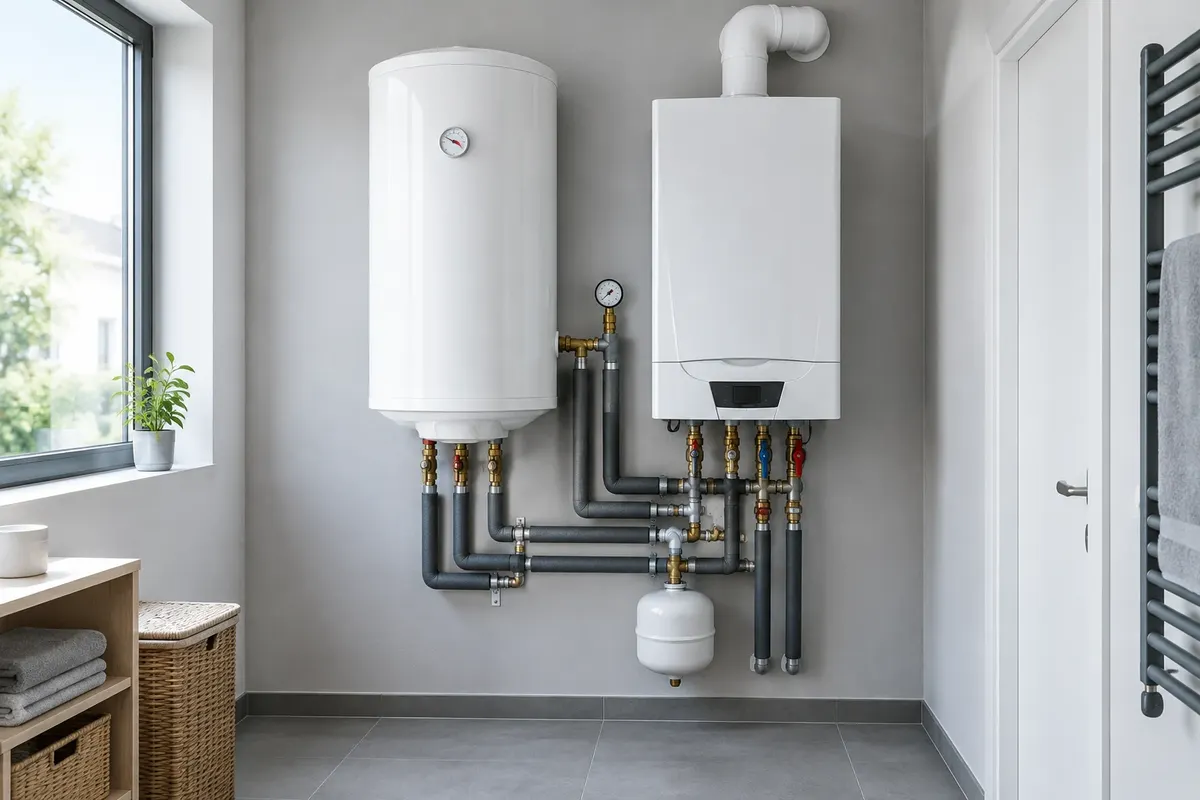
A boiler, or storage water heater, is chosen based on how much hot water the household consumes and how you want to heat it. For two people with a shower, 50 to 80 litres is often sufficient, for a family of four 80 to 120 litres, and with a bath 120 to 150 litres. An electric boiler heats in low tariff, a combined (dual-purpose) one heats from the boiler in winter and with electricity in summer.
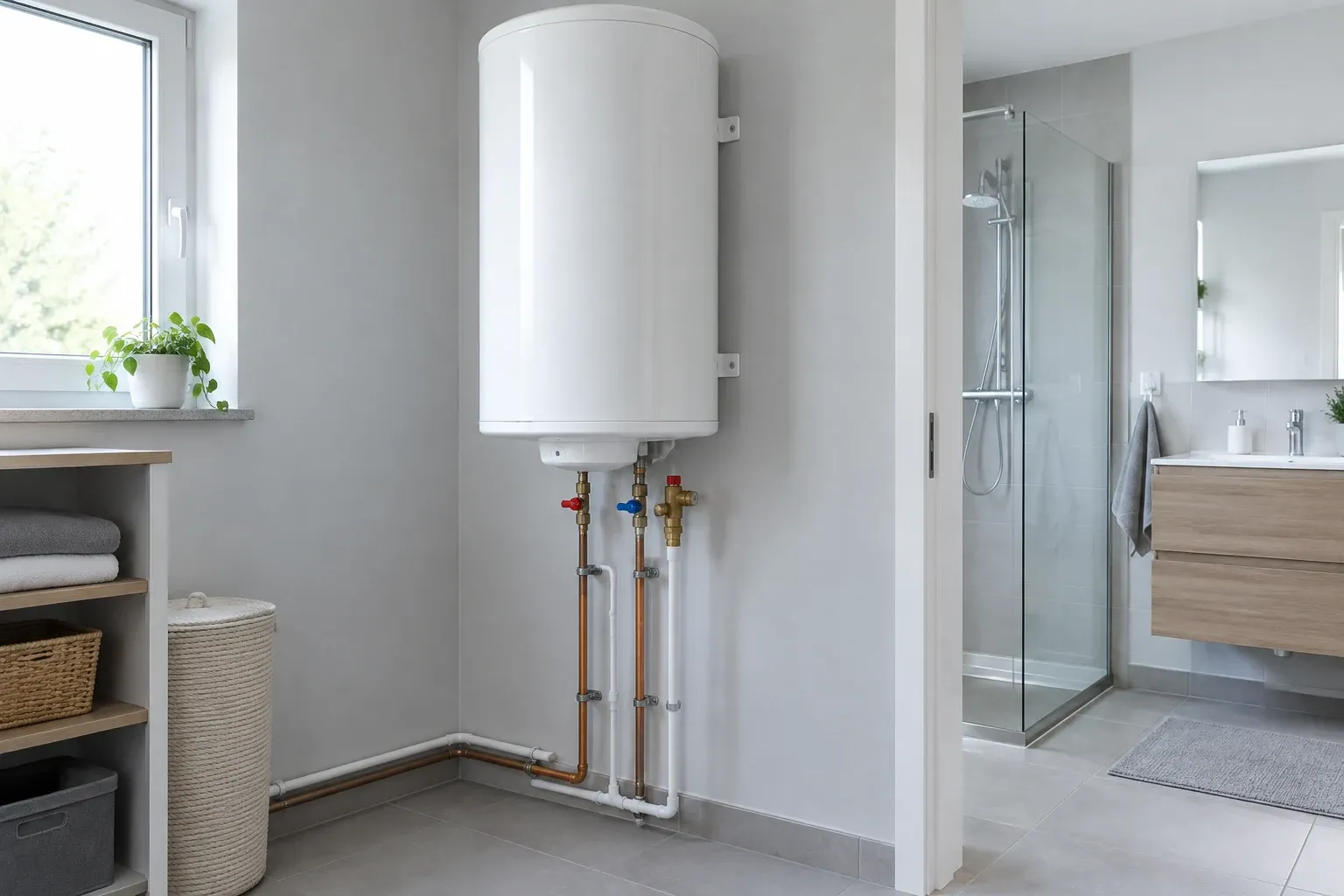
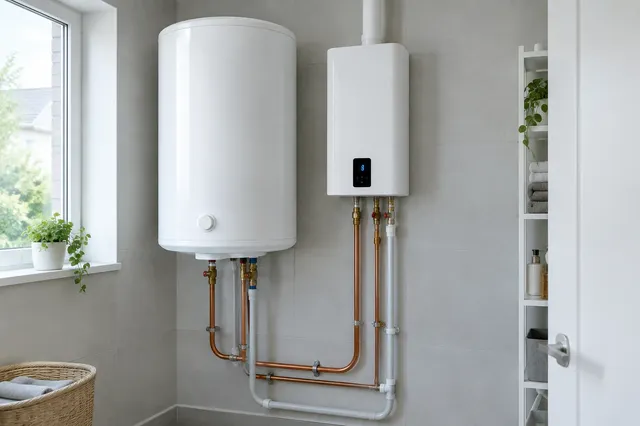
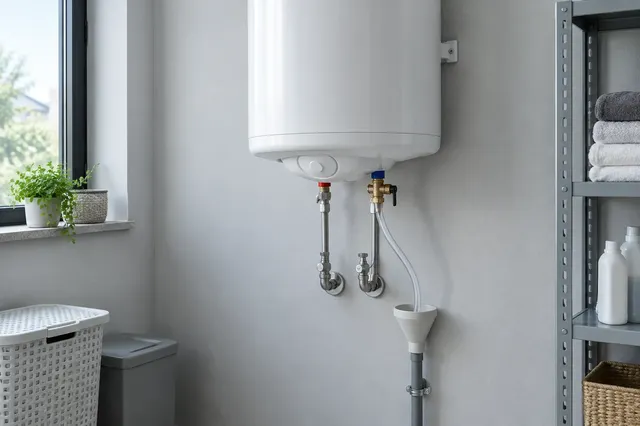
Illustrative image: White electric boiler mounted on the wall of the technical room next to the bathroom
A boiler is changed once every many years. A boiler that is too small is insufficient for a family shower in the morning, while one that is too large unnecessarily heats water and takes up more space. The number of people, bath, heating and wall space are decisive.
Types of water heaters
| Type | How it heats | When it suits |
|---|---|---|
| electric storage boiler | the electric heater heats the water supply, most often in low tariff | flat or house without a boiler that would heat the water |
| combined boiler (dual-purpose) | electric element and heat exchanger connected to the boiler | house or flat with its own boiler – heating in winter, electricity in summer |
| indirectly heated storage tank | only the heat exchanger from the boiler or heat pump, standing on the floor | family house with a technical room |
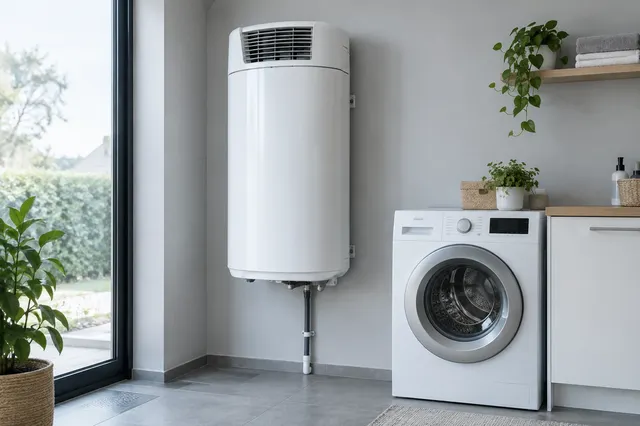
| boiler with a heat pump | takes heat from the air, electricity assists in heating | house with space and air from which the pump can draw heat |
| instantaneous water heater | heats only when water is drawn, has no storage | one draw-off point, cottage, supplement to the boiler |
| small heater above or below the sink | storage for example 5 or 10 l | sink in the WC, kitchen sink far from the boiler |
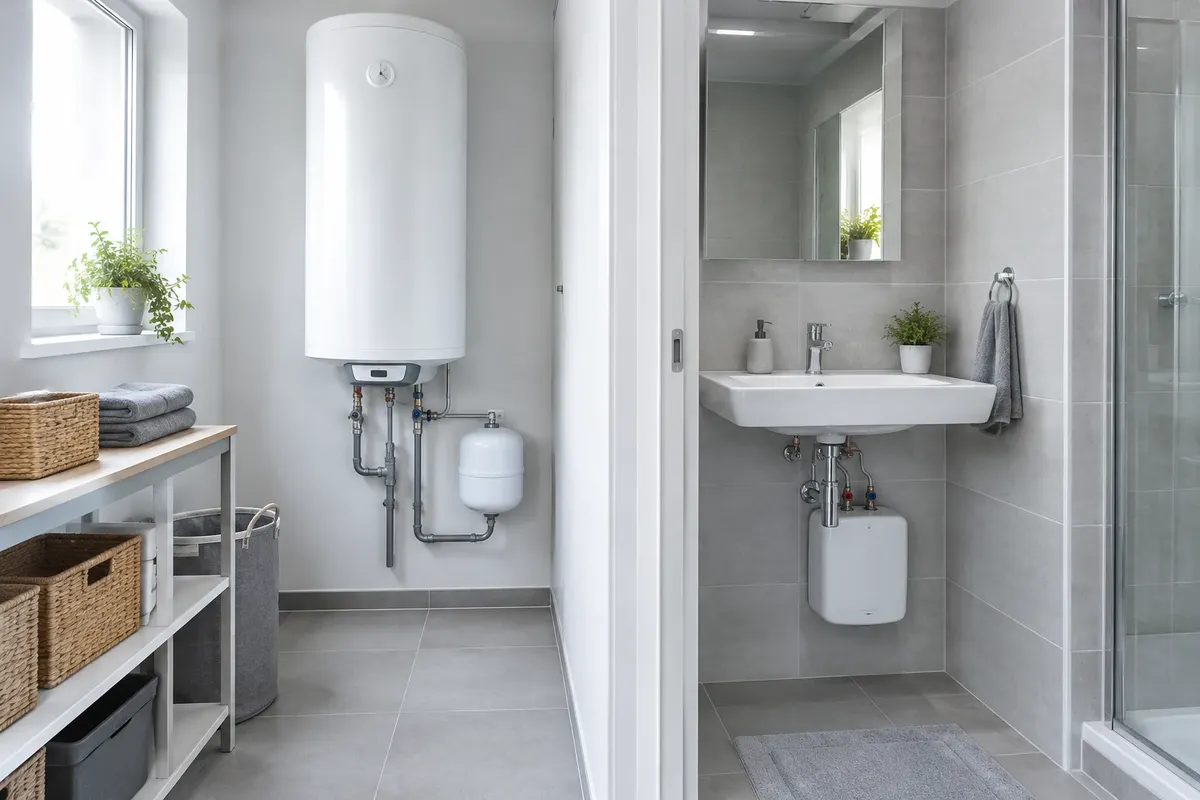
What volume of boiler: 50, 80 or 120 litres
The manufacturer of heaters Tatramat (Stiebel Eltron) states that for showering one person, you need to account for 30 to 50 litres of water at 40 °C. However, in the boiler, you have hotter water, usually around 60 °C, and you mix it with cold in the tap. If the cold water is 10 °C, from one litre of water at 60 °C, you get approximately 1.7 litres of water at 40 °C. From an 80-litre boiler, that’s about 130 litres of water for showering.
| Household | Approximate boiler volume | Note |
|---|---|---|
| 1 – 2 persons, shower | 50 – 80 l | two showers a day consume 60 to 100 l of water at 40 °C |
| 3 persons, shower | 80 – 100 l | with a reserve for washing dishes by hand |
| 4 persons, shower enclosure | 80 – 120 l | Tatramat's recommendation for 8-hour low tariff |
| 4 persons, bath and shower | 120 – 150 l | Tatramat's recommendation, a filled bath consumes a lot of hot water at once |
The table is indicative. If you bathe in the bath every day or take long showers, choose a larger volume. Manufacturers also state the so-called amount of mixed water at 40 °C – for example, with the 150-litre heater Tatramat EO 150 EL, it is 288 litres. You can find this information in the technical sheet and it is useful for comparing different boilers. How to save hot water in the shower and at the sink is described in the article How to save water in the bathroom.
How long does heating take and how much energy does it consume
To heat 80 litres of water from 10 to 60 °C, it takes approximately 4.7 kWh, for 120 litres about 7 kWh. Electric boilers Tatramat series EOV with a volume of 50 to 150 litres have an element with a power of 2,000 W, so they heat 80 litres in about 2.3 hours and 120 litres in 3.5 hours – in reality, it takes a bit longer because some heat is lost. Therefore, the electric boiler is connected to a low tariff: distribution rates with accumulated water heating usually have a low tariff for about 8 hours a day, which is sufficient for heating a standard boiler. Which rate suits your draw-off point will be advised by your electricity supplier.
Consumption is also influenced by insulation. On the energy label according to EU regulation No. 812/2013, you will find the energy efficiency class, load profile, and annual consumption – based on these, you can compare boilers of the same volume.
Combined boiler – dual-purpose
Dual-purpose is a colloquial term for a combined boiler. In addition to the electric element, it has a tubular heat exchanger through which water from the central heating boiler flows. When heating in winter, the boiler heats the water, in summer it is heated by electricity, and the boiler does not need to run for hot water. When choosing, pay attention to:
- Connection side of the heat exchanger – left or right connection depending on where the heating pipes come to the boiler.
- Vertical or horizontal installation – combined boilers are made in both configurations, for example, the Q-term TREND HKM series is horizontal with a volume of 80 to 200 litres.
- Connection and regulation – connection to the boiler and setting the priority heating of water is handled by the heating engineer.
If you have a boiler or heat pump in the technical room and space on the floor, consider an indirectly heated storage tank. All the water is then heated from the heating source and the bathroom remains without a boiler on the wall.
Where to place the boiler
- As close as possible to the draw-off point – the shorter the pipe to the shower, the sooner hot water flows and the less water you waste.
- On a solid wall – a full 80-litre boiler weighs more than 80 kilograms just with water, plus you need to add the weight of the heater. Do not hang it on a drywall installation wall without reinforcement, more in the article Drywall in the bathroom.
- Horizontal boiler is suitable where there is little height, for example above doors or in the attic. Horizontal installation must be approved by the manufacturer – vertical boilers are generally not allowed to be installed horizontally.
- Access for service – you need to access the body and anode from below, so do not place a cabinet too close under the boiler.
- Electricity – the boiler is connected permanently. The placement in the bathroom regarding the zones near the bath and shower will be assessed by an electrician according to STN 33 2000-7-701.
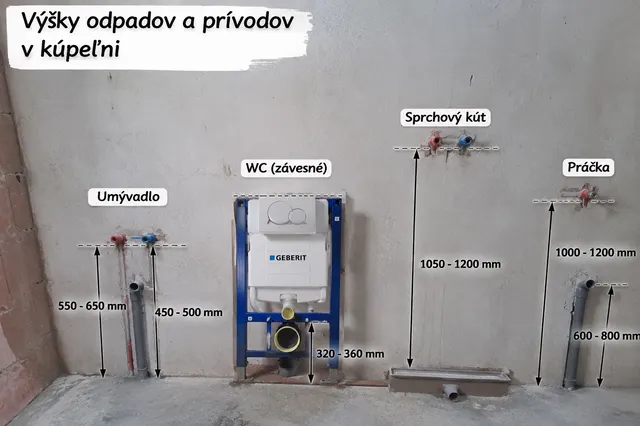
You can find the heights of water supply and waste in the bathroom in the article Heights of waste and water supply.
Safety: safety valve and temperature 60 °C
A pressure boiler must have a safety valve on the cold water inlet, which releases excess pressure during heating. It is normal for water to drip from it occasionally – therefore, it requires drainage to waste. Never close or remove the valve.
The World Health Organization (WHO) recommends heating and storing hot water at 60 °C to prevent the growth of legionella bacteria. If you set the boiler lower, at least occasionally let it heat to 60 °C. However, water at this temperature can scald – in a family with children or seniors, you will appreciate a thermostatic mixer that maintains a safe temperature. We describe the selection in the article Shower mixer.
How to maintain a boiler – safety valve, magnesium anode, limescale and draining before winter – described in the article Boiler maintenance.
Instantaneous water heater instead of a boiler
An instantaneous water heater heats water only when you turn it on, so it has no storage and never 'runs out'. However, it requires a high power – a heater for the entire shower is usually three-phase and the electricity supply is designed by an electrician. A small instantaneous water heater or a mixer with heating is suitable for one sink, more in the article Instantaneous mixer with heating. In a cottage where you are only for a few days, an instantaneous water heater is often more practical than a boiler – see Bathroom in the cottage and summer house.
When is a flow heater sufficient and when is a storage tank better? We discuss this in the article Flow heater or boiler. How a boiler with a heat pump works, where to place it, and what to expect from it is described in the article Boiler with heat pump.
What to look for when choosing
- volume and amount of mixed water at 40 °C from the technical sheet,
- dimensions – the diameter or width and height must fit the wall where the boiler will be,
- tank and anode – enamelled tanks are protected by a magnesium anode, which needs to be checked and replaced according to the instructions,
- power rating of the unit and energy label,
- warranty conditions – some manufacturers extend the warranty on the tank with regular anode checks.
On the e-shop vkupelni.sk you will find the category Water heaters and boilers – storage and combination boilers, instantaneous heaters, and heat pump boilers from brands Mora, Metalac, Pyramis, Hakl, Mereo, Ariston, Cata, and Hansa. We will advise you on choosing a mixer and shower for your new boiler at our studio in Senec at Bratislavská 71.
Common mistakes
- Boiler by price, not by consumption – a small boiler is not sufficient for a family of four in the morning.
- Vertical boiler horizontally – if the manufacturer does not allow it, the boiler will not function properly and you will lose the warranty.
- Closed safety valve – a valve that cannot release pressure is dangerous.
- Forgotten anode – without checking the anode, the tank is at risk of corrosion.
- Boiler far from the shower – you wait for hot water and waste cold water.
Sources: Tatramat (Stiebel Eltron) – consumption of 30 to 50 l of water at 40 °C for showering, recommended volumes for a four-person household, technical data for the EOV and EO 150 EL series; World Health Organization (WHO) – recommendation to store hot water at 60 °C; EU regulation No. 812/2013 (energy labels for water heaters); STN 33 2000-7-701; Mora and Q-term catalogues. The calculation of energy for heating is a physical estimate without losses. For a specific boiler, the manufacturer's instructions apply.
Terms in the glossary: Moisture-resistant plasterboard · Installation wall · Thermostatic mixer
Frequently Asked Questions
What size boiler for 4 people?
For a shower, 80 to 120 litres, if you have both a bath and shower, 120 to 150 litres. This is recommended by the manufacturer Tatramat for heating in an 8-hour low tariff.
Is a 50-litre boiler sufficient?
For one to two people showering, often yes. For a shower, you need to account for 30 to 50 litres of water at 40 °C and 50 litres of water at 60 °C gives approximately 80 litres when mixed.
What is a dual-purpose boiler?
A colloquial term for a combined boiler. It has an electric heater and a heat exchanger connected to the boiler, so in winter it heats water from the heating system and in summer with electricity.
How long does it take to heat an 80-litre boiler?
To heat 80 litres from 10 to 60 °C takes approximately 4.7 kWh. With a 2,000 W heater, it takes about 2.3 hours, practically a bit longer.
What temperature should the boiler be set to?
The World Health Organization recommends storing hot water at 60 °C to prevent legionella growth. A thermostatic mixer helps prevent scalding.
Can water drip from the safety valve?
Yes, during heating the valve releases excess pressure, so it should have a drain to waste. Never close the valve.
AI Advisor
Have a question on the topic? Ask the advisor – they will respond based on TGB Kúpeľne articles.
AI advisor – answers are generated by artificial intelligence from TGB Kúpeľne articles and may contain errors.
Bathroom design
These are tips. We will draw your bathroom for you.
In the 3D bathroom planner, you can design your bathroom yourself for free. We will prepare a custom visualisation with specific wall tiles for you in the studio – free of charge with your purchase.
Online design for free Custom visualisation
TGB Kúpeľne Studio · Bratislavská 71, Senec · Map