Taps and showers
Non-pressure faucet: which heater it belongs to and how to choose it
Small water heaters above or below the sink are often non-pressurised – water flows out of them through the open outlet of the tap. Such a heater is only compatible with a non-pressurised, also called low-pressure tap. A standard pressurised tap would expose the tank to water supply pressure, for which it is not designed. We will explain the difference, types for installation above and below the sink, and what to look for when purchasing.
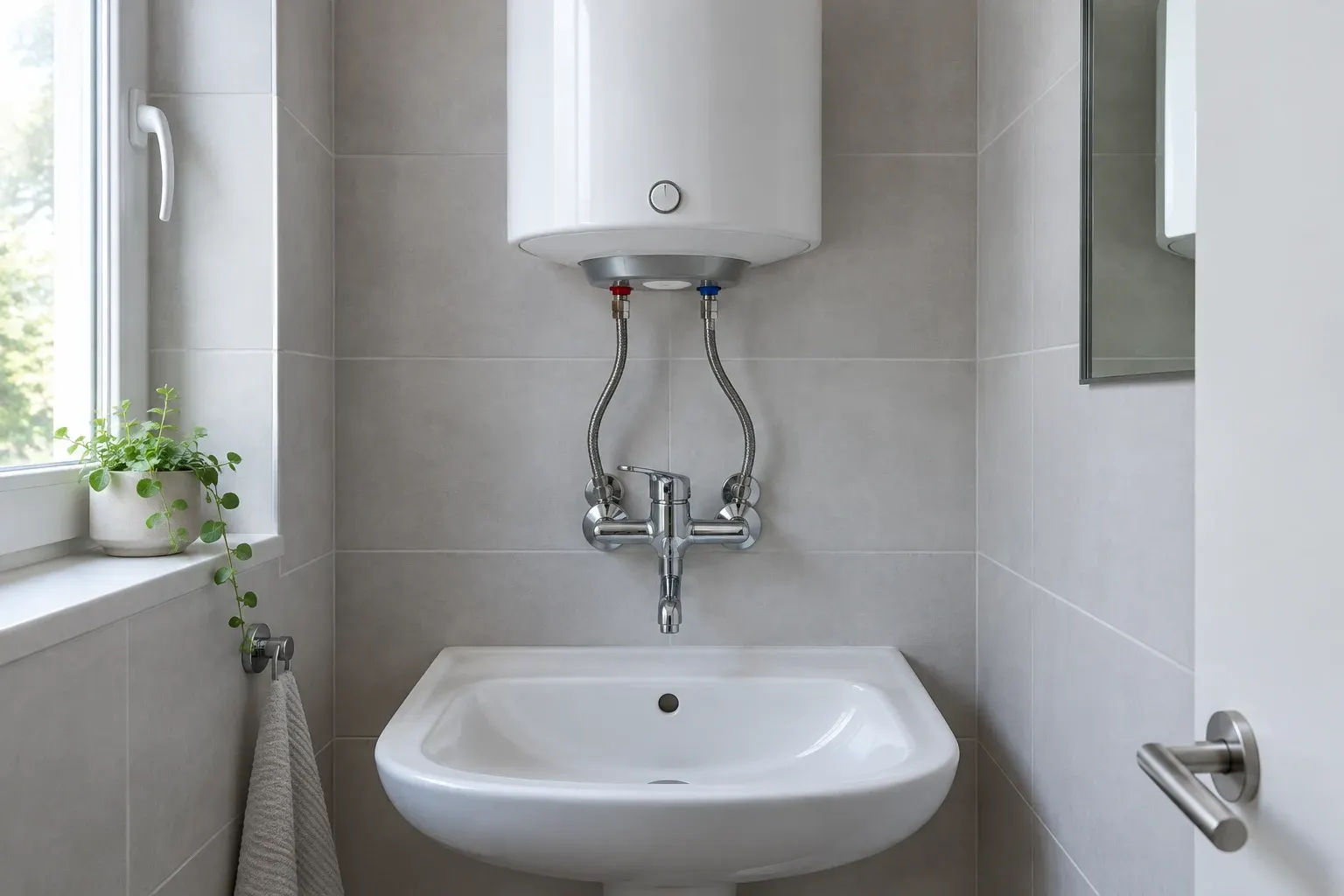
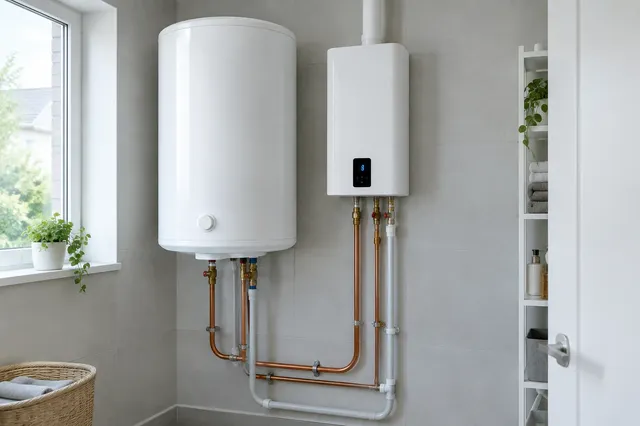
Illustrative image: small water heater above the vanity unit with a non-pressurised tap
A non-pressure heater is typical for a WC with a sink, kitchenette, workshop or cottage where there is no hot water supply. We discuss which heater to choose in the article Instantaneous heater or boiler. Here we address the mixer, without which the non-pressure heater does not operate safely. We compare standard sink mixers in the article Bath and sink mixer.
How a non-pressure mixer works
In a standard pressure mixer, the entire system and boiler are under water pressure, and the mixer simply releases water. With a non-pressure heater, it is the opposite. The mixer is connected to cold water from the mains and holds the pressure within itself. When you open the hot water, it allows cold water into the heater, which pushes hot water out through the mixer outlet. The heater is thus always open to the outlet, and there is no mains pressure in the tank.
Therefore, two rules apply: the heater may only be connected to a mixer designed for non-pressure heaters, and the mixer outlet must never be closed. Eliz specifies for the EURO 5 and 10 heaters that the non-pressure heater must be connected exclusively to a special non-pressure mixing mixer supplied by the manufacturer and must not be connected to a mixer of another type. Mora stipulates for the BTOM heaters that only a free-flowing mixer with an open outlet is permitted.
Non-pressure or pressure mixer: the difference
| Non-pressure mixer | Pressure mixer | |
|---|---|---|
| what it belongs to | small non-pressure heater above or below the sink | boiler, furnace or hot water supply |
| inlets | cold water from the mains, two hoses to the heater | cold and hot water from the system |
| pressure in the heater | none, the outlet is open | mains pressure |
| outlet | must not be blocked or extended with a hose | without restriction |
| safety valve | not needed, the heater is not under pressure | mandatory for the boiler |
Types: above sink and below sink
- Heater above the sink – wall-mounted mixer under the heater or pillar mixer with hoses going up to the heater. Manufacturers label these mixers as mixers for heaters above the draw-off point.
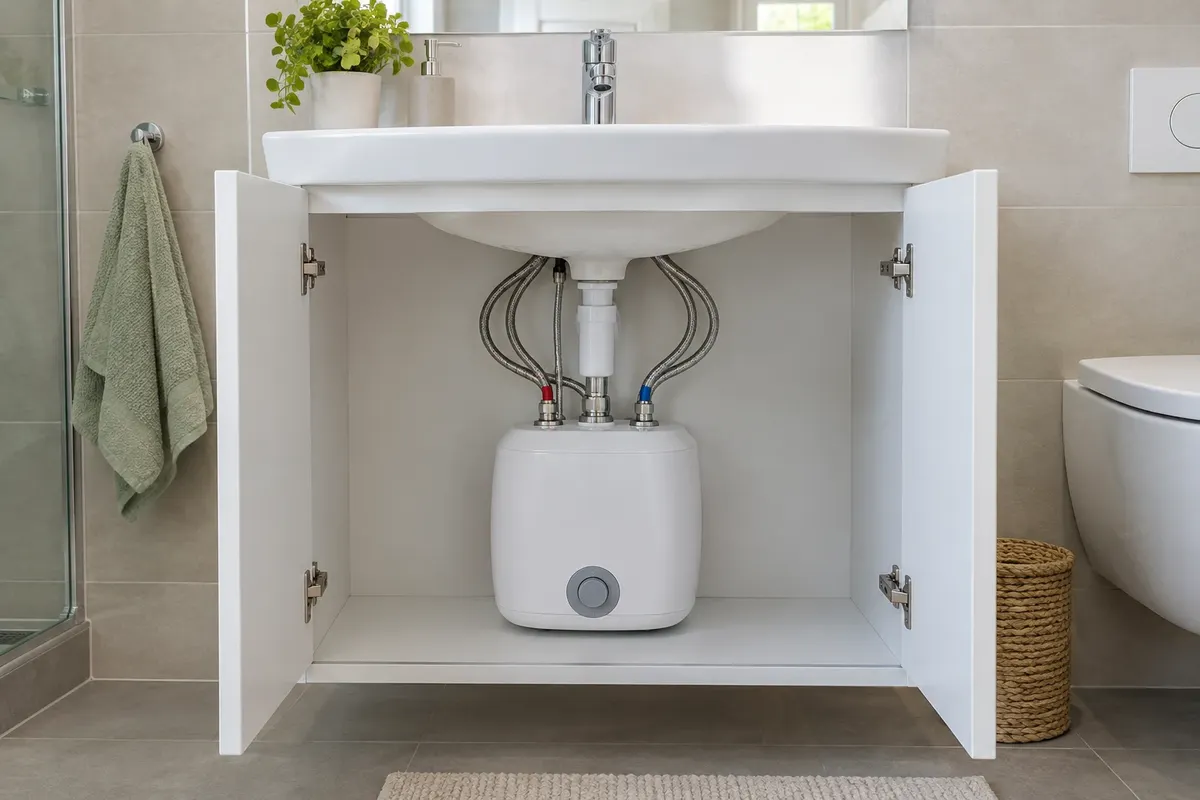
- Heater below the sink – pillar mixer on the sink or worktop with three hoses: cold water supply and two hoses to the heater in the cabinet.
- Tap or single-lever – for example, Eliz supplies EURO heaters with a tap mixer and PB models with a single-lever mixer.
- Sink or basin – for basins, there is usually a higher swivel arm.
Mora warns with its heaters that depending on whether the non-pressure heater is above or below the sink, a suitable mixing mixer must be used. Therefore, choose the type of mixer according to the specific heater's instructions.
What to look for when buying
- Heater instructions – if the manufacturer specifies its mixer, buy it. For example, Eliz explicitly prohibits the use of a mixer of another type.
- Heater location – a mixer for a heater above the sink is not the same as for a heater below it.
- Outlet arm – only that which is supplied with the mixer or heater. Manufacturers explicitly prohibit blocking the outlet or attaching a hose to it.
- Aerator – a clogged aerator slows drainage and pressure can build up in the heater. Clean it regularly, more in the article Limescale on the mixer.
- Size and reach – the length of the arm should reach the centre of the sink or basin.
On vkupelni.sk, for example, there is a three-way low-pressure sink mixer from Deante for the heater for €86.35 (as of November 2026). Deante recommends such mixers where there is no central hot water supply, for example in cottages.
Installation: what to watch out for
- Flush the system before installation to prevent dirt from blocking the mixer.
- Connect the hoses exactly according to the instructions – for example, with Eliz, the hose from the red tap of the mixer goes to the blue inlet of the heater and from the blue tap to the red outlet. The hoses must not cross.
- First fill the heater – open the hot water and wait until water flows from the outlet. Only then turn it on.
- Check the tightness of the connections and the function of the mixer.
- Electrical connection is done by an electrician according to the instructions and zones in the bathroom.
Dripping and other phenomena that are not a fault
- Dripping from the outlet during heating – water expands when heated and the excess drips from the mixer outlet. The EO 10 heater instructions state that this is due to the design and is not a fault.
- Dripping after closing – a little water may still flow out for a while after the outlet is opened.
- Weaker flow of hot water – a small instantaneous heater provides about 2 l/min at a heating of 25 °C, more in the article Instantaneous heater or boiler.
If water continues to flow from the outlet even when not heating, have the sealing or cartridge of the mixer checked. Before winter, drain the heater in an unheated cottage – the heater below the sink should be removed and turned with the pipes down according to the EO 10 instructions. We describe how to winterize the entire bathroom in the article Bathroom in a cottage and summer house.
Sources: instructions for Eliz EURO 5 and 10 (only supplied low-pressure tap, connection of hoses, outlet must not be blocked), Mora BTOM (flow tap with open outlet, tap according to installation above or below the sink), Tatramat EO 10 (outlet without hose, dripping during heating, winter drainage), ETA – instructions for taps for low-pressure heaters (installation above and below the draw-off point), instructions for small low-pressure flow heaters (outlet arm, flow), Deante BEZ (low-pressure taps for heaters), offer from vkupelni.sk (November 2026); our articles Bath and sink tap and Kitchen tap.
Terms in the dictionary: Aerator · Cartridge
Frequently Asked Questions
What is a non-pressurised tap?
A tap for a small non-pressurised water heater. It stops the water supply pressure inside and when the hot water is opened, it lets cold water into the heater, which pushes the hot water out through the open outlet. Thus, there is no water supply pressure in the heater.
Can I use a standard tap with a non-pressurised heater?
No. A pressurised tap would expose the tank to water supply pressure, for which it is not designed. Manufacturers only specify the supplied or designated non-pressurised tap, for example, Eliz explicitly prohibits taps of another type.
Why does water drip from the non-pressurised tap?
When heating, the water in the heater expands and the excess drips from the tap outlet. This is due to the design and is not a fault. If water continues to flow even without heating, have the seal or cartridge checked.
What is the difference between a tap above and below the sink?
For a heater above the sink, the tap is below it with hoses going up, for a heater below the sink, a standing tap with three hoses into the unit. Choose the type according to the heater's instructions.
Can I attach a hose or aerator to the outlet?
No hose – manufacturers explicitly prohibit blocking or extending the outlet with a hose, as this would create pressure in the heater. Regularly clean the aerator that is part of the tap to ensure water flows freely.
How much does a non-pressurised tap cost?
On vkupelni.sk, for example, a three-way low-pressure sink tap Deante for the heater is priced at €86.35 (as of November 2026). Often, the tap is included in the heater's packaging.
AI Advisor
Have a question on the topic? Ask the advisor – they will respond based on TGB Kúpeľne articles.
AI advisor – answers are generated by artificial intelligence from TGB Kúpeľne articles and may contain errors.
Bathroom design
These are tips. We will draw your bathroom for you.
In the 3D bathroom planner, you can design your bathroom yourself for free. We will prepare a custom visualisation with specific wall tiles for you in the studio – free of charge with your purchase.
Online design for free Custom visualisation
TGB Kúpeľne Studio · Bratislavská 71, Senec · Map