Taps and showers
Sensor Tap: When It’s Worth It, Power Supply and Maintenance
The sensor tap releases water when you place your hands under it and stops automatically. It is especially useful in guest WCs, in businesses, and where taps are not meant to be touched with dirty hands. It can be powered by batteries, a lithium cell, or mains power via an adapter – for mains power, you need a socket under the sink, which an electrician will connect. Choose a model with temperature control if you do not have pre-mixed water under the sink.
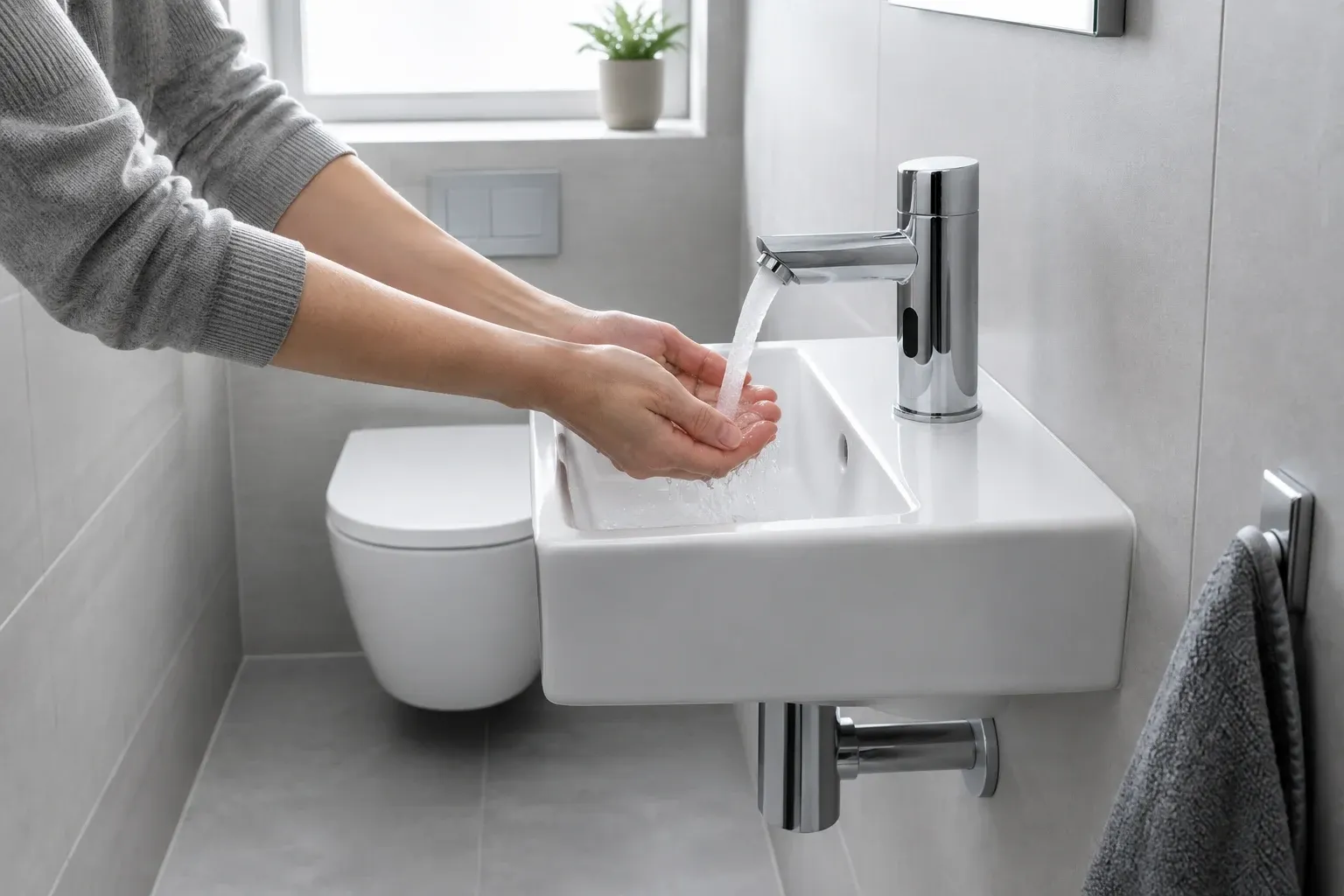
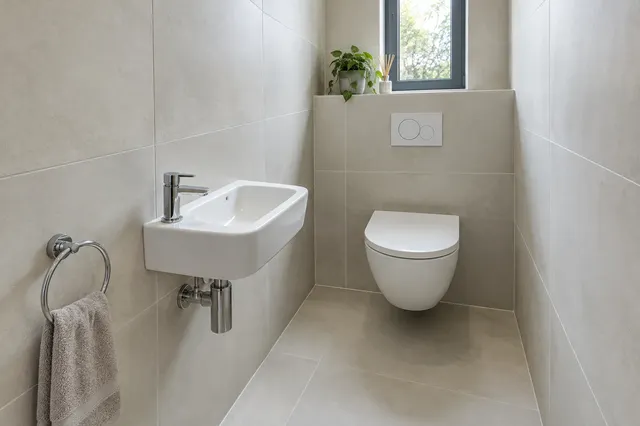
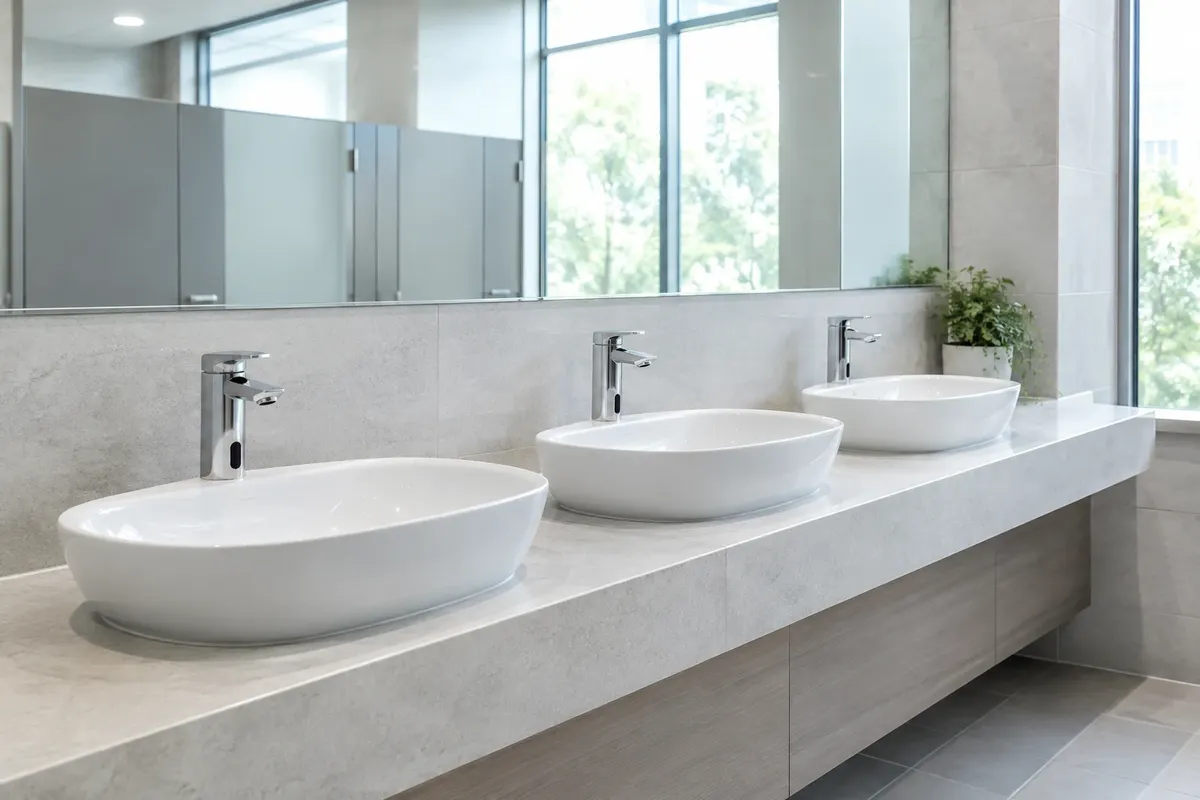
Illustrative image: touchless basin tap in the guest WC, hands under the flow of water
Touchless mixers are familiar from airports, shopping centres, and restaurants. However, they are increasingly appearing in homes – in guest WCs, children's bathrooms, or at the sink in the hallway. You don't need to touch the lever, water doesn't flow unnecessarily, and the mixer is easier to keep clean. On the downside, it requires power and costs more than a standard single-lever mixer. In the article, you'll find how a sensor mixer works, when it's worth it, what power supply options and temperature settings are available, and how to maintain it.
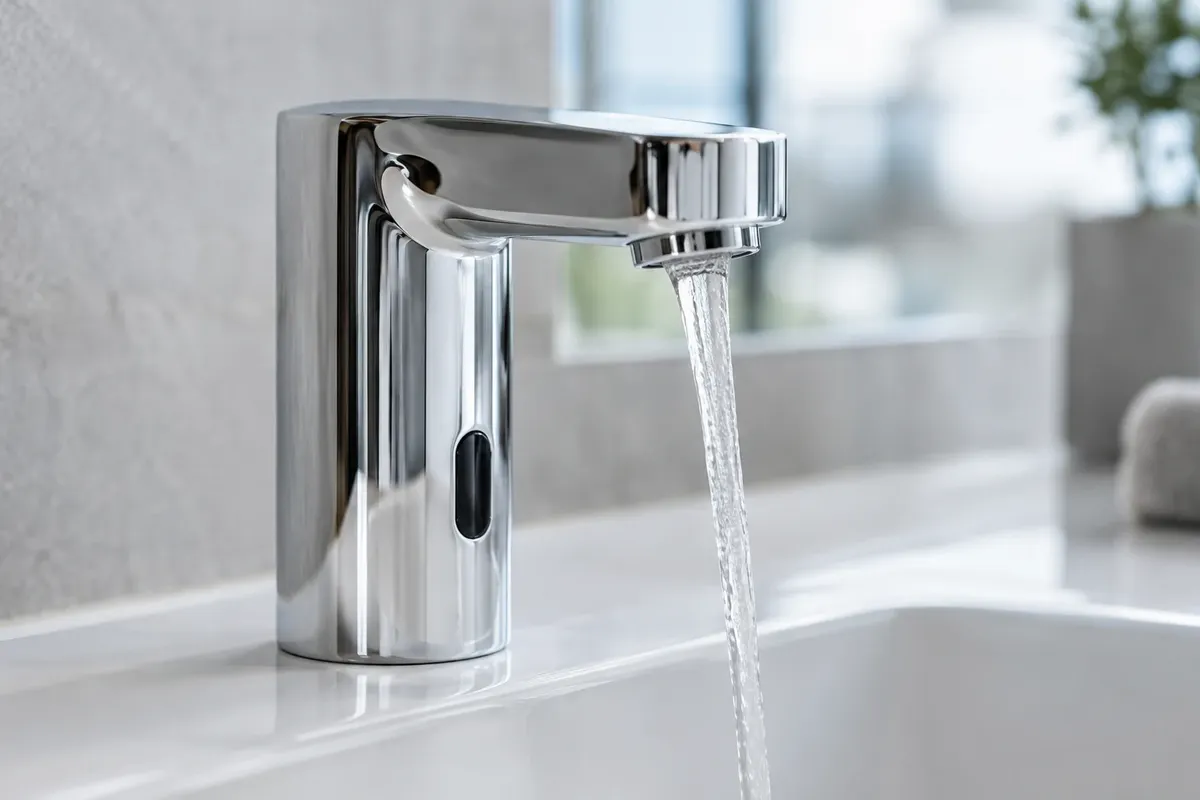
How a sensor mixer works
Inside the mixer, there is a sensor that detects hands under the spout. The control electronics then open the valve, and water flows until you remove your hands. When the hands are gone, the valve closes. Manufacturers also add safety features – for example, Grohe's Get E series stops the water after 60 seconds, even if the sensor still detects something, and has a 3-minute cleaning mode during which the mixer won't release water while wiping.
When is it worth it
| Location | Is it worth it? | Why |
|---|---|---|
| Guest WC, sink in the hallway | yes | guests do not need to touch the lever, water does not flow unnecessarily |
| company, office, clinic, operation | yes | hygiene, less forgotten running water |
| family with small children | yes | children won't let the water run, they wash their hands themselves |
| seniors, weaker hand grip | yes | no need to press or turn the lever, suitable for wheelchair-accessible bathrooms |
| main sink in the family bathroom | rather not | brushing teeth and shaving are more comfortable with a lever and constant flow |
| sink for filling containers | no | the sensor reacts to hands, not to filling a bucket |
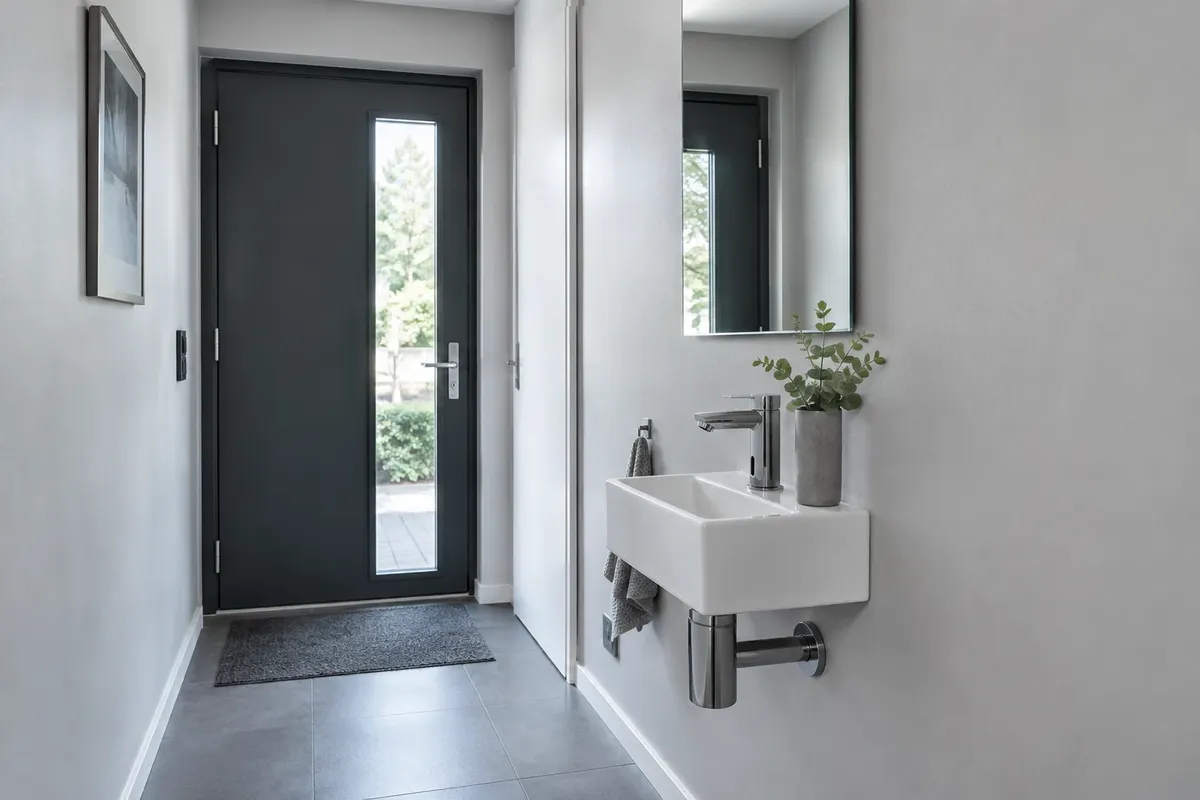
At home, a sensor mixer makes the most sense at the second sink – in the WC or hallway, where only hands are washed. You can find out how to choose a sink for the WC in the article Sink for WC.
Power supply: batteries or mains
| Power supply | Example | Advantage | What to consider |
|---|---|---|---|
| AA batteries | SAPHO 6 V (4 × AA) | no socket under the sink, installation anywhere | battery replacement |
| lithium battery 6 V | Grohe CR-P2 | long lifespan – Grohe states around 7 years with 150 uses per day | replacement CR-P2 type battery |
| mains adapter 230/6 V | Deante Sense | no battery replacement | socket or supply under the sink, water does not flow during a power outage |
| source 24 V DC | SAPHO 24 V | for multiple mixers in one operation | electrical installation project |
For households, the simplest model is battery-operated. There's no need to cut the wall for electricity supply, and you can install it when replacing an old single-lever mixer. Mains power is suitable for a new bathroom where the socket under the sink is planned before tiling.
Water temperature
A touchless mixer does not have a lever to mix hot and cold water. Temperature is managed in three ways:
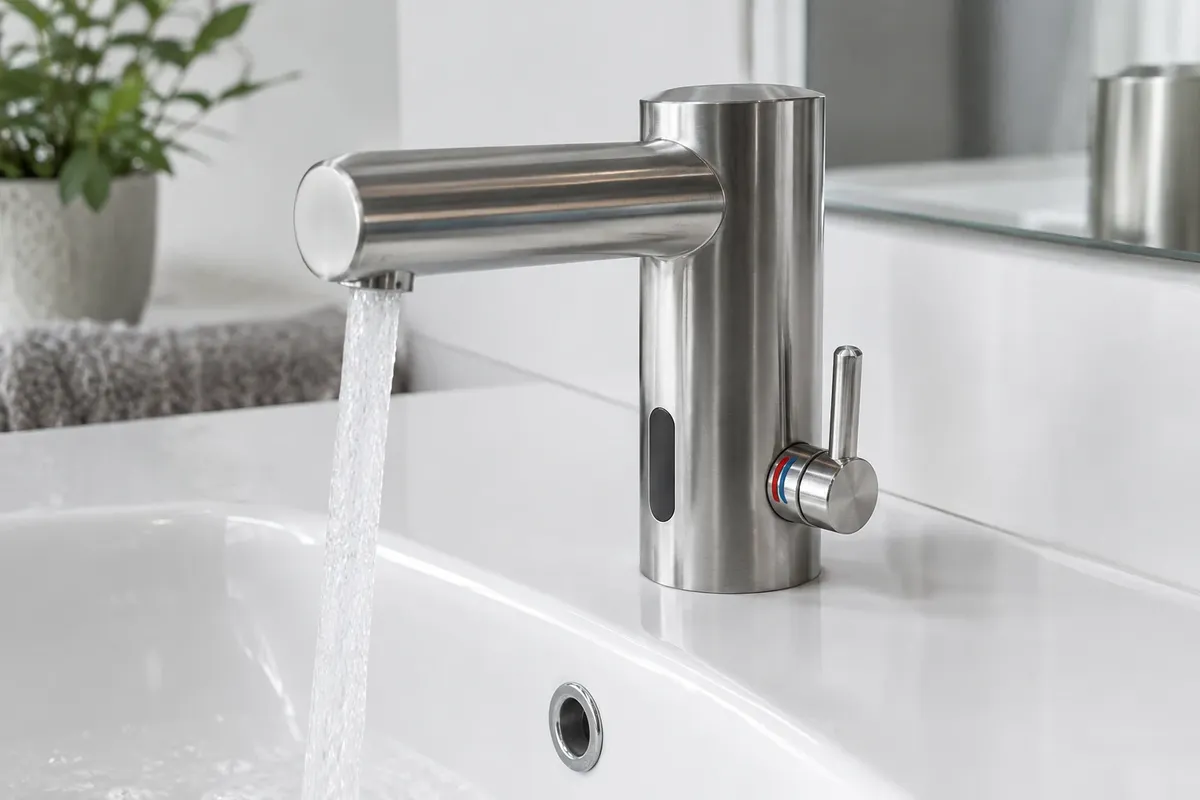
- Temperature control on the mixer – a small lever or knob on the side. You set it once and then just place your hands under the spout. This is how SAPHO PS204 or Deante Sense works, for example.
- Pre-mixed water – there is a thermostatic mixing valve under the sink that prepares water at the set temperature. Grohe manufactures touchless mixers in versions for cold or pre-mixed water.
- Only cold water – in operations and WCs without hot water.
When regulating at the mixer, consider children and seniors: if the lever is set to hot water, the next user may not notice. Grohe's Eurosmart Cosmopolitan E series features a temperature limiter to prevent this.
What to consider during installation
- Water pressure – the electronic valve requires a minimum pressure. Grohe states at least 1.0 bar for the Eurosmart Cosmopolitan E. If the pressure in the house is low, check the specification sheet.
- Protection – the electronics are exposed to water in the bathroom. Grohe states IP59 protection for this series.
- Flow rate – Deante states a flow rate class Z for the Sense mixer, meaning 4 to 9 litres per minute, and backflow preventers.
- Height and sink – a stand mixer for a standard sink, tall for a countertop sink. For some sinks, you may need to adjust the sensor range according to the instructions to prevent the mixer from activating by itself.
- Wall version – requires a concealed part in the wall and preparation before tiling.
Maintenance
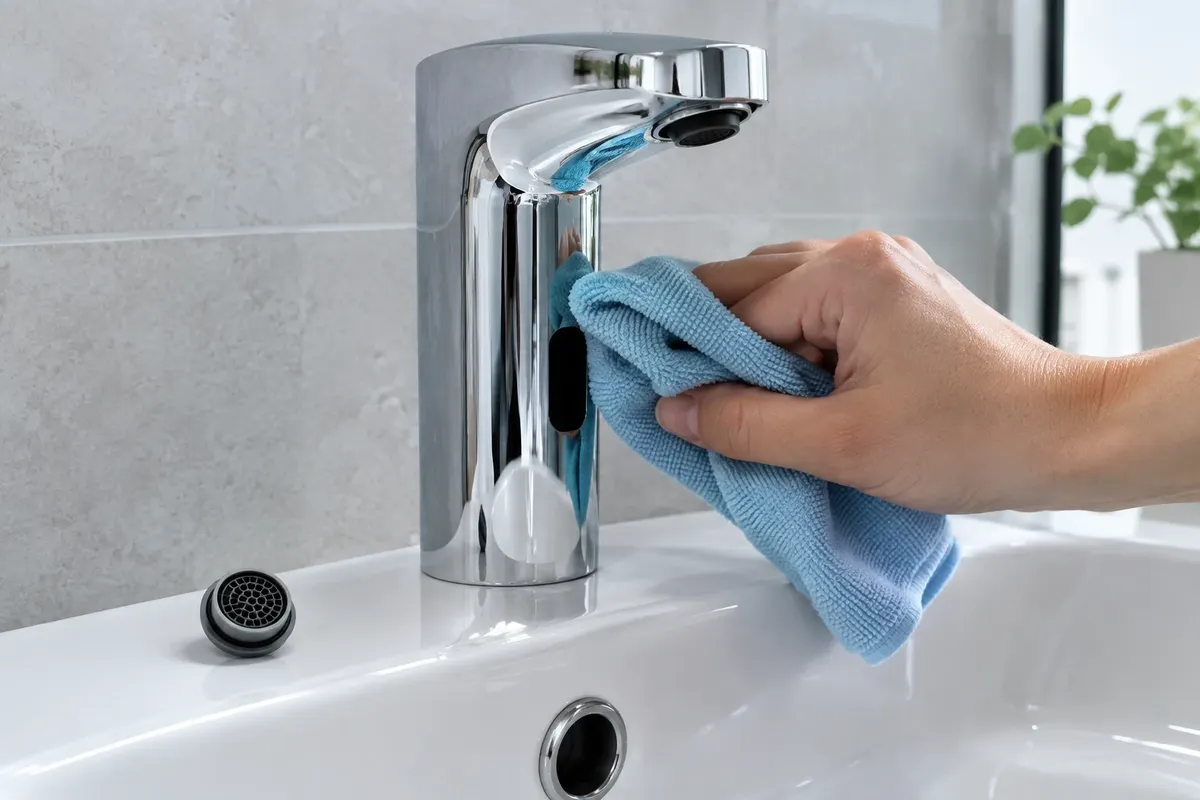
- Sensor window wipe with a soft cloth. Limescale or soap on the sensor may cause the mixer to respond slowly or release water on its own.
- Occasionally unscrew the aerator and clean it of limescale. Deante specifies an M24 threaded aerator for Sense.
- Replace the mixers when the water flows weakly or the sensor responds slowly. Use the type specified by the manufacturer.
- Cleaning agents – only mild, without abrasives and acids that could damage the surface and the sensor window.
How to clean the aerator and what to do when the mixer drips can be found in the guide Dripping mixer.
Examples of prices at vkupelni.sk
| Mixer | Power supply | Price (November 2026) |
|---|---|---|
| SAPHO countertop | 6 V, 4 × AA | 134,99 € |
| SAPHO PS204 with temperature control | 6 V, 4 × AA | 158,99 € |
| Deante Sensor | according to the technical sheet | 227,43 € |
| Deante Sense with temperature control | 230/6 V | 250,20 € |
| SAPHO freestanding | 24 V DC | 257,99 € |
| SAPHO wall-mounted | 6 V | 398 € |
In the category Sensor mixers, there are 35 mixers from brands Deante, SAPHO, Nofer, Creavit, and Bruckner available on vkupelni.sk. Deante offers a 7-year warranty on the Sense mixer, while SAPHO offers 2 years on the PS204. Prices are indicative and may change.
Advantages and disadvantages
| Advantages | Disadvantages |
|---|---|
| touchless – more hygienic | higher price than a single-lever mixer |
| water does not flow unnecessarily, it stops by itself | requires batteries or electricity |
| easy for children and seniors | temperature is set differently than with a lever |
| the mixer and sink stay cleaner | with mains power, no water flows without electricity |
Common mistakes
- Mains mixer without a prepared socket under the sink.
- Mixer without temperature control connected only to hot water.
- Sensor mixer at the main sink where teeth are brushed and shaving is done.
- Clogged sensor window and aerator – the mixer then responds unreliably.
- Replacement batteries of a different type than specified by the manufacturer.
Common sink, bath, and shower mixers are compared in the article Bath and sink mixer, kitchen mixers in the article Kitchen mixer. All articles about mixers can be found in the section Shower systems and mixers. You can also view the mixers at the TGB Kúpeľne studio in Senec.
Sources: technical data from Grohe (lithium battery 6 V CR-P2 lasting around 7 years with 150 uses per day; Get E – stops after 60 s, 3-minute cleaning mode; Eurosmart Cosmopolitan E – minimum pressure 1.0 bar, IP59 rating, temperature limiter, versions for cold or pre-mixed water), Deante Sense (power supply 230/6 V, temperature regulation, flow class Z 4 to 9 l/min, check valves, aerator M24, 7-year warranty), SAPHO (power supply 6 V, 4 × AA, PS204 with temperature regulation, 2-year warranty), prices and quantities from vkupelni.sk (category Sensor taps, November 2026).
Terms in the dictionary: Barrier-free shower · IP rating · Aerator
Frequently Asked Questions
How Does a Sensor Tap Work?
The sensor in the body of the tap detects hands under the spout and the electronics open the valve. When you remove your hands, the water stops. Some models also have a safety shut-off, for example, Grohe Get E after 60 seconds.
What powers the touchless tap?
With AA batteries (for example, SAPHO 6 V, 4 × AA), a 6 V lithium battery (Grohe CR-P2 with a lifespan of about 7 years at 150 uses per day) or mains power via a 230/6 V adapter (Deante Sense).
Is a sensor tap worth it at home?
Especially in guest WCs, at a washbasin in the hallway, in families with small children, and for seniors. For the main washbasin, where you brush your teeth and shave, a single-lever mixer is more convenient.
How is the temperature set on a touchless tap?
With a lever or button on the side of the tap, or pre-mixed water from a thermostatic valve under the sink. In models without regulation, only the water that is connected flows.
Why does the sensor tap release water on its own or not respond?
The most common reason is a dirty sensor window or weak batteries. Wipe the window with a soft cloth, replace the batteries, and check the sensor range settings according to the instructions.
How much does a sensor tap cost?
On vkupelni.sk, for example, SAPHO battery-operated tap costs €134.99, with temperature control €158.99, Deante Sense with mains adapter €250.20 (November 2026).
AI Advisor
Have a question on the topic? Ask the advisor – they will respond based on TGB Kúpeľne articles.
AI advisor – answers are generated by artificial intelligence from TGB Kúpeľne articles and may contain errors.
Bathroom design
These are tips. We will draw your bathroom for you.
In the 3D bathroom planner, you can design your bathroom yourself – for free and without registration. If you want assurance, we will prepare a photorealistic custom visualisation based on actual dimensions and specific tiles in the studio. It's free with a purchase.
Online design for free Custom visualisation
TGB Kúpeľne Studio · Bratislavská 71, Senec · Mon–Fri 8:00–12:00 and 12:30–17:00, Sat 9:00–12:00 · Map