Small bathrooms and types of bathrooms
Bathroom in the basement: drainage, pumping, humidity, and light
In the basement, the biggest issue is drainage. If the sewage connection is lower than the basement floor, waste flows by itself. If it is higher, a pumping unit is needed. A small unit behind the toilet may only be used for one toilet in the same room, and only if there is another toilet in the house above the level of backflow. Additionally, moisture, ventilation, heating, and light must be addressed.
The basement offers space that is lacking on the upper floors – for a guest bathroom, a shower by the workshop or garage, a laundry room, or a shower by the gym. However, an underground bathroom has three specific tasks: drainage that may not flow by itself, moisture from the walls, and limited natural light. If you address these in advance, a basement bathroom functions just as well as any other.
Drainage: does it flow by itself, or does it need pumping?
Wastewater needs a constant fall. It depends on where the sewage connection or pipe you will connect to is located:
| Situation | Solution |
|---|---|
| the connection is lower than the drains in the basement | gravity drainage with fall like on the upper floors |
| the connection is higher, with only a sink, shower, or washing machine in the basement | pumping unit for water without faeces (EN 12050-2) |
| the connection is higher, with one toilet in the basement and a sink, shower, or bidet in the same room, and another toilet in the house above | small pumping unit for limited use (EN 12050-3) |
| the connection is higher, with multiple toilets in the basement or an entire flat unit | pumping station for waste with faeces (EN 12050-1) |
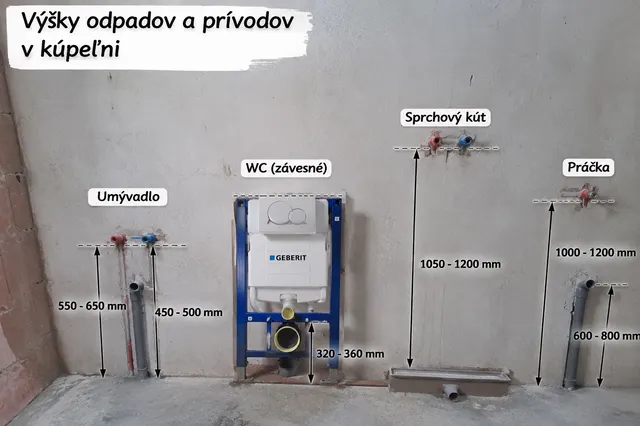
Which situation applies to your home will be verified by the designer or plumber based on the height of the connection and the location of the soil stack. You can find the heights of the drains for individual fixtures in the article Heights of drains and water supplies.
Small pumping unit behind the toilet
The small pumping unit is installed behind or next to the toilet and pumps waste upwards into the sewage system through a thin pipe. It is a convenient solution for one small bathroom, but standard EN 12050-3 limits it:
- it serves for one toilet to which it is directly connected, and a sink, shower, or bidet may go to it,
- the unit must be in the same room as the toilet and other connected fixtures,
- there must be another toilet above the level of backflow in the house – if the unit fails, you will have another toilet available.
The unit requires electricity, access for maintenance, and discharge piping according to the manufacturer's instructions – the discharge height and length of the pipe are determined by the specific product. During pumping, the pump can be heard, so do not place it behind a bedroom wall. An electrician will design the electrical supply, and a plumber will connect it.
Backflow: when sewage returns
During heavy rain or a blocked sewage system, water in the sewage can rise. Everything in the basement that is below the so-called level of backflow can be flooded. This level is determined by the designer or sewage operator – often considering the level of the terrain or street. Drains below this level must be protected with a backflow valve or pumping with a loop above the level of backflow. The solution is always up to the designer and plumber.
Moisture: first dry masonry
Neither wall tiles nor waterproofing will solve wet masonry. If the basement is damp, the cause must first be identified – missing insulation of the foundation, rising damp, or condensation – and eliminated. Only then can the bathroom proceed:
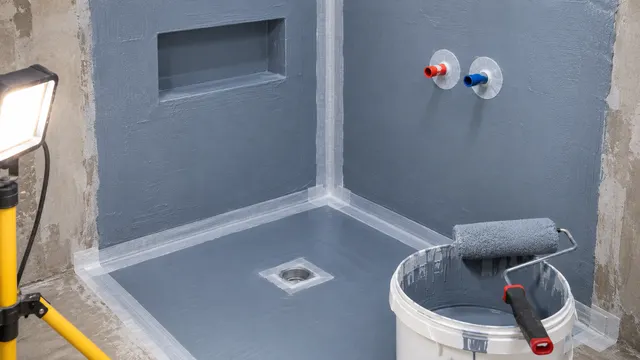
- Waterproofing in the shower and around the bath as in any bathroom – the process is described in the article Waterproofing the shower enclosure.
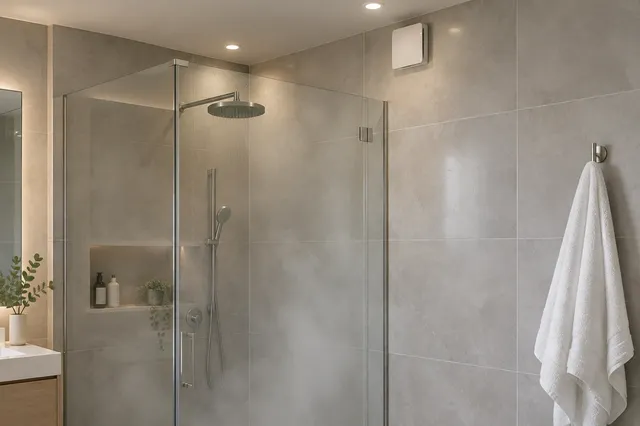
- Ventilation – basement bathrooms often lack windows. A fan with a hygrostat or timer will expel steam outside. The performance is calculated by the fan performance calculator, and the selection is described in the article Bathroom fan.
- Heating – cold walls attract condensation. Underfloor heating or a heated towel rail will keep surfaces warmer. The performance is estimated by the radiator performance calculator.
Light and ceiling height
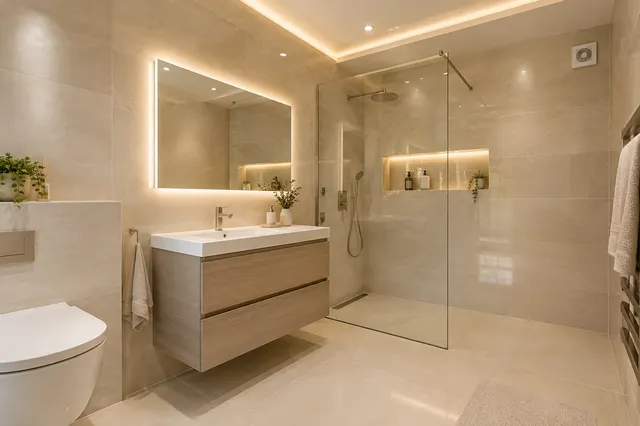
There is little or no natural light in the basement. Light wall tiles, a matte or slightly glossy surface that diffuses light, and good artificial lighting at several levels – general light, light at the mirror, and ambient light for the evening will help. More in the article Bathroom lighting. With a lower ceiling, check the height of the shower – an overhead shower and glass wall need their centimetres. Installation heights are described in the article Height of the shower mixer.
What suits the basement
- Shower instead of bath – less water to pump out and less space. For a level-access shower, the height for the fall must be considered; if the floor cannot be raised, choose a low shower tray.
- Utility room – the basement is ideal for laundry. Recommendations and layouts can be found in the article Laundry in a family house.
- Floor drain – if the drainage allows, it will secure the basement in case of water leakage from the washing machine or shower.
- Slip-resistant floor tiles – R10 for the bathroom, R11 or class B for level-access showers. Parameters are explained in the article Floor tile parameters.
How to handle a bathroom without a window can also be found in the article Bathroom without a window. You can see wall tiles and sanitary ware live at the store in Senec at Bratislavská 71. On the e-shop vkupelni.sk, you will find floor drains and bathroom fans. Waste, pumping, electricity, and insulation of the basement should always be designed and carried out by a professional.
Procedure: what to address in what order
- Waste – check the height of the sewer connection and decide whether gravity drainage is sufficient or if pumping is needed.
- Moisture – identify the cause of the damp masonry and eliminate it, then continue.
- Electricity – supply for the pumping device, fan, heating, and lighting will be designed by an electrician.
- Pipework and floor – waste with fall, water supply, underfloor heating, and drain.
- Waterproofing and tiling – waterproofing in the shower and around the bath, then wall and floor tiles.
- Installation – sanitary ware, mixers, fan, and lights, finally testing the pumping and waste.
Most common mistakes in the basement
- tiling on damp masonry without eliminating the cause of moisture,
- small pumping device for multiple WCs or without another WC higher in the house,
- waste below the level of backflow without protection,
- bathroom without a fan and heating, where moisture condenses on cold walls.
Sources: EN 12050-1, EN 12050-2 and EN 12050-3 (pumping devices for buildings, scope of application according to CEN), our articles Heights of wastes and water supplies, Floor tile parameters (slip resistance) and Bathroom fan. Specific parameters for the pumping device are provided by its manufacturer.
Terms in the dictionary: Fall · Soil stack (riser) · Waterproofing · Hygrostat · Fan timer · Underfloor heating
Frequently Asked Questions
Can a bathroom be made in the basement without pumping?
Yes, if the sewer connection is lower than the waste in the basement and the waste has a constant fall. If the connection is higher, a pumping device is needed.
When is a small pumping device behind the toilet sufficient?
According to EN 12050-3, it serves for a maximum of one toilet in the same room, to which a sink, shower, or bidet can be connected. There must be another toilet above the level of backflow.
What is the level of backflow?
The height to which water can rise in the sewage system, for example during heavy rain. It is determined by the designer or the sewage operator, often considering the level of the terrain or street.
How to prevent moisture in a basement bathroom?
First, eliminate the cause of damp walls, then apply waterproofing in the shower, install a fan with a hygrostat, and heating to keep surfaces warmer.
Is a fan necessary in a basement bathroom?
Yes, a basement bathroom usually has no window or a small one. A fan with a hygrostat or timer will remove moisture after a shower.
Is the pumping unit noisy?
During pumping, the pump can be heard. Do not place it behind a bedroom wall and follow the manufacturer's installation and maintenance instructions.
Can a level-access shower be installed in the basement?
Yes, if there is enough height in the floor for fall and drainage, and the waste leads by gravity or to a pumping unit. If the floor cannot be raised, choose a low shower tray.
Where to place the pumping unit behind the toilet?
In the same room as the toilet, with access for maintenance and away from the bedroom, as the pump can be heard during pumping. Installation is done by a plumber according to the manufacturer's instructions.
What floor tiles for a basement bathroom?
Porcelain stoneware tiles with slip resistance R10, for a level-access shower R11 or class B for bare feet.
AI Advisor
Have a question on the topic? Ask the advisor – they will respond based on TGB Kúpeľne articles.
AI advisor – answers are generated by artificial intelligence from TGB Kúpeľne articles and may contain errors.
Bathroom design
These are tips. We will draw your bathroom for you.
In the 3D bathroom planner, you can design your bathroom yourself – for free and without registration. If you want assurance, we will prepare a photorealistic custom visualisation based on actual dimensions and specific tiles in the studio. It's free with a purchase.
Online design for free Custom visualisation
TGB Kúpeľne Studio · Bratislavská 71, Senec · Mon–Fri 8:00–12:00 and 12:30–17:00, Sat 9:00–12:00 · Map