Heating and ventilation
Thermostatic head for radiators: how it works and how to set it
The thermostatic head automatically adds and subtracts hot water in the radiator to maintain the set room temperature. The numbers on it are not degrees – for standard heads, position 3 corresponds to approximately 20 °C and one notch is about 3 to 4 °C. In the bathroom, position around 4 is suitable, so roughly 23 to 24 °C. The head must sense the air in the room: it is installed horizontally and must not be covered by curtains, furniture, or radiator covers; otherwise, a remote sensor is needed.
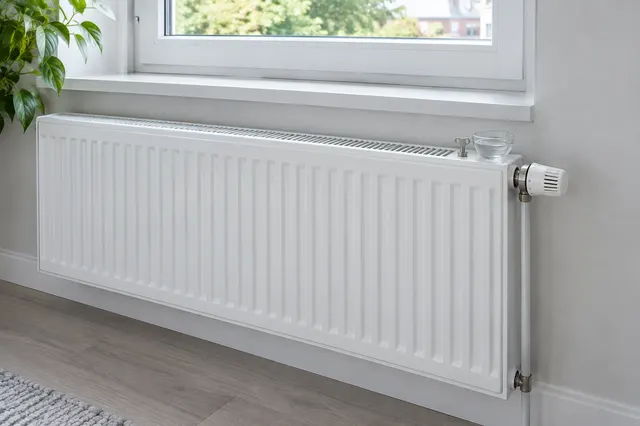
The thermostatic head is a white dial with numbers on the radiator valve. Many people use it like a tap – in winter they turn it up fully and when it’s warm, they turn it down. However, the head does more: it automatically monitors the temperature in the room and adjusts the radiator to maintain the same temperature. We will explain how it works, what the numbers mean, how to set it in the bathroom and in rooms, where to install it and how to replace it.
How the thermostatic head works
Inside the head is a sensor – a small container with liquid, gas, or wax. When the air around the head heats up, the filling expands and pushes on the valve pin. The valve closes and less water flows into the radiator. When the room cools down, the filling contracts and the valve opens. Danfoss describes this principle as proportional control: the head does not open and close the valve at once, but smoothly according to how much the temperature differs from the set one.
| Sensor | How quickly it reacts | Example |
|---|---|---|
| liquid | according to Danfoss 15 to 22 minutes | Danfoss Regus, IVAR T 3000 (6.5 to 28 °C), Caleffi series 200 (7 to 28 °C) |
| vapour-gas | according to Danfoss around 10 minutes, the fastest mechanical | Danfoss Aero |
| wax | slower than liquid | older and cheaper heads |
This leads to the most important advice: the head is not a switch. If you turn it from 3 to 5, the radiator will not heat up faster – it will just heat for longer until the room reaches a higher temperature. Set the position that suits you and let the head do its job.
What do the numbers 1 to 5 mean
The numbers on the head are not degrees Celsius, but positions. Each manufacturer has them slightly differently, the exact values are in the manual. For reference, two heads from the same manufacturer – the values are approximate according to the manufacturer, the actual temperature will also be influenced by the installation location:
| Position | Danfoss Aero | Danfoss Regus |
|---|---|---|
| * (asterisk) | 7 °C | 8 °C |
| 1 | 14 °C | 12 °C |
| 2 | 17 °C | 16 °C |
| 3 | 20 °C | 20 °C |
| 4 | 23 °C | 24 °C |
| 5 | 26 °C | 28 °C |
Similarly, it is with other brands: the head according to EN 215 in the Hornbach manual has about 19 to 21 °C at position 3, and the asterisk maintains the temperature above 6 °C to prevent the water in the radiator from freezing. They all have in common that three is around 20 °C and one notch adds or subtracts about 3 to 4 °C. The small dots between the numbers serve for fine tuning.
How to set the head
The calculated temperature for living rooms is usually 20 °C, for the bathroom 24 °C – in the bathroom, you change and come out of the shower wet. Approximately:
| Room | Temperature | Head position |
|---|---|---|
| living room, children's room | around 20 to 21 °C | 3 to 3,5 |
| bedroom | about 2 to 3 °C less | between 2 and 3 |
| bathroom | around 23 to 24 °C | around 4 |
| hallway, unused room | 16 to 18 °C | 2 |
| longer absence | protection against freezing | * (asterisk) |
- Set the position according to the table.
- Wait a few hours – the room heats up slowly and the head reacts with a delay.
- Fine-tune by half a notch if you feel cold or hot.
- During longer ventilation turn the head to the asterisk. The head senses cold air from the window and the radiator would heat fully into the open window.
Night setback: Danfoss recommends reducing the temperature by 2 to 3 °C at night or during absence, which is about one notch. A larger drop is not worth it – in the morning, the room would take a long time and cost a lot to heat up again.
Thermostatic head in the bathroom and on the towel rail
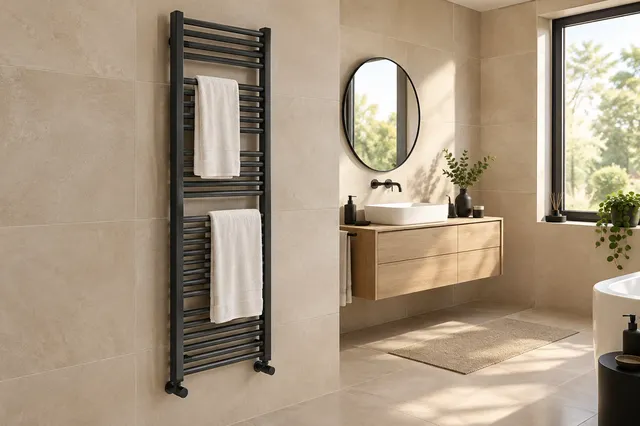
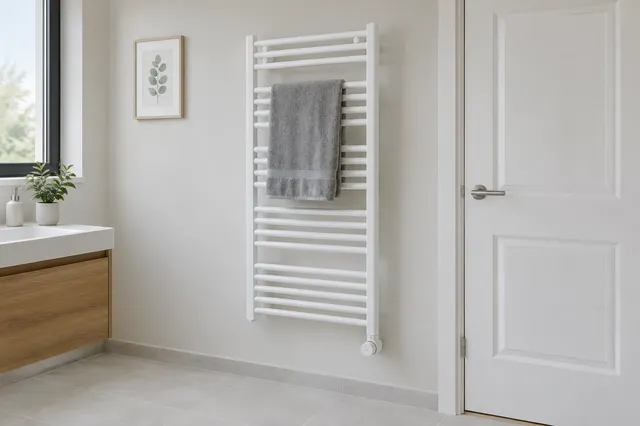
In the bathroom, there is usually a heated towel rail with bottom or middle connection, and the valve with the head is down by the floor. Towels often hang on the towel rail, covering the head. The head then senses the heat from the towels and the rail and closes the valve before the bathroom heats up. It helps to leave space around the head, or use a head with a remote sensor on the wall.
- A position around 4 corresponds to 23 to 24 °C with standard heads. If the towel rail does not heat the bathroom even at 5, it has low output – you can find the output calculation in the article Heated towel rail for the bathroom.
- Combined towel rail with heating rod – outside the heating season, the electric rod heats, which has its own thermostat or regulator. The thermostatic head only regulates the water from the heating. For example, the digital thermostat Mereo TZ33 for the heating rod costs 58.43 € on vkupelni.sk (November 2026). More in the article Electric radiator for the bathroom.
- Design valves – for coloured and designer towel rails, thermostatic valves are produced in the same finish, for example, Deante in matte titanium for 170.52 € or in matte gold for 238.82 € (vkupelni.sk, November 2026).
- Underfloor heating has its own regulation – see Underfloor heating in the bathroom.
Where to install the head and when to use a remote sensor
According to the data sheet from Danfoss, the head must always sense the air temperature in the room. Heads with an internal sensor are therefore installed horizontally, so that air can flow freely around them – not vertically above the valve, where the heat from the valve body affects them and the head does not work properly. If the head cannot be installed horizontally, Danfoss recommends a remote sensor.
- do not cover the head with curtains, drapes, furniture or a radiator cover,
- do not place it in a recess under the windowsill, where warm air accumulates,
- if covering cannot be avoided, choose a head with a remote sensor – Danfoss supplies it with a capillary tube up to 2 m, the sensor is attached to the wall away from the radiator.
Replacing the head: thread and procedure
The most common connection of the head to the valve is the thread M30 × 1,5. Some valves have their own connection – for example, Danfoss provides adapters for RA, RAV, RAVL, RTD valves and M30 × 1,5 with the electronic head. The type of valve is usually stamped on its body. The Klum liquid head with thread M30 × 1,5 costs 7.26 € on vkupelni.sk (November 2026).
- Find out the type of valve – the inscription on the valve body or a photo, which the store can help you with.
- Turn the old head to 5 and unscrew the union nut. Water will not leak – the valve will remain open and the radiator will heat fully.
- Set the new head to 5 – this is how it is stated before installation, for example, by Heimeier in the manual for head K.
- Attach it and tighten by hand, without a wrench. Danfoss states a maximum of 5 Nm for the adapter.
- Set the temperature according to the table above.
You can replace the head yourself. The valve, fitting or radiator should be changed by a heating engineer – the water needs to be drained, connected correctly, and the system refilled and bled. How to bleed a radiator is described in the article How to bleed a radiator.
Electronic head with programme
The electronic head features a display, clock, and programme – it automatically lowers the temperature at night or when you're not home and heats the room before your arrival. Smart heads can be controlled via a mobile app, and some can detect an open window. They are powered by batteries; for example, Danfoss living connect uses AA batteries and keeps the valve slightly open before they run out to prevent the radiator from cooling down completely. An electronic head is particularly beneficial in places where you are not home all day or where rooms are used only part of the day.
Apartment building: valves and administrator
In an apartment building, the central heating is shared. You can replace the head on the existing thermostatic valve yourself. However, the plumber will change the valve or radiator in agreement with the administrator – the soil stack must be drained and refilled, and the heating in the building must remain regulated. The numbers on the valve body (preset) are set by the plumber during regulation; do not adjust them. For information on renovations in a prefab block of flats, see the article Bathroom in a prefab block of flats.
Most common problems
| Problem | Possible cause | What to do |
|---|---|---|
| radiator does not heat even at 5 | stuck valve pin after summer, air in the radiator | remove the head and gently push and release the pin; bleed the radiator |
| the radiator is warm at the top and cold at the bottom | air or low flow | bleed it; if it repeats, call a plumber |
| the room is cold, the radiator turns off | the head is covered or in a warm area | clear space around the head, remote sensor |
| the valve is noisy or whistles | high flow or pressure in the system | plumber, system regulation |
If the valve pin cannot be pushed even after removing the head, do not use force – call a plumber.
Heated towel rails, designer thermostatic valves, and connection sets can be viewed live at the store in Senec. Schedule a visit. You can also find valves in the categories Thermostats and Connection sets on vkupelni.sk.
Related: Heated towel rail for the bathroom · How to bleed a radiator · Electric radiator for the bathroom · Heating in the guide · Heating and ventilation in the bathroom
Sources: data sheets Danfoss Aero and Danfoss Regus (approximate scales, proportional regulation, horizontal installation, remote sensor 0–2 m), Danfoss – thermostatic heads (reaction time of liquid and gas heads, night setback 2–3 °C), Danfoss living connect – installation manual (adapters, AA batteries), Heimeier – manual for thermostatic head K, head according to EN 215 (Hornbach manual), IVAR T 3000, Caleffi series 200, STN EN 12831 (calculation temperatures of rooms), e-shop vkupelni.sk – categories Thermostats and Connection sets (prices, November 2026).
Terms in the dictionary: Heated towel rail · Underfloor heating · Soil stack
Frequently Asked Questions
What should I set the thermostatic head to?
In the living room and children's room to 3 to 3.5, which is around 20 to 21 °C for standard heads. In the bedroom a notch lower, in the bathroom around 4, so about 23 to 24 °C. After changing, wait a few hours for the room to stabilise.
What do the numbers on the thermostatic head mean?
They are positions, not degrees. For standard heads, 3 is around 20 °C and one notch adds or subtracts about 3 to 4 °C – for example, Danfoss Aero has 4 = 23 °C and 5 = 26 °C. The star protects the radiator from freezing.
Will the room heat up faster if I set the head to 5?
No. The head is not a switch – at 5 the radiator does not heat faster, it just heats longer until the room reaches a higher temperature. Set the position that suits you and let the head do its job.
Why is the radiator not heating even though the head is set to 5?
Often, after summer, the valve pin is stuck or there is air in the radiator. Remove the head, gently push the pin and release it, and bleed the radiator. If the pin cannot be pushed, call a heating engineer.
Can the thermostatic head be replaced without draining the water?
Yes. Turn the head to 5 and unscrew it – the valve will remain open and water will not leak out. Set the new head with the correct connection, most often M30 × 1.5, to 5 and tighten it by hand. The heating engineer will change the valve or radiator.
Must the thermostatic head be horizontal?
Yes, the head with the sensor must be horizontal – according to Danfoss, it is installed horizontally to allow air to flow freely around it. If it is covered by a curtain or radiator cover, choose a head with a remote sensor on the wall.
Does the thermostatic head save energy?
Yes, if you do not use it as a switch. The head prevents the room from overheating, and with a night setback of 2 to 3 °C, as recommended by Danfoss, additional heat is saved. A larger drop is not worth it, as the room would take a long time to heat up in the morning.
AI Advisor
Have a question on the topic? Ask the advisor – they will respond based on TGB Kúpeľne articles.
AI advisor – answers are generated by artificial intelligence from TGB Kúpeľne articles and may contain errors.
Bathroom design
These are tips. We will draw your bathroom for you.
In the 3D bathroom planner, you can design your bathroom yourself – for free and without registration. If you want assurance, we will prepare a photorealistic custom visualisation based on actual dimensions and specific tiles in the studio. It's free with a purchase.
Online design for free Custom visualisation
TGB Kúpeľne Studio · Bratislavská 71, Senec · Mon–Fri 8:00–12:00 and 12:30–17:00, Sat 9:00–12:00 · Map