Tiles and cladding for the whole house
Tiles for garages: what withstands cars, frost and salt
For garages, gres coloured in the mass or technical gres with a thickness of at least 9 to 10 mm, abrasion resistance PEI IV to V and slip resistance R10 to R11 is required. If the garage is unheated, the tiles must be frost-resistant and withstand salt and water from wheels in winter. Equally important is the installation: on a solid concrete substrate, with flexible adhesive fully and without voids, otherwise the tile will crack under the wheel.
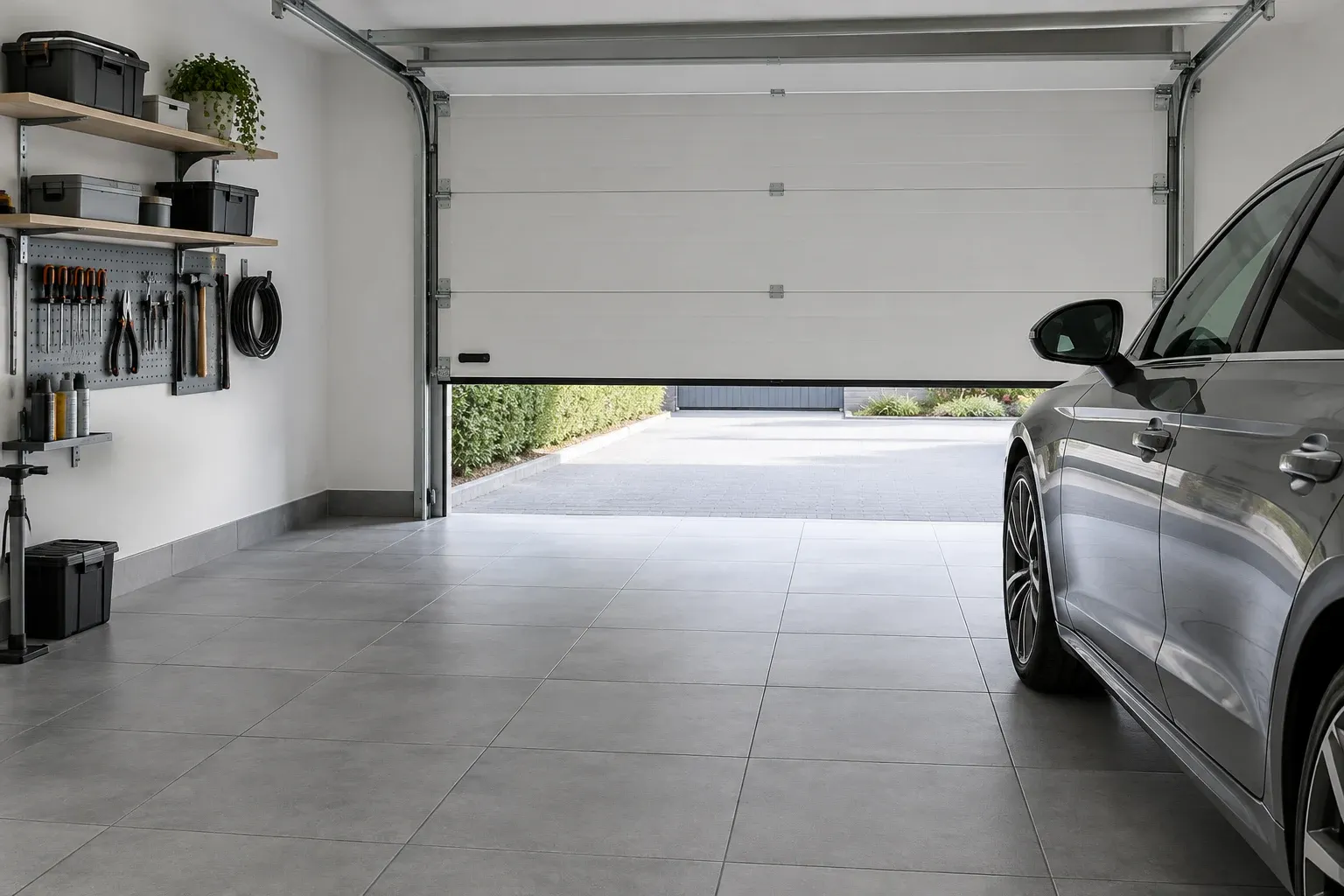
Illustrative image: garage with matte grey gres tiles 60 × 60 cm
The floor tiles in the garage have a tough job. They bear the weight of the car concentrated on four small areas under the wheels, and when turning the steering wheel in place, the tyres grind against them, while in winter, water mixed with salt drips from the car onto them. Additionally, there are oil, petrol, and tools that occasionally fall. We will advise you on which tiles can withstand this and what to watch out for during installation.
What must the floor tiles in the garage endure
| Load | What it will do | What helps |
|---|---|---|
| weight of the car | pressure concentrated under the wheel, the tile above the cavity will crack | thicker tiles, full-surface bonding |
| turning of the wheels | surface wear | PEI IV to V or through-body gres |
| frost and water | in an unheated garage, water freezes in the pores and cavities | frost-resistant gres, water absorption up to 0,5 % |
| salt, oil, petrol | stains and damage to the surface and joints | glazed or unglazed gres, durable grout |
| wet wheels and snow | slipping | slip resistance R10 to R11 |
What tiles for the garage
- Through-body gres – the colour runs through the entire thickness of the tile, so if the edge chips, no different colour is visible. This is the most durable choice for the garage.
- Glazed gres – is possible if it has abrasion resistance PEI IV to V. However, if it chips, a lighter piece is visible under the glaze.
- Thickness – at least 9 to 10 mm, more is better. The strength of the tile can be found in the technical data sheet as breaking strength according to EN ISO 10545-4. For gres at least 7.5 mm thick, the STN EN 14411 standard requires at least 1,300 N, so choose tiles with a higher value for the garage.
- Frost resistance – a requirement in an unheated garage. Tested according to EN ISO 10545-12.
- Chemical resistance – salt, oil, and cleaning agents. The data according to EN ISO 10545-13 is in the technical data sheet.
Why gres is so durable is explained in the article Gres tiles, and what PEI and R mean in the article Tile parameters.
Garage tiles 60 × 60 cm and other formats
The 60 × 60 cm format is the most common choice for garages. It is large enough to have few joints in the floor and still safe under concentrated load from the wheel. Smaller formats like 30 × 60 or 30 × 30 cm adapt more easily to the fall towards the drain. Larger formats, such as 60 × 120 cm, require a perfectly level substrate and precise full-surface bonding – even a small cavity under the tile will result in cracking under the wheel.
Colour of the tiles in the garage
The most practical are medium shades of grey, concrete look, and anthracite, on which oil, dust, and tyre marks are not visible. Very light tiles show dark marks from the wheels, while black tiles show white stains from salt. If the garage connects to a hallway or technical room, you can use the same series in them.
Installation of tiles in the garage
- Substrate – a solid concrete slab, flat and cured. Repair cracks and unevenness on the old floor.
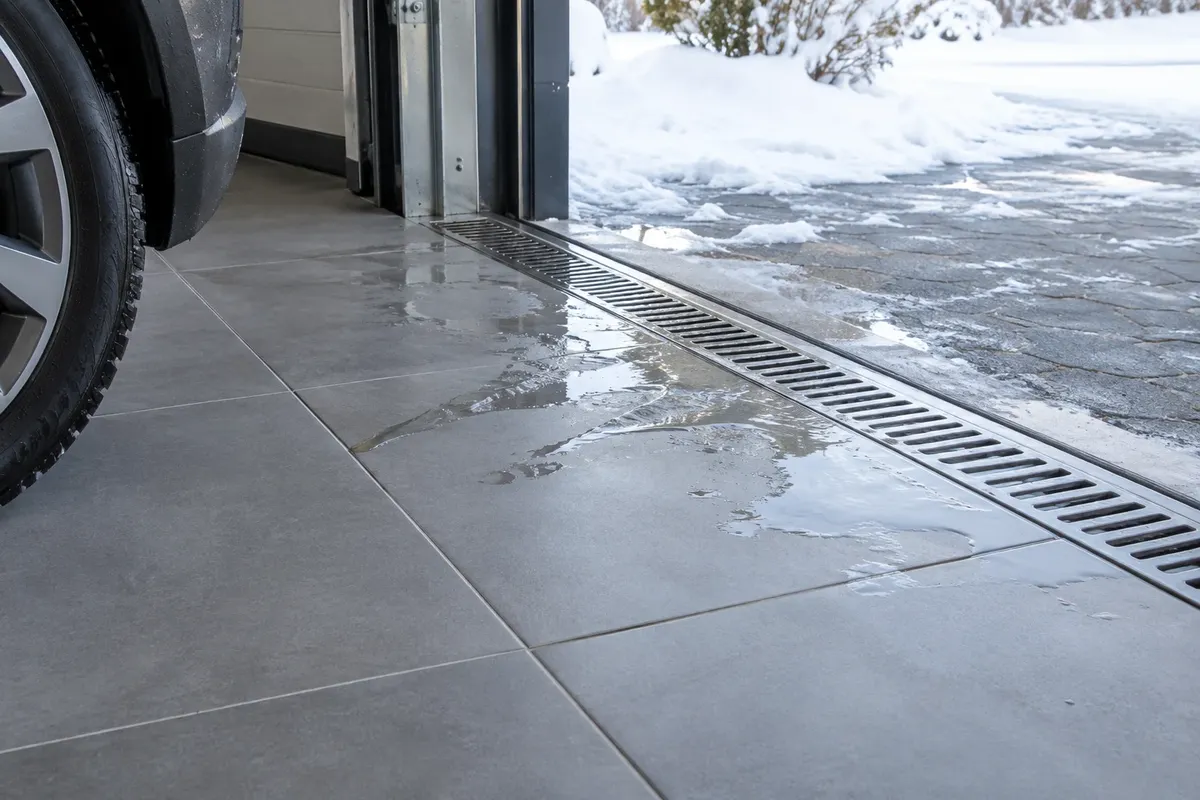
- Fall – a slight fall towards the door or drainage channel, so that water from the snow does not stand under the car.
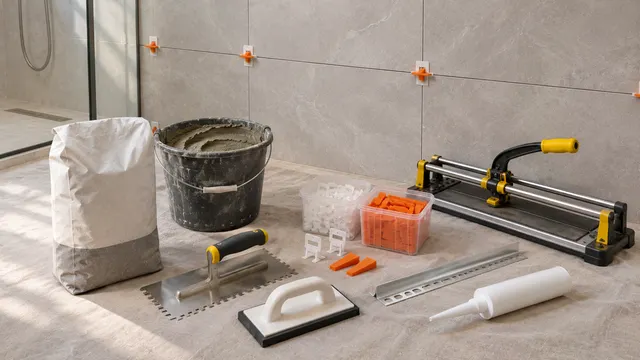
- Adhesive – flexible C2 S1, suitable for unheated garages and also for outdoor use. It is applied to both the substrate and the back of the tile to prevent cavities underneath.
- Grout – cement class CG2 WA or epoxy RG, which does not absorb oil or salt.
- Expansion joints – around the perimeter and at the door, on large areas and in areas according to the project.
- Skirting and transition – ceramic skirting along the walls and a transition profile at the door.
We describe adhesives, grouts, and profiles in the article Adhesive, grout, and profiles and have them available in the TGB studio.
Gres, epoxy coating or PVC tiles for the garage
| Floor | Advantages | Disadvantages |
|---|---|---|
| gres tiles | the most durable, frost-resistant, lasts for decades | higher price and longer installation |
| epoxy coating | seamless, quick | scratches easily, needs to be renewed over time, slippery when wet |
| PVC tiles (click-in) | quick installation without gluing, easily replaceable | less resistant to sharp objects and chemicals, shorter lifespan |
| bare concrete | the cheapest | dusty, absorbs oil, difficult to clean |
PVC tiles for the garage make sense as a quick and cheaper solution for existing concrete, for example in rentals. For years, porcelain stoneware tiles are the safest choice.
Maintenance of garage tiles
- Wash away winter salt with clean water as soon as possible to avoid white stains.
- Catch oil immediately – it wipes off from porcelain stoneware, but is harder to remove from the grout.
- You can place a mat under the car to catch water and snow.
View samples of durable tiles at TGB Kúpeľne studio at Bratislavská 71 in Senec. You can find out what tiles to choose for other rooms on the page Wall and floor tiles for the whole house.
Related: Wall and floor tiles for the whole house · Porcelain stoneware tiles · Tiles for hallways and stairs · Tiles for terraces · Tile parameters
Sources: STN EN 14411 (water absorption, breaking strength), EN ISO 10545-4 (breaking strength), EN ISO 10545-7 (PEI), EN ISO 10545-12 (frost resistance), EN ISO 10545-13 (chemical resistance), DIN 51130 (slip resistance), STN EN 12004 and STN EN 13888.
Frequently Asked Questions
What is the best tile for a garage?
Gres coloured in the mass with a thickness of at least 9 to 10 mm, abrasion resistance PEI IV to V and slip resistance R10 to R11. In an unheated garage, it must be frost-resistant.
What thickness should garage tiles be?
At least 9 to 10 mm, thicker is more durable. The breaking strength in the technical data sheet and full-surface bonding without voids also matter.
Is tile 60 × 60 cm suitable for a garage?
Yes, it is the most common format for garages. Larger formats require a perfectly flat substrate and precise full-surface bonding.
Will the tiles in the garage withstand salt?
Gres will, salt will not damage it. However, wash off the salt as soon as possible to avoid white stains, and choose grout CG2 WA or epoxy for the joints.
Why do tiles crack in the garage?
Most often due to voids under the tile, where the wheel breaks it, due to weak or movable substrate, or due to tiles that are too thin.
Is PVC flooring worth it for a garage?
As a quick solution for existing concrete, yes – it snaps in without glue. However, it is less durable than gres and lasts shorter.
What adhesive for garage tiles?
Flexible tile adhesive C2 S1, in an unheated garage also suitable for outdoor use, applied to the substrate and the back of the tile.
AI Advisor
Have a question on the topic? Ask the advisor – they will respond based on TGB Kúpeľne articles.
AI advisor – answers are generated by artificial intelligence from TGB Kúpeľne articles and may contain errors.
Bathroom design
These are tips. We will draw your bathroom for you.
In the 3D bathroom planner, you can design your bathroom yourself – for free and without registration. If you want assurance, we will prepare a photorealistic custom visualisation based on actual dimensions and specific tiles in the studio. It's free with a purchase.
Online design for free Custom visualisation
TGB Kúpeľne Studio · Bratislavská 71, Senec · Mon–Fri 8:00–12:00 and 12:30–17:00, Sat 9:00–12:00 · Map